
To read the full report, please download the PDF above.
Middle East Daily
SOOJIN KIM
Research Analyst
DIFC Branch – Dubai
T: +44(4)387 5031
E: soojin.kim@ae.mufg.jp
MUFG Bank, Ltd. and MUFG Securities plc
A member of MUFG, a global financial group
Middle East Daily
COMMODITIES / ENERGY
Oil rises as US-Iran hostilities renew Hormuz supply risks. Brent crude rose to around USD91/b and WTI above USD86/b, as renewed US-Iran hostilities heightened concerns over disruptions to Persian Gulf energy flows. The escalation, including US strikes near the Strait of Hormuz and subsequent Iranian retaliation against targets in the UAE and Jordan, marked the first direct exchange in about a month and raised the risk of further conflict. Shipping conditions remain fragile, with another tanker reportedly attacked near Oman, although Gulf producers continue exporting through Hormuz despite elevated risks. On the supply side, ADNOC’s Ruwais refinery has reportedly returned to full capacity, providing some relief to tight refined-product markets, while Saudi Aramco increased September LPG prices and is expected to raise October Arab Light crude prices for Asia. Looking ahead, persistent geopolitical tensions and tanker attacks are likely to keep a risk premium embedded in oil prices, with the ability of Gulf producers to maintain exports remaining the key factor.
Gold holds near USD4,450/oz as renewed Iran conflict revives inflation risks. Gold traded around USD4,445/oz, supported by safe-haven demand as renewed US-Iran hostilities increased geopolitical uncertainty. However, higher oil prices have also revived concerns that energy-driven inflation could force the Fed to maintain a hawkish stance or tighten policy further. Gold gained nearly 10% in August, driven by concerns over US fiscal sustainability and currency debasement, but momentum has softened after Fed Chair Kevin Warsh signalled a tougher stance on inflation, leading markets to price a higher probability of a September rate hike. Going forward, geopolitical risks should continue to support bullion, although persistent inflationary pressures and expectations of higher-for-longer US interest rates are likely to limit its upside potential.
MIDDLE EAST - CREDIT TRADING
End of day comment – 28 August 2026. The Fed/ Warsh has spoken, the market reaction in GCC still is outstanding. Post Jackson Hole we have a substantial curve flattening which initially pivoted at the 10y point but starting to look more like a bear flattening into the close. There wasn't much of activity though in GCC post comments. I marked my bonds 3 (long end)/5bp (short end/belly) tighter. Most visibility/ activity was in long end bonds today pre and post Warsh. We also saw month end flows from US RM increasing but they were still small in comparison to another month end. Overall, as said the market reaction remains to be seen. The question will be whether the repricing of fed hike probabilities will alter flows and pricing of new issues as primary markets are expected to get more active from next week on. (Source: Domonik Roth, Credit Trader)
MIDDLE EAST - MACRO / MARKETS
Saudi Arabia explores USD8bn loan as funding needs rise. Saudi Arabia is in early talks to raise at least USD8bn through a new syndicated loan, as the kingdom diversifies its funding sources amid rising fiscal pressures and the economic fallout from the Iran conflict. The NDMC has begun discussions with banks over a potential dollar-denominated facility, while Saudi Aramco is reportedly exploring separate borrowing, although both transactions remain preliminary. The potential financing comes as Saudi Arabia targets around SAR217bn (USD57.9bn) of funding in 2026 to cover a projected SAR165bn budget deficit and SAR52bn of debt maturities. Fiscal pressures have intensified, with the H1 deficit reaching SAR160bn, close to the original full-year target, amid elevated spending and pressure on oil revenues. The kingdom has increasingly diversified its funding mix across international bonds and sukuk, domestic issuance and syndicated loans, following a sizeable syndicated facility secured late last year. Going forward, weaker oil revenues and elevated expenditure are likely to keep borrowing needs high, with the pricing and size of new facilities and the balance between loans, sukuk and reserve drawdowns determining the kingdom’s financing strategy through the remainder of 2026.
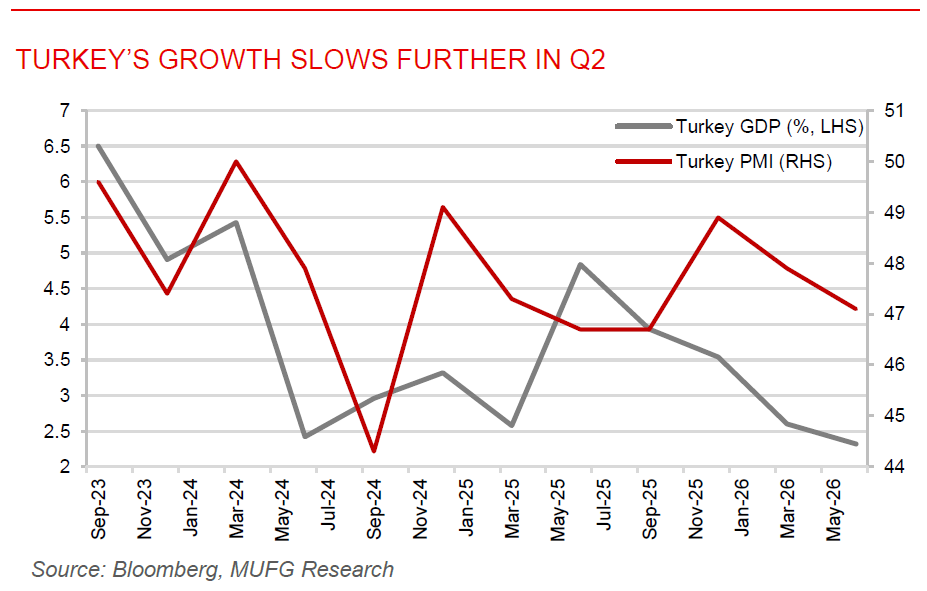
Turkey’s growth slow further in Q2. Turkey’s economy expanded 2.3% y/y in Q2 2026, slowing from 2.5% in Q1 and marking a fourth consecutive quarter of decelerating growth, while also falling short of market expectations. On a seasonally adjusted basis, GDP grew 1.1% q/q, accelerating from 0.3% in Q1, supported primarily by net exports, which contributed around 1.5ppt to annual growth, alongside inventory accumulation. Agriculture recorded the strongest sectoral expansion at 13.3%, while domestic demand remained supportive but lost momentum as the CBRT’s restrictive 37% policy rate continued to weigh on consumption and investment. The softer growth backdrop comes alongside persistent manufacturing weakness and elevated fiscal pressures, although external balances have improved on strong services receipts. Looking ahead, weaker activity is likely to strengthen the case for further monetary easing, with the pace of CBRT rate cuts, the sustainability of the net-export contribution and the recovery in domestic demand key to Turkey’s growth outlook in H2 2026.