
To read the full report, please download the PDF above.
Middle East Daily
SOOJIN KIM
Research Analyst
DIFC Branch – Dubai
T: +44(4)387 5031
E: soojin.kim@ae.mufg.jp
MUFG Bank, Ltd. and MUFG Securities plc
A member of MUFG, a global financial group
Middle East Daily
COMMODITIES / ENERGY
Oil posts second weekly gain as Hormuz closure persists. Oil prices secured a second consecutive weekly gain, with Brent rising above USD111/b and WTI near USD106/b, as President Trump reaffirmed the continuation of a naval blockade on Iranian ports, raising doubts about the reopening of the Strait of Hormuz. Iranian leadership signalled no willingness to compromise on nuclear and missile capabilities, reinforcing expectations of a prolonged standoff and sustained control over the key waterway. With Hormuz remaining largely shut, oil prices have surged more than 25% over the past two weeks, driven by tightening supply and heightened geopolitical risk. The disruption has begun to translate into real physical market tightness, even as global buyers increasingly turn to US exports to offset shortages, underscoring the growing strain on global energy markets.
Gold supported by weaker dollar despite war-driven inflation risks. Gold edged higher to around USD4,630oz, supported by a sharp decline in the US dollar following suspected intervention by Japan, which boosted the appeal of bullion priced in the greenback. The rebound comes after recent losses driven by the ongoing Middle East conflict, which has kept the Strait of Hormuz effectively closed and energy prices elevated. Donald Trump continues to enforce a naval blockade on Iranian ports, while Iran has signalled it will maintain control of the strait, prolonging supply disruptions and inflation risks. These pressures have increased expectations that central banks may keep interest rates higher for longer, a headwind for non-yielding gold, which remains down about 12% since the war began. However, continued strong central bank demand, highlighted by increased purchases reported by the World Gold Council, is helping to support prices despite ongoing geopolitical and macroeconomic challenges.
MIDDLE EAST - CREDIT TRADING
End of day comment – 30 April 2026. Spreads wider, quiet month end flows. The market was greeted by the hawkish hold of the FED overnight and subsequently higher UST yields. Cash adjusted to the left early morning, and the market had outflows in UAE index names. With oil correcting from the highs, G3 govt bonds found their footing and started a recovery. Whilst cash moved higher on these rates move it failed to revert to yesterday’s closing levels and as result spreads were broadly 2/5bp wider. That said flows were fairly balanced in the afternoon session. There was some selling again in UAE index bonds, but it was overall a quiet month end and bonds easily found clearing levels. One area which has shown some weakness in the past days were MUBAUH belly bonds, especially from 2029s to 2033s which again were up to 0.20pt lower today and another 5bp wider on average. Away from this though most names were 2/3bp wider with cash anywhere from unch to -0.25pt in the long end.
MIDDLE EAST - MACRO / MARKETS
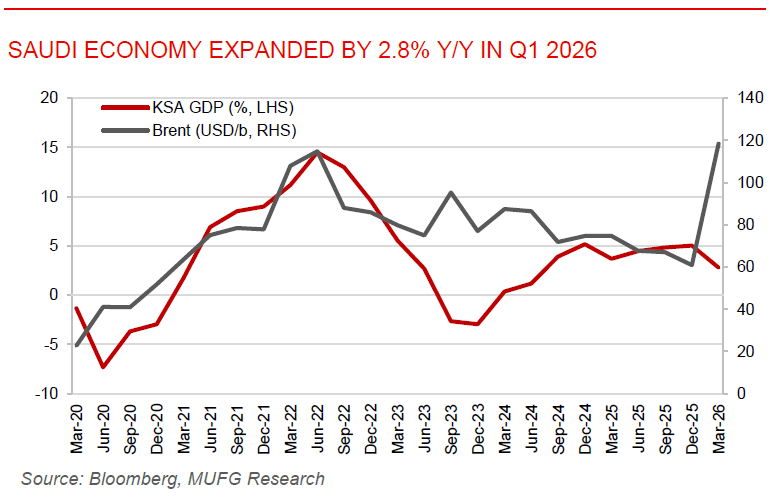
Saudi GDP growth driven by non-oil expansion despite quarterly dip. Saudi Arabia’s economy expanded by 2.8% y/y in Q1 2026, reflecting broad-based growth across all major sectors despite regional headwinds, with non-oil activity emerging as the primary driver of expansion. According to General Authority for Statistics, non-oil sectors grew 2.8% and contributed 1.7ppts to overall GDP growth, underscoring progress in diversification, while oil activities rose 2.3% and government activity increased 1.5%, indicating balanced support across the economy. However, on a seasonally adjusted quarterly basis, GDP contracted by 1.5%, mainly due to a sharp 7.2% decline in oil output, which subtracted 1.7ppts from growth, partially offset by modest gains of 0.2% in non-oil activities and 0.8% in government spending. The data highlights the economy’s resilience, with strong domestic fundamentals and diversification efforts helping to cushion volatility in the oil sector, especially amid ongoing regional tensions. Supported by robust institutions and reform momentum, the International Monetary Fund expects Saudi Arabia to maintain growth of around 3.1% in 2026, reinforcing a positive medium-term outlook despite short-term fluctuations.
Dubai financial market sees strong Q1 growth driven by trading surge. The Dubai Financial Market delivered a robust performance in Q1 2026, supported by strong trading activity, rising liquidity, and increased investor participation. Average daily trading value surged 56% y/y to exceed USD280 million (AED1.03bn), while total traded value jumped 48% to about USD16.6bn (AED61bn). This momentum drove a 36% increase in total revenue to roughly USD69 million and a 43% rise in net profit before tax to around USD53 million. The exchange attracted over 20,700 new investors during the quarter, with international investors accounting for 79% of new registrations, highlighting its growing global appeal. Institutional investors contributed 70% of trading activity, while foreign investors made up 54%, reinforcing the market’s depth and sophistication. Despite a late-quarter dip in the index, overall activity remained strong, with market capitalisation reaching approximately USD244bn, reflecting continued confidence in Dubai’s position as a leading international financial hub.