
To read the full report, please download the PDF above.
Middle East Daily
SOOJIN KIM
Research Analyst
DIFC Branch – Dubai
T: +44(4)387 5031
E: soojin.kim@ae.mufg.jp
MUFG Bank, Ltd. and MUFG Securities plc
A member of MUFG, a global financial group
Middle East Daily
COMMODITIES / ENERGY
Oil rebounds as uncertainty over Iran peace deal persists. Oil prices rose from six-week lows as uncertainty surrounding US-Iran negotiations tempered expectations for a quick resolution to the conflict. Brent crude climbed toward USD93/b while WTI approached USD89/b, with markets reassessing optimism that a peace agreement would soon reopen the Strait of Hormuz and restore disrupted energy flows. Although both sides continued exchanging revisions to a proposed deal, progress remains unclear and reports suggest the negotiations could still collapse. Despite the recent pullback, Brent remains more than 25% higher than before the conflict began in late February, reflecting the significant impact of prolonged disruptions in the Strait of Hormuz on global energy markets. Geopolitical risks also remain elevated as tensions spill over into Lebanon, where Israel has expanded military operations against Hezbollah, adding another layer of uncertainty to the regional outlook.
Gold eases as uncertainty over Iran ceasefire extension continues. Gold edged lower, slipping below USD4,520/oz, as uncertainty surrounding US-Iran negotiations kept investors cautious about the outlook for inflation and interest rates. While both sides appeared closer to extending the ceasefire and potentially reopening the Strait of Hormuz, negotiations remained unresolved after further amendments were exchanged over the weekend. The prospect of restored energy flows could ease inflation pressures and support future monetary easing by major central banks, a generally positive backdrop for gold. However, lingering geopolitical risks continue to cloud the regional outlook. A stronger US dollar and firmer oil prices also weighed on gold, which remains around 14% below its pre-war levels despite trading within a relatively narrow range in recent weeks.
MIDDLE EAST - CREDIT TRADING
End of day comment – 29 May 2026. Into the close DJT is in the situation room and about to make a decision on a possible Iran deal. Up until his tweet the market flows were dominated by month end activity. RM and ETFs were selling the index phase out UAE names. But dealers showed a strong appetite to bid bonds, and this flow never had a real impact on price action. Spread gyrations on UST moves into the close aside the market broadly held 2/3bp tighter in ADGB with cash up to 0.5pt higher, again this tightening was led by long end bonds. QATAR didn't see much activity away from some trade in QPETRO 51s (+0.25pt/-1bp). MOROC had month end inflows as part of EM ex GCC month end buying. Newly issued EUR 34s and 38s are now nearly back to issuance spread levels today with a preference for 34s closing +0.375pt/-2bp.
MIDDLE EAST - MACRO / MARKETS
UAE economy expands 6.2% in 2025, driven by strong non-oil growth. The UAE’s real GDP grew by 6.2% y/y in 2025 to AED1.9 trillion (USD517bn), according to the Federal Competitiveness and Statistics Centre. The performance was underpinned by continued momentum in non-oil economic activity, with non-oil GDP rising 6.8% in AED1.5 trillion (USD409bn), reflecting increasing contribution of diversified sectors to overall economic growth. Construction emerged as the fastest growing sector, expanding by 11.1%, supported by sustained investment in infrastructure, real estate development and major projects. Financial insurance activities also posted robust growth of 10.4%, demonstrating the strength of the UAE’s financial ecosystem and its role in supporting investment and business activity. Meanwhile, growth in real estate, transport and storage further highlighted the county’s position as a major regional business, logistics, and investment hub. Overall, the latest GDP figures underline the UAE’s success in building a more diversified and resilient economy, reducing dependence on hydrocarbons while strengthening sectors that support long-term growth and competitiveness.
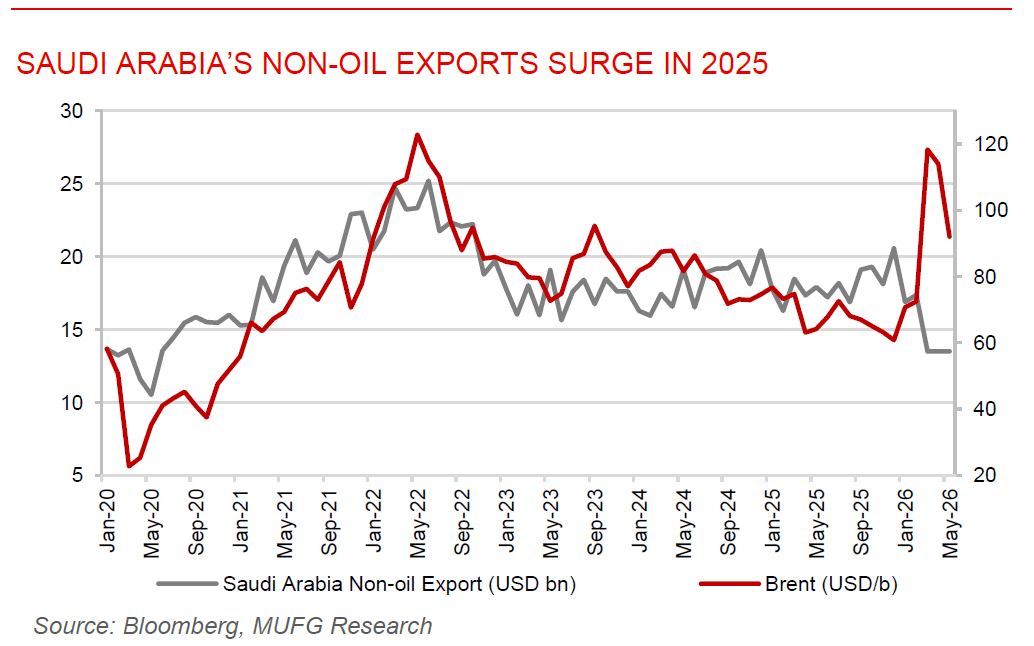
Saudi Arabia’s non-oil exports surge on re-export boom. Saudi Arabia’s non-oil exports, including re-exports, rose 18.9% in 2025 to USD97bn, driven primarily by a 64.4% surge in re-export activity, reflecting Saudi Arabia’s growing importance as a regional trade, distribution and logistics hub. In contrast, national non-oil exports excluding re-exports recorded a marginal decline of 0.1%, suggesting that growth in domestically produced exports remained relatively subdued during the year. Nonetheless, the ratio of non-oil exports to imports improved to 38.5%, from 35.3% in 2024, indicating a strengthening contribution from non-oil trade activity. The figures support Saudi Arabia’s broader economic diversification objectives under Vision 2030, particularly its ambition to enhance logistics connectivity and increase its integration into regional and global supply chains. Overall, merchandise exports rose 2.1% to USD320bn, even as oil exports declined 4%, reducing oil’s share of total exports to 68.7% y/y from 73.1%. China remained Saudi Arabia’s largest trading partner, leading both export destinations and import sources, while key ports and airports continued to play an important role in supporting the KSA’s growing trade and re-export activity.