
Key Points
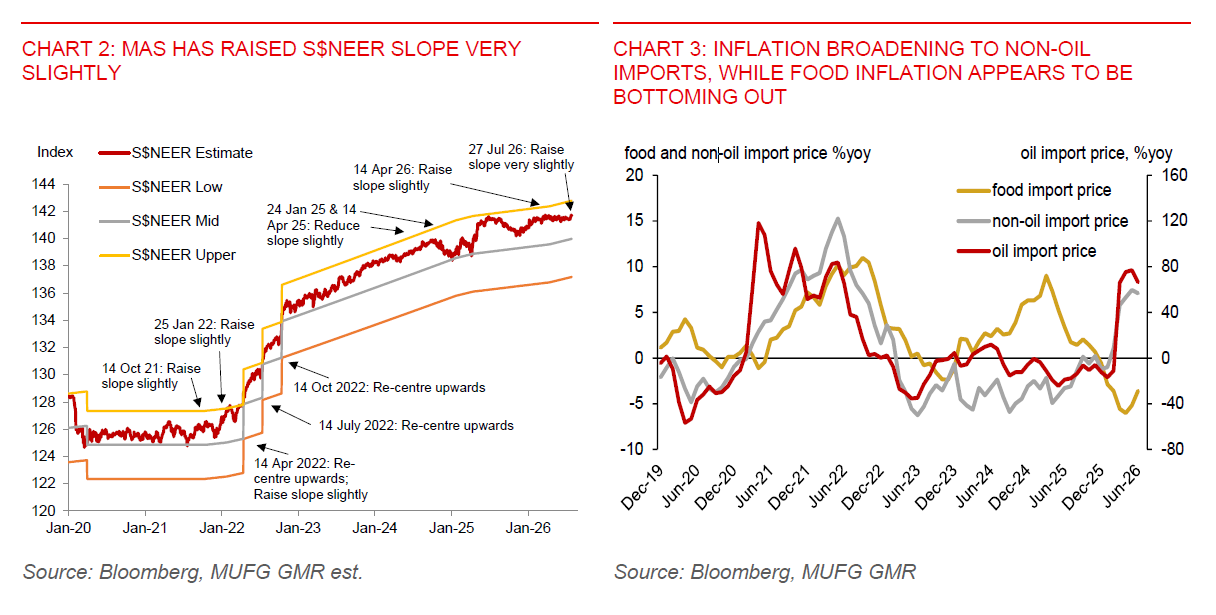
MAS surprised markets by delivering a second consecutive tightening, raising the rate of appreciation of the S$NEER policy band by a very slight amount, while leaving the width and centre unchanged. Notably, the adjustment was explicitly described as being smaller than the move in April, signalling that while policy tightening was warranted, MAS believes only a measured response is needed at this stage. We estimate the slope of S$NEER has increased by 25bps to 1.25% per annum. While the magnitude of the move was modest, the decision itself is significant. It confirms that MAS is increasingly concerned about the persistence of imported inflation pressures and believes the economy remains strong enough to absorb further policy tightening.
The growth backdrop remains strong. Following GDP growth of 6.3%yoy in Q1 and 5.7%yoy in Q2, MAS now expects the positive output gap to widen in 2026 as the economy continues to expand above trend. Importantly, growth is not only confined to tech-related sectors, with broad-based strength seen across construction and financial services. Labour market conditions also remain supportive. Taken together, these factors suggest Singapore's economy remains resilient despite heightened global uncertainty and rising energy costs.
On inflation, MAS appears concerned that the recent energy shock is feeding more broadly into the economy. While core inflation remains relatively contained, policymakers expect core inflation to step up from July and remain elevated into early 2027. Beyond higher fuel and electricity prices, costs will rise for imported goods, food commodities, construction materials and capital equipment. Meanwhile, higher fertiliser costs and potential El Niño-related disruptions could drive food inflation risks. In other words, inflation risks are no longer limited to direct energy costs but are gradually spreading through upstream and consumer-facing sectors.
Nevertheless, domestic inflation pressures remain contained. Unit labour cost growth continues to moderate, productivity gains remain healthy and there is still little evidence of broad-based second-round inflation effects. This distinction explains why the tightening was deliberately modest. Policy stance is now mildly restrictive. MAS appears to be comfortable with current stance while monitoring whether imported price pressures evolve into more persistent demand-pull inflation.
Implications for USD/SGD: SGD remains sensitive to high US yields and any significant escalation in geopolitical tensions that could drive safe haven flows into USD. But the latest policy move, albeit modest, reinforces a hawkish policy bias and should keep SGD well supported. We continue to expect USD/SGD to trend lower over the medium term, although external USD dynamics remain the key near-term risk.
On rates, we maintain our outlook for 3-month compounded SORA to edge higher to 1.30% in Q3 2026, 1.36% in Q4 2026 and 1.40% in Q1 2027. Core inflation could run above 2% over the coming quarters amid a widening output gap and higher electricity tariffs. The SGD rate curve has shifted higher across tenors and rates could stay high for longer, especially if global yields stay elevated and inflation risks persist.