
Key Points
We expect MAS to leave policy settings unchanged at its July policy meeting while retaining a clear tightening bias. The case for a hold rests on the fact that underlying inflation pressures remain relatively contained despite a significant oil shock. June headline inflation rose only modestly to 1.9%yoy from 1.8%yoy, while core inflation increased to 1.6%yoy from 1.4%yoy. Although food and services inflation have firmed in June, inflation remains contained. More importantly, unit labour costs continue to decline, suggesting that broad-based wage-driven inflation has yet to emerge.
That said, the policy debate is becoming increasingly balanced. Singapore's growth momentum remains exceptionally strong. With GDP expanding by 6.3%yoy in Q1 and 5.7%yoy in Q2, even a moderation in H2 growth momentum could leave full-year growth close to 5%, the same pace in 2025. In our view, this implies the economy is likely operating with a wider positive output gap. Growth conditions alone would justify maintaining a tight policy stance.
At the same time, inflation risks are clearly skewed to the upside. Brent crude has rebounded towards US$100/bbl, electricity tariffs have risen sharply in Q3, and renewed Middle East disruptions threaten to prolong supply-chain pressures. While the June CPI report remains relatively benign, it likely understates the inflation impulse that will emerge in coming months as higher energy costs pass through to utilities, food production, logistics and services. The recent pickup in food and services inflation may represent the first signs of this transmission process.
Nevertheless, we believe MAS is likely to distinguish between an energy-driven inflation shock and persistent domestically generated inflation. Policymakers have highlighted moderating labour cost pressures and potentially softer consumer spending as offsets to rising imported inflation. In addition, the S$NEER remains near the upper end of its policy band, indicating that monetary conditions are already relatively restrictive and the exchange-rate channel continues to provide an important buffer against imported price pressures.
Alternative High-Conviction Case: Pre-emptive Tightening: While our base case remains a hawkish hold, we believe markets may be underestimating the probability of a pre-emptive tightening move. A tightening decision could be justified by three factors: stronger-than-expected GDP growth, a positive output gap, and an anticipated inflationary shock in the coming months. Policymakers could choose to tighten policy now rather than wait for second-round effects to become fully visible.
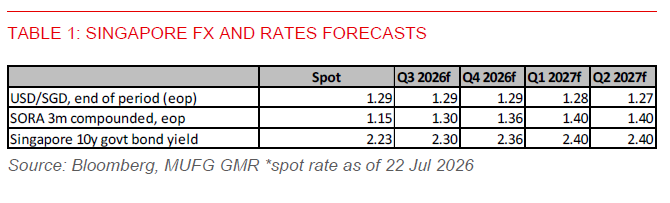
Implications for USD/SGD: Regardless of whether MAS delivers a hawkish hold or a modest tightening, the policy signal remains broadly SGD-supportive. Singapore continues to benefit from strong growth, a sizeable external surplus and a S$NEER trading near the upper end of its policy band. A hawkish hold would likely reinforce expectations that the next policy move remains biased towards tightening rather than easing, which will provide some offset to a firm dollar. A tightening surprise, however, would likely trigger a more immediate repricing lower in USD/SGD as markets reassess the likelihood of further MAS tightening.
On rates, we expect the 3-month compounded SORA to edge higher to 1.30% in Q3 2026, 1.36% in Q4 2026 and 1.40% in Q1 2027. SORA fixings have continued to print at the upper end of the recent range, at around 1.3-1.4%. Upside risks to inflation are building from the rebound in oil prices, a 17% increase in electricity tariffs in Q3, and renewed escalation in Middle East tensions. The SGD rate curve has shifted higher across tenors and rates could stay high for longer, especially if global yields stay elevated and inflation risks persist.