

To read the full report, please download PDF.
Quick reversal of mid-term elections USD sell-off
FX View:
The USD has strengthened towards the end of this week, supported by further evidence of a strengthening US labour market and safe-haven demand triggered by the sharp sell-off in global equity markets. This has resulted in a quick reversal of the initial losses sustained after the US mid-term election results revealed a ‘Blue Wave’. The US mid-term election results are not a game changer for near-term USD performance, but they have increased downside risks further ahead. One downside risk is that the result puts pressure on the Trump administration to reach a quicker deal with Iran to help ease the cost-of-living pressures from the energy price shock. A second risk is that Democratic interference could undermine investor confidence in AI-related investment, contributing to a reversal of US equity outperformance so far this year. A deeper US equity market correction and further tightening of financial conditions could, in turn, make the Fed more wary of tightening policy again in December, as currently planned.
G10 FX PERFORMANCE REFLECTS MORE RISK-OFF TRADING
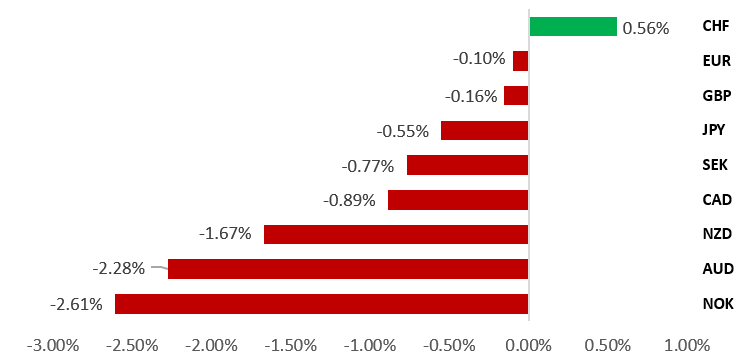
Source: Bloomberg, as of 6th November 2026 13.45 GMT (Weekly % Change vs. USD)
Trade Ideas:
We are recommending a new short NOK/CHF trade idea and maintaining our short EUR/JPY trade idea.
Democratic Sweep: What Comes Next for Financial Markets:
The Democratic sweep alone does not provide a sufficiently reliable directional USD signal. The 2006 analogue points towards USD weakness, while our political ranking suggests that larger increases in Democratic congressional power have historically coincided with weaker DXY performance. However, the limited number of comparable episodes means we would not use the political outcome alone to justify a bearish USD view.
FX Views
USD: US mid-term elections results raise downside risks
The USD’s performance has been mixed following the US mid-term elections. The dollar index initially fell by around 0.8% in response to the ‘Blue Wave’, but has quickly reversed those initial losses. For the week as a whole, the USD has been one of the top three performing G10 currencies, alongside the other traditional safe-haven currencies, the JPY and CHF. In contrast, the higher-beta G10 currencies, including the AUD, SEK, NOK and NZD, have underperformed. The price action is more consistent with risk-off trading conditions, which have intensified over the past 24 hours following the sharp sell-off in US equity markets overnight. The S&P 500 and Nasdaq Composite indices fell sharply by 4.4% and 5.5%, respectively. It was the largest daily decline for the broader S&P 500 since President Trump announced his ‘Liberation Day’ tariffs in early April 2025. The flight to quality has also helped government bonds extend their recent rebound. After reaching a high of 5.36% on 7th October, the 10-year US Treasury yield has since fallen by almost 50 bps.
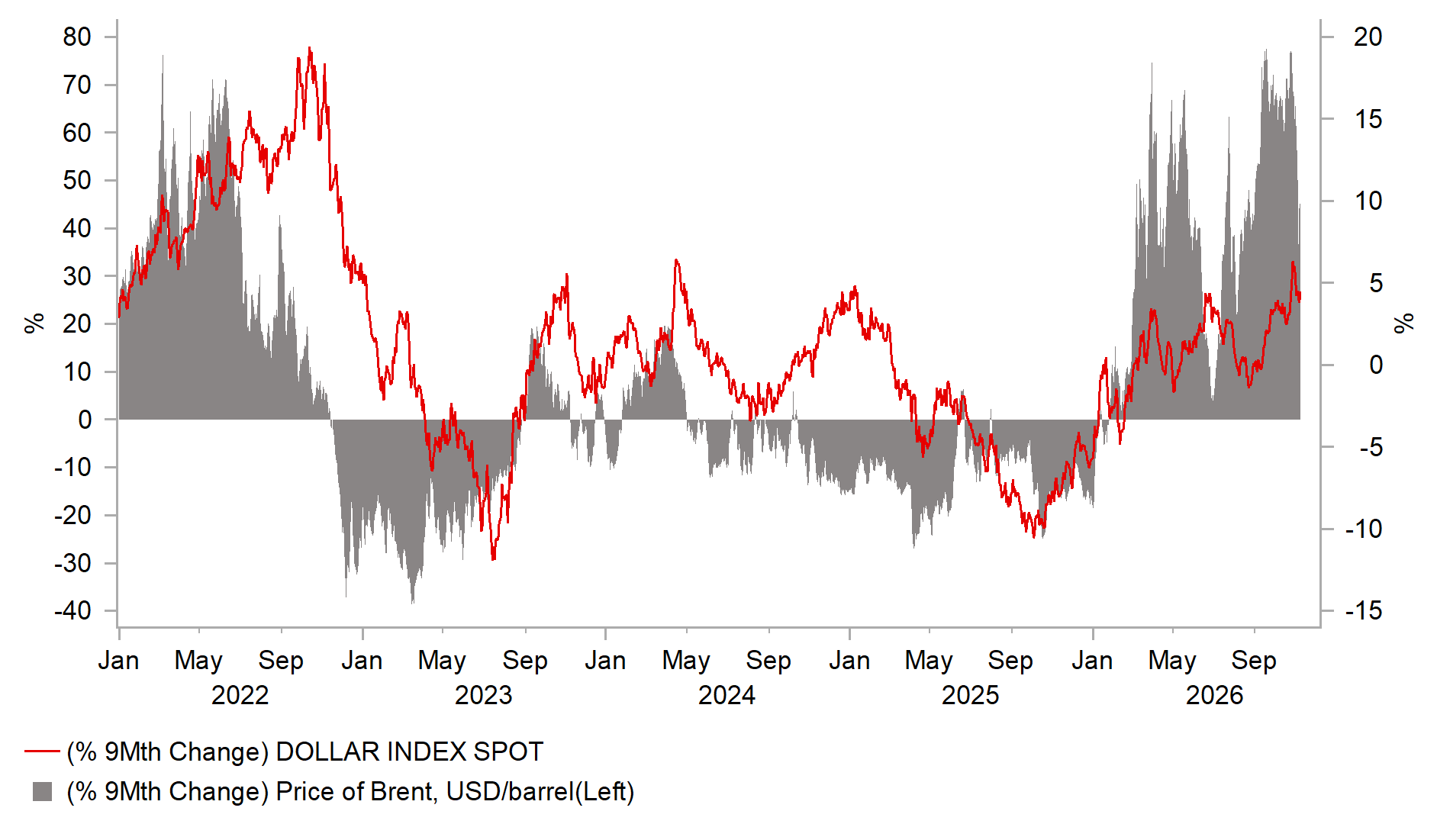
The US mid-term election results are not a game changer for the USD in the near term, but they have increased downside risks going forward. The heavy defeat for the Republicans sends a clear signal that voters are unhappy with the rising cost of living, driven primarily by the US-Iran war. It will increase pressure on the Trump administration to reach a deal with Iran and end the conflict, potentially creating more room for compromise on the US side in future negotiations. At the start of this week, the media had already reported tentative signs of progress towards renewed negotiations. Iran’s President Masoud Pezeshkian has also said that his government has been granted greater authority by Supreme Leader Mojtaba Khamenei to pursue peace talks, including on issues that had previously been considered “non-negotiable”. Recent developments have encouraged fresh investor optimism that a deal can be reached, contributing to a sharp adjustment lower in energy prices this week. Brent crude and European natural gas prices have both fallen by around 17-18% from their highs at the end of last month. A quicker-than-expected deal would help ease the energy shock facing the global economy and encourage a reversal of USD strength
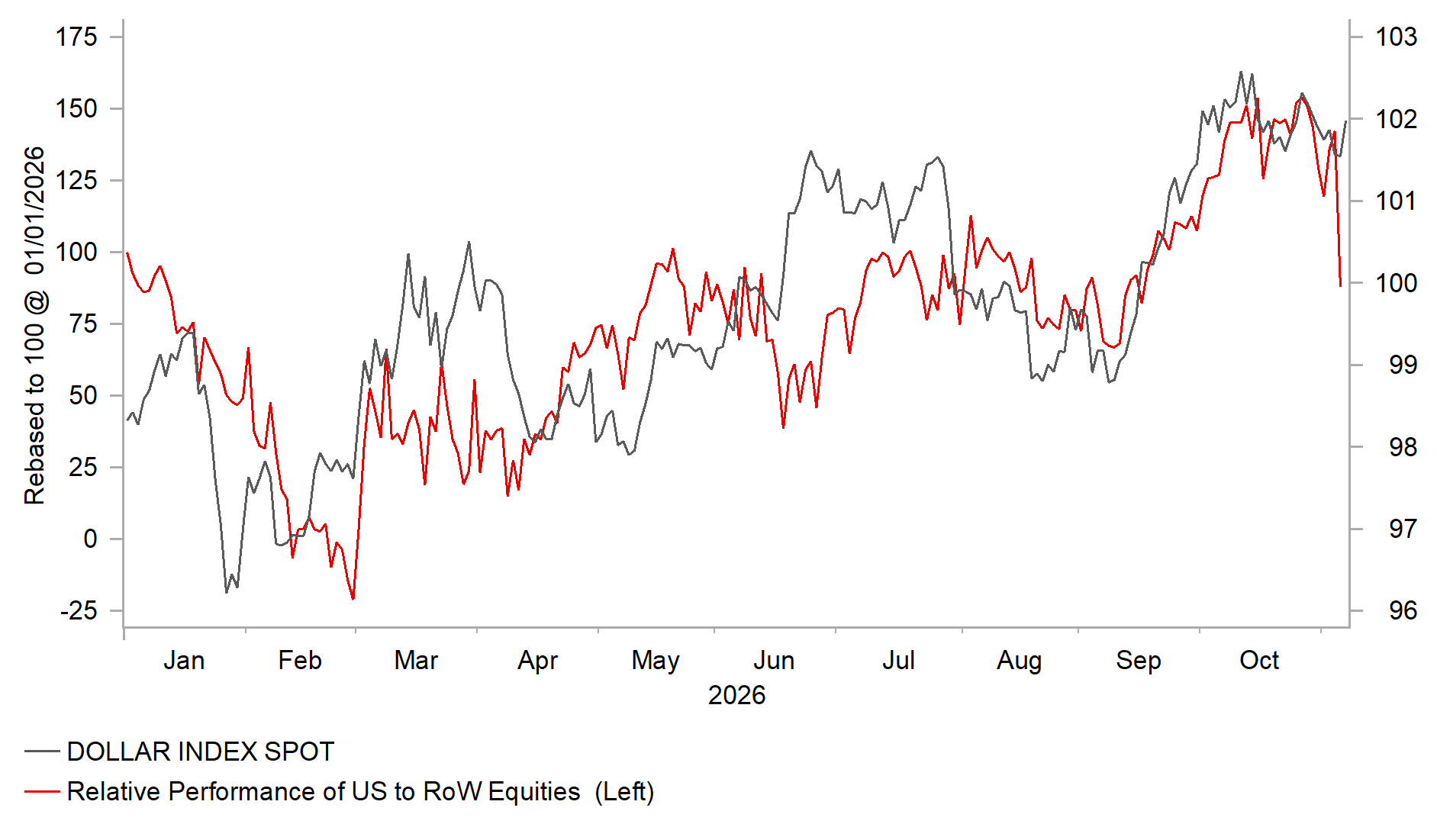
A second downside risk for the USD from the US mid-term election results comes from potential disruption to capital inflows. The strong victory for the Democrats has heightened investor uncertainty over the ongoing build-out of data centres in the US and raised the risk of tighter regulation of AI companies in the future, weighing further on investor sentiment. The results have reinforced the recent sell-off in AI-related investments. The Nasdaq Composite has extended its recent correction and is now around 12% below its early-October high. It is the largest correction since Q1 this year, when the index fell by almost 14%. AI-related stocks have been hit particularly hard, especially semiconductor and neocloud companies. The Philadelphia Stock Exchange Semiconductor Index has fallen by around a third from last month’s high and is now around 39% below its year-to-date peak in June. The CITIC CLSA US Neocloud Basket Equity Index has fallen even more sharply, dropping by around 50% from last month’s high and by around 62% from its June peak. These developments have contributed to US equities underperforming other global equity markets this month.
ENERGY PRICE SHOCK SUPPORTING STRONGER USD
Source: Bloomberg, Macrobond & MUFG GMR
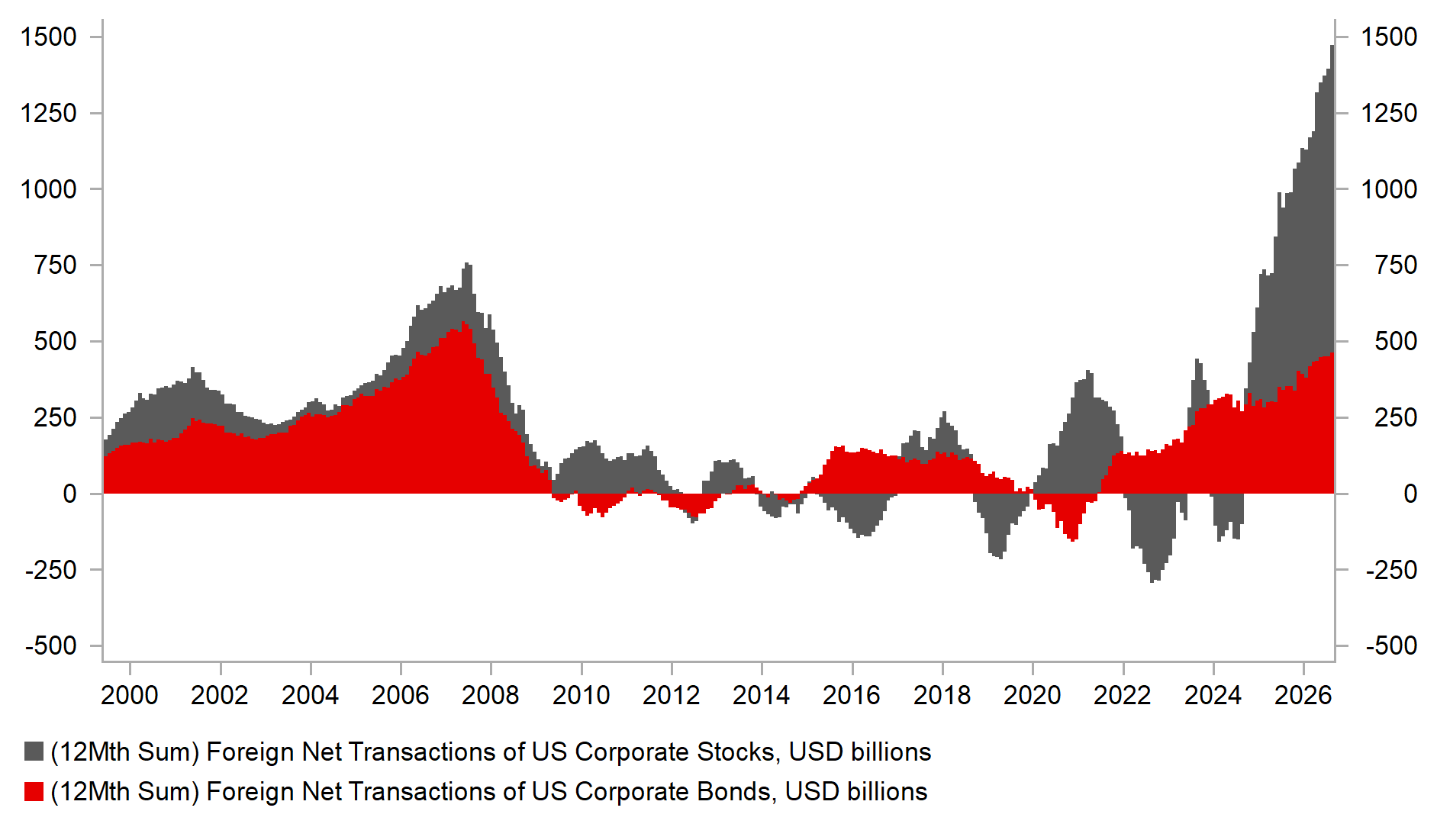
RECORD FOREIGN DEMAND FOR RISKIER US ASSETS
Source: Bloomberg, Macrobond & MUFG GMR
A more sustained reversal of US equity market outperformance, which has been the dominant trend since the US-Iran conflict began, would increase downside risks for the USD. As we have highlighted previously, the USD has been supported by record foreign demand for riskier US assets over the past year. Foreign investors purchased a net USD1.474 trillion of US corporate bonds and equities in the year to August, almost double the previous peak of USD759.3 billion recorded in the run-up to the Global Financial Crisis in the year to June 2007. Alongside low FX hedge ratios, a loss of confidence in US assets and increased expectations of USD weakness could encourage foreign investors to raise their hedges and/or pare back long US asset positions, putting a further dampener on USD strength. Record inflows into riskier US assets have been encouraged by expectations of higher returns. This potentially challenges the USD’s traditional role as a safe-haven currency, which has historically been underpinned by its status as the world’s dominant reserve currency and the depth and liquidity of the US Treasury market. The USD has initially strengthened as the global equity market sell-off has intensified over the past 24 hours, but the rally may prove difficult to sustain if weakness in US equities prompts a broader reversal of foreign capital inflows.
Finally, recent developments in financial markets could affect the performance of the USD by changing the outlook for Fed policy. The Fed decided to leave rates on hold last month after hiking for the first time in September in response to the energy price shock. The updated communication was surprisingly cautious about the need for further rate hikes, particularly given the recent strength of US growth and inflation. Fed Chair Kevin Warsh emphasised that higher rates are beginning to have a greater impact on the AI sector, making it more challenging for highly leveraged companies to secure financing. AI-related investments have sold off further since then, contributing to a tightening of US financial conditions. Alongside the recent sharp drop in energy prices, this has encouraged the US rates market to pare back expectations for a December rate hike. A second hike in December is still judged to be more likely than not, but if financial conditions tighten further, expectations for another hike could be scaled back further. The Fed could then decide to delay its next hike, putting downward pressure on US yields and the USD heading into year-end.
US EQUITIES OUTPERFORMED DURING CONFLICT
Source: Bloomberg, Macrobond & MUFG GMR
YIELD SPREADS MOVING AGAINST USD
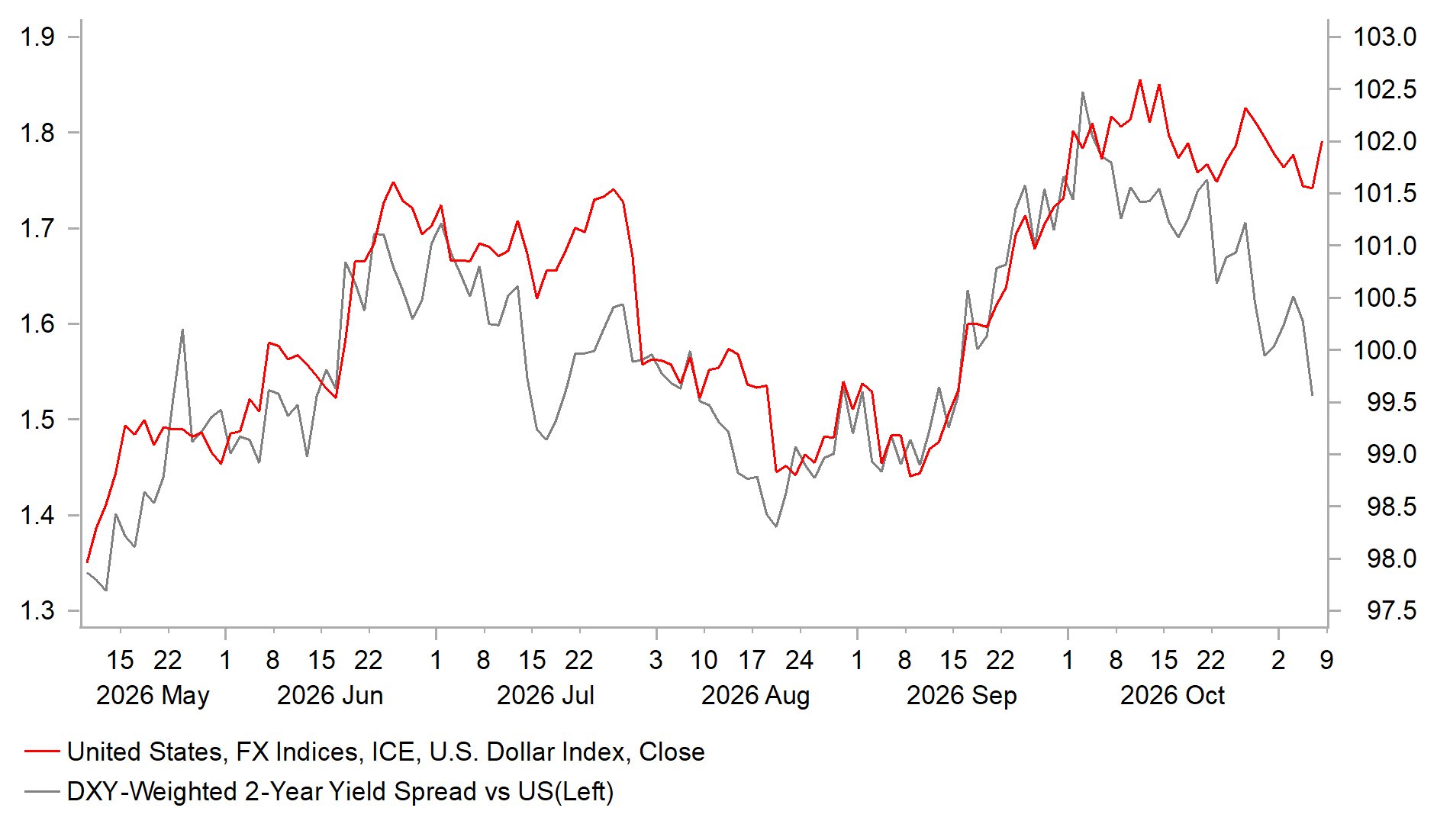
Source: Bloomberg, Macrobond & MUFG GMR
Weekly Calendar
Ccy | Date | GMT | Indicator/Event | Period | Consensus | Previous | Mkt Moving |
NZD | 07/11/2026 | Tbc | General Election | !! | |||
EUR | 09/11/2026 | 07:00 | Germany Trade Balance SA | Sep | -- | 19.4b | !! |
USD | 09/11/2026 | 15:00 | Fed's Goolsbee Speaks | !! | |||
JPY | 09/11/2026 | 23:50 | BoP Current Account Balance | Sep | ¥3354.4b | ¥4062.0b | !! |
NZD | 10/11/2026 | 00:15 | RBNZ Chief Economist Conway Speaks | !! | |||
NOK | 10/11/2026 | 07:00 | CPI YoY | Oct | -- | 3.4% | !! |
SEK | 10/11/2026 | 08:30 | Riksbank Publishes Minutes | !! | |||
USD | 10/11/2026 | 09:00 | Fed's Waller Gives Keynote Speech | !! | |||
USD | 10/11/2026 | 11:00 | NFIB Small Business Optimism | Oct | -- | 97.9 | !! |
USD | 10/11/2026 | 13:30 | Core CPI MoM | Oct | 0.2% | 0.3% | !!! |
EUR | 10/11/2026 | 16:45 | ECB's Lane Speaks | !! | |||
CAD | 10/11/2026 | 18:30 | Bank of Canada Summary of Deliberations | !! | |||
USD | 10/11/2026 | 23:30 | Fed's Paulson Speaks | !! | |||
EUR | 11/11/2026 | 07:00 | Germany CPI YoY | Oct F | -- | 2.8% | !! |
EUR | 11/11/2026 | 09:00 | Italy Industrial Production MoM | Sep | -- | -1.3% | !! |
GBP | 12/11/2026 | 07:00 | GDP QoQ | 3Q P | -- | 0.5% | !!! |
SEK | 12/11/2026 | 07:00 | CPI YoY | Oct F | -- | 0.9% | !! |
GBP | 12/11/2026 | 07:00 | Trade Balance GBP/Mn | Sep | -- | -£920m | !! |
EUR | 12/11/2026 | 09:00 | ECB Publishes Economic Bulletin | !! | |||
USD | 12/11/2026 | 13:30 | Initial Jobless Claims | -- | -- | !! | |
USD | 12/11/2026 | 14:00 | Fed's Hammack Speaks | !! | |||
USD | 12/11/2026 | 15:00 | Existing Home Sales | Oct | 3.87m | 3.99m | !! |
USD | 12/11/2026 | 18:10 | Fed's Daly Delivers Keynote Remarks | !! | |||
USD | 12/11/2026 | 23:30 | Fed's Williams Participates in Discussion | !! | |||
CHF | 13/11/2026 | 07:30 | Producer & Import Prices YoY | Oct | -- | -0.2% | !! |
EUR | 13/11/2026 | 07:45 | France CPI YoY | Oct F | -- | 3.4% | !! |
EUR | 13/11/2026 | 10:00 | GDP SA QoQ | 3Q S | -- | 0.4% | !! |
USD | 13/11/2026 | 13:30 | PPI Final Demand MoM | Oct | 0.4% | 1.3% | !!! |
Source: Bloomberg & MUFG GMR
Key Events:
There is a quieter schedule for economic data releases and events in the week ahead. The main economic release will be the latest US CPI report for October. Market participants will be watching closely for any further evidence that underlying inflation pressures are picking up alongside higher energy prices. Core inflation has surprised to the upside in both August and September, adding pressure on the Fed to tighten policy further. It has lifted the annualized rate of core inflation to 3.4% over the last three quarters. The pick-up in core inflation in September was driven by core services. However, core services inflation is expected to step back down in October following strong monthly readings for housing, hotels and airfares in the prior month. A softer US CPI report could reinforce the recent paring back of Fed rate hike expectations, which has been triggered by the Fed’s cautious guidance on further tightening and the sharp drop in oil prices over the past week. The release of the October PPI report will also have an impact on forecasts for the core PCE deflator. A number of Fed officials are scheduled to speak in the week ahead, including New York Fed President Williams and Fed Governor Waller.
The main economic data release in the UK will be the latest GDP report for Q3. After the recent run of stronger monthly activity data, we expect the UK economy to have expanded by a strong 0.7% in Q3. Stronger growth has been driven primarily by the service sector, which has been supported by the adoption of AI and higher productivity growth. The BoE acknowledged stronger economic growth when it raised the policy rate for the first time this week, although its updated guidance remained cautious over the need for further rate hikes.
New Zealand will hold a general election this weekend. The election is viewed as too close to call, with neither the incumbent centre-right coalition government nor the centre-left opposition expected to win a comfortable majority. If the existing coalition of National, ACT and New Zealand First manages to hold on to power, it is likely to require additional support from another party. Alternatively, a Labour-led government could slow the pace of fiscal consolidation, aiming to return the budget to surplus one year later. Labour has also proposed a new 28% capital gains tax on residential investment and commercial property.