

To read the full report, please download PDF.
Bullish USD trend suffers setback
FX View:
The USD is on course to weaken this week, bringing an end to four consecutive weeks of gains. After climbing to a fresh year-to-date high following the stronger-than-expected US CPI report for September, the USD quickly surrendered those gains, marking the beginning of the current pullback. The Fed is still widely expected to leave rates on hold this month after recent communication from officials, including Fed Chair Kevin Warsh, failed to signal any urgency to tighten policy again. The proximity of the US midterm elections may also discourage a back-to-back rate hike. If the Democrats take control of Congress, it could contribute at the margin to a further pullback in US yields and the USD. The USD’s correction has also coincided with a moderation in investor optimism towards AI-related trades. Strong inflows into riskier US assets have helped to support the USD alongside higher US yields and the positive terms-of-trade shock from elevated energy prices. However, heavily overweight positioning leaves the USD vulnerable to a reversal when sentiment towards AI deteriorates.
PARTIAL REVERSAL OF RECENT USD GAINS
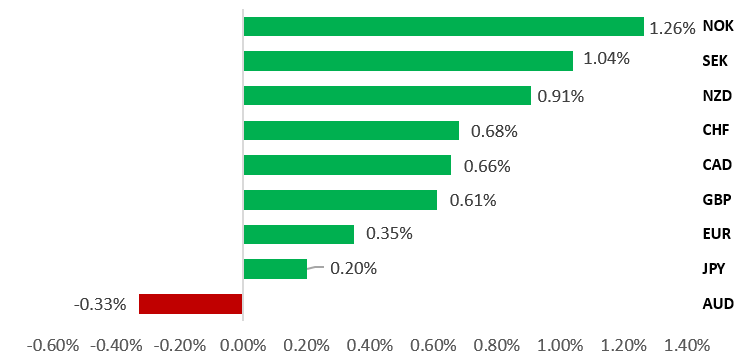
Source: Bloomberg, as of 16th October 14:20 BST (Weekly % Change vs. USD)
Trade Ideas:
We are maintaining our short EUR/JPY trade idea and closing our long USD/SEK trade idea after this week’s reversal.
JPY Flows - Balance of Payments:
The MoF Balance of Payments data for August was released last week and reveals the 3-month sum of the investment income balance remains at a lower level. This reflects a sharp drop-off in the investment income balance for equities.
IMM FX Positioning:
The latest IMM positioning data for the week ending 6 October showed that leveraged funds reduced their short USD positions for a third consecutive week. On the other hand, there was a sharp increase in long BRL positions driven by the first round of Brazil's presidential election.
FX Views
USD: Reversals underway for the USD & AI trades
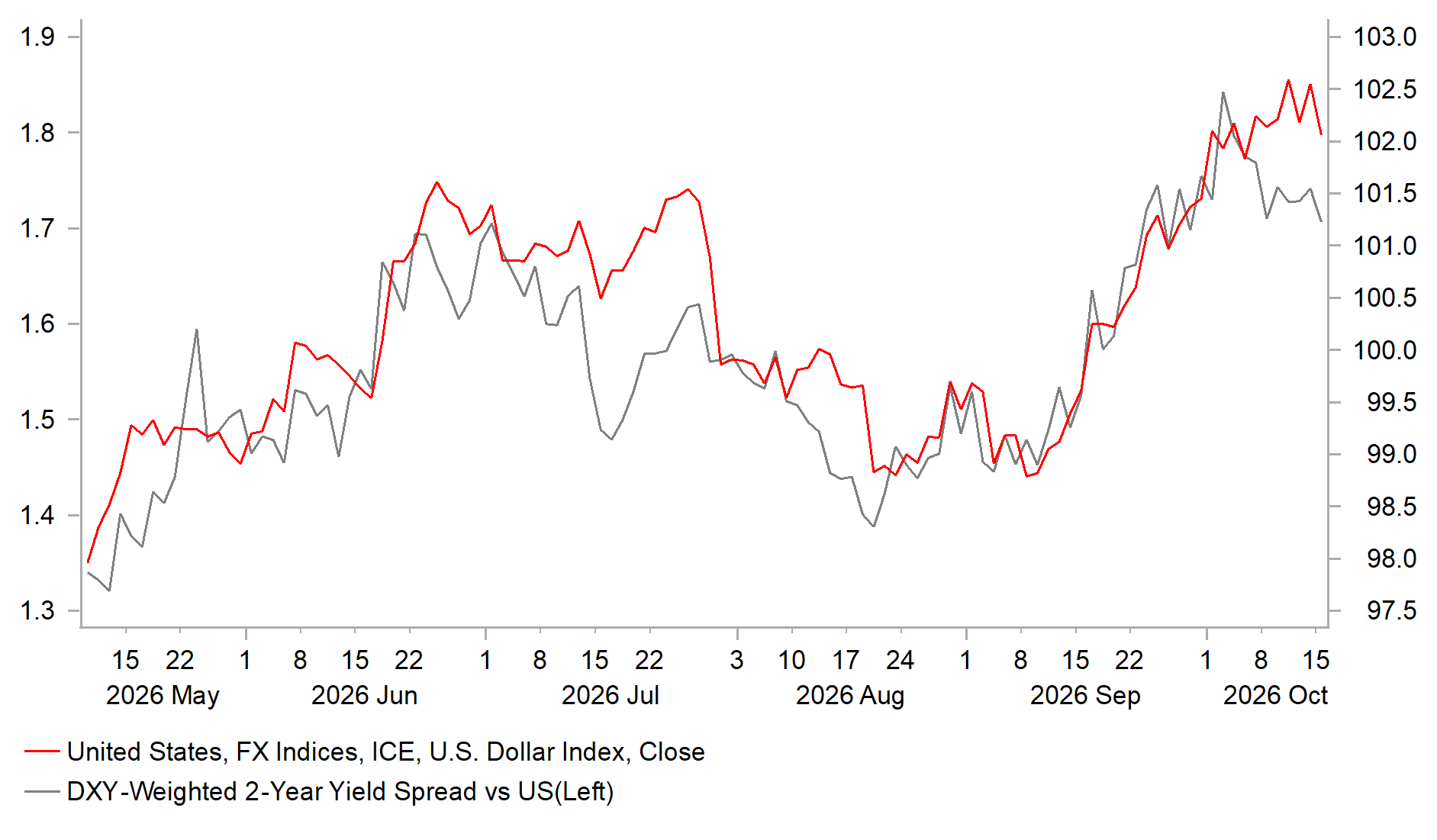
The USD has reversed course this week, with the dollar index currently on track to decline and snap a four-week winning streak. The main beneficiaries of the softer USD have been the Scandinavian currencies, particularly the NOK and SEK, alongside the NZD. The SEK and NZD were among the worst-performing currencies during the USD rally between 9 September and the recent peak in the dollar index on 14th October. In contrast, the AUD has underperformed the NZD, weakening against the USD this week and pushing AUD/USD back towards the 0.6900 level. The pullback in the USD has coincided with a continued decline in global government bond yields this month, following the sharp repricing higher in September. At the long end of the US yield curve, yields have fallen significantly, with the 10-year Treasury yield down by almost 30bps from the peak reached earlier this month.
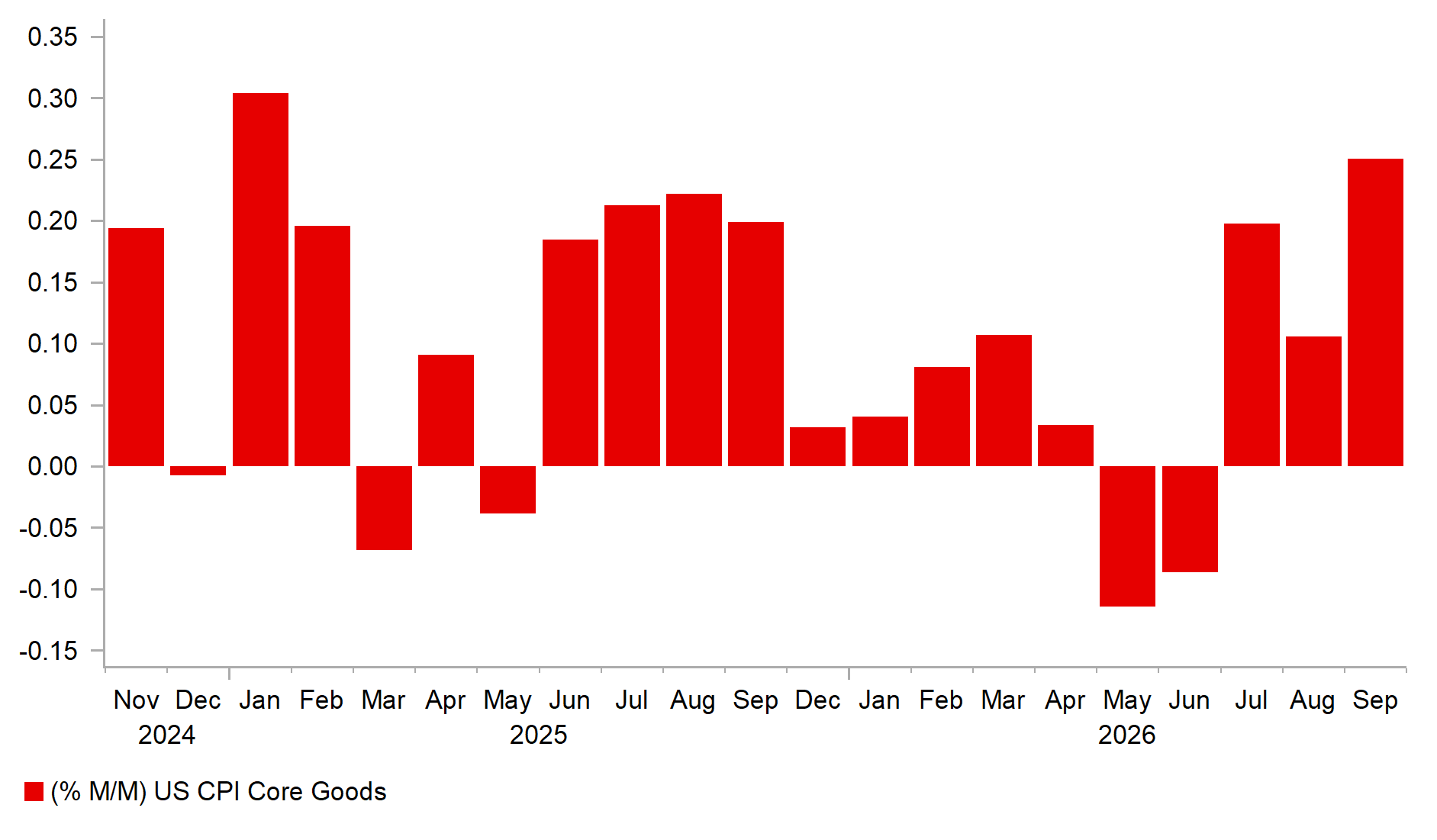
The USD’s failure to extend its gains this week following the release of stronger US inflation data has been disappointing and has likely encouraged some investors to trim long positions accumulated over the past month. The September CPI and PPI reports will have reinforced concerns within the Fed about the risk of more persistent inflation. Looking beyond the inflationary impact of higher energy prices, a second consecutive month of firm core inflation (+0.34% M/M) increases pressure on the Fed to continue tightening policy. The pickup in core inflation was evident across both the goods (+0.25% M/M) and services (+0.37% M/M) sectors. Core goods inflation recorded its strongest monthly increase since January 2025, potentially signalling greater pass-through from higher transportation and energy costs. The price of personal computers and peripheral equipment also rose by a robust 1.4% M/M for a third consecutive month, supported by strengthening AI-related demand. However, its contribution to the monthly increase in core goods inflation remains relatively modest at around 0.01ppt. Taken together, the CPI and PPI reports have prompted economists to revise higher their forecasts for the core PCE deflator in September, with expectations now centred in the 0.3%-0.4% M/M range.
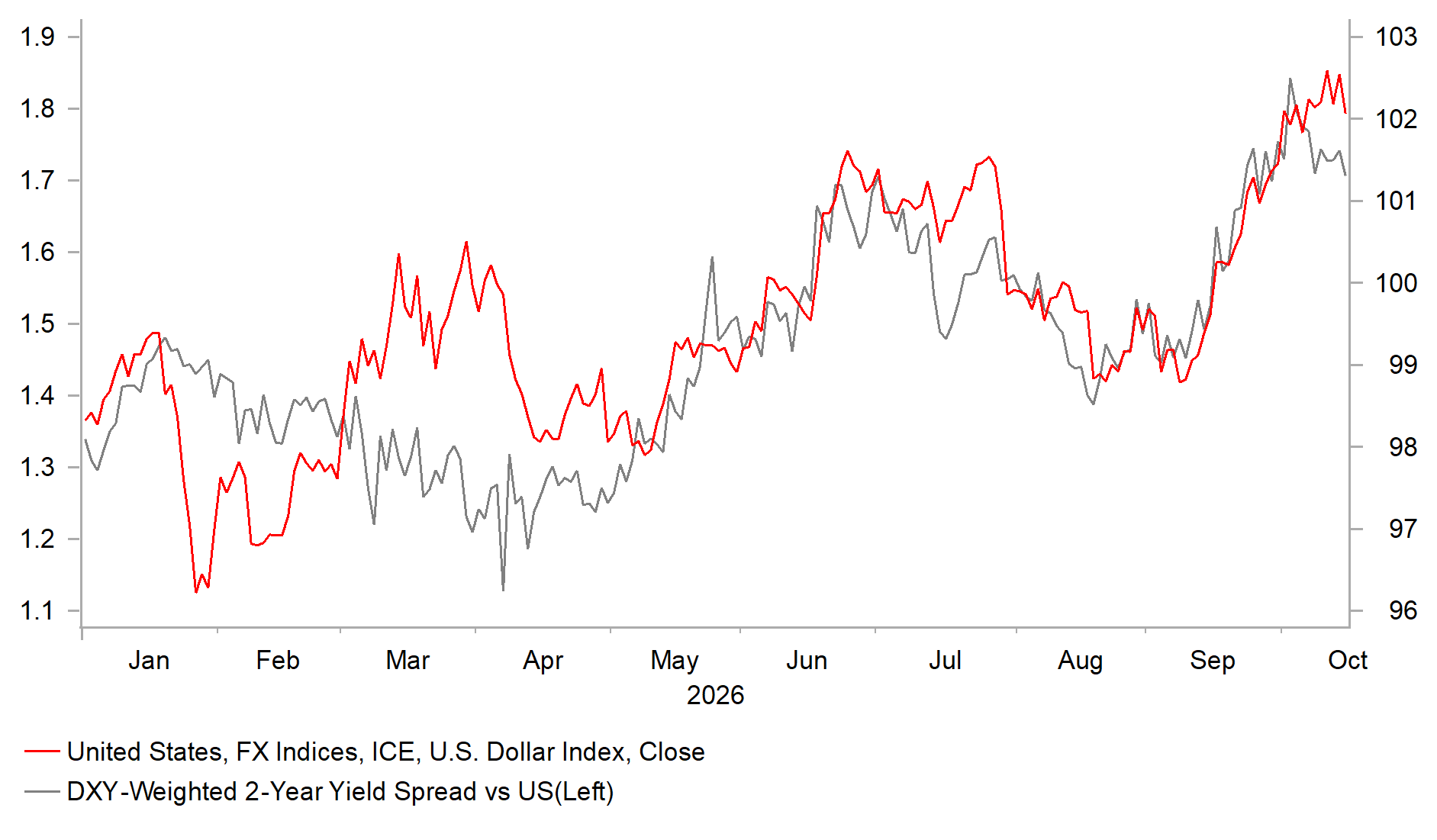
Despite the stronger US inflation data, which further highlights the limited progress towards the Fed’s inflation objective, market participants have been reluctant to price in a more hawkish policy path. Market pricing for a back-to-back Fed rate hike later this month has fallen to around 4bps after Fed Chair Kevin Warsh refrained from signalling a clear need for another increase so soon after last month’s initial hike. In addition, recent comments from other Fed officials, including New York Fed President Williams and Vice Chair Jefferson, have suggested that there is no urgent need to tighten policy again in the near term. This preference for a more gradual pace of policy tightening is helping to contain upside risks for both US yields and the USD in the near term.
YIELD SPREADS LESS SUPPORTIVE FOR USD UPSIDE
Source: Bloomberg, Macrobond & MUFG GMR
PASSTHROUGH FROM HIGHER ENERGY PRICES
Source: Bloomberg, Macrobond & MUFG GMR
The USD’s pullback this week has coincided with a wobble in AI-related trades. After reaching a fresh record high earlier this month, Bloomberg’s AI equity index has since fallen by around 6%. The correction has been even more pronounced in semiconductor and neocloud equity indices. The sell-off has been driven by a combination of factors, including renewed concerns that the scale of AI investment could ultimately result in oversupply. At the same time, the growing need to raise capital to finance AI infrastructure is contributing to tighter financing conditions. Bonds issued to fund major data centres, where companies such as Meta, Nvidia and Oracle are expected to become tenants, have fallen below par in recent weeks. Neocloud firms such as CoreWeave, which have been among the most aggressive in financing their expansion, have experienced stronger selling pressure in their debt lifting yields above 15%.
The IMF identified an AI-driven market correction as one of the three key risks to financial stability in its latest Financial Stability Report. The report noted that AI-related firms and their investors are increasingly relying on three major sources of leverage. First, hyperscalers' share of global investment-grade bond issuance has risen to 10%, up from less than 1% in 2024. The IMF also singled out neocloud operators due to their higher debt burdens and weaker profitability. Second, hedge funds’ gross equity exposure, combined with equity margin loans, has increased to around 15% of advanced economy GDP, up from 10%, reflecting a build-up of leveraged positions in AI-related equities. Third, the share of single-stock products within leveraged exchange-traded funds has increased from 16% to 28%, as retail investors have increasingly used these vehicles to gain leveraged exposure to AI stocks. These growing sources of leverage increase the risk of forced selling, heightened equity market volatility, and wider credit spreads if AI-related investment and profitability prove less durable than currently anticipated.
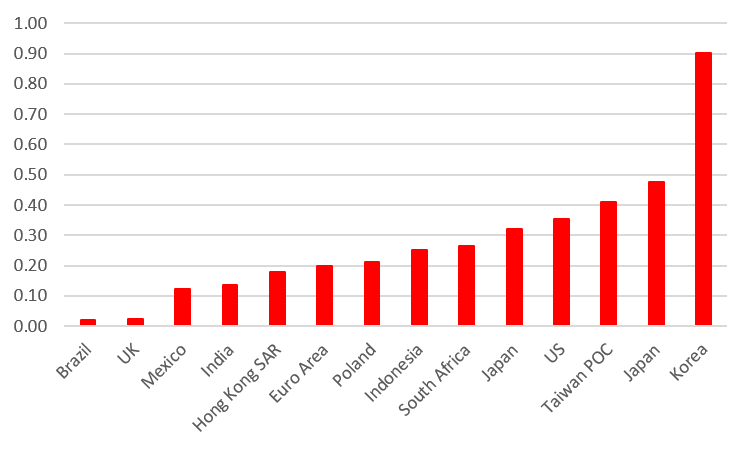
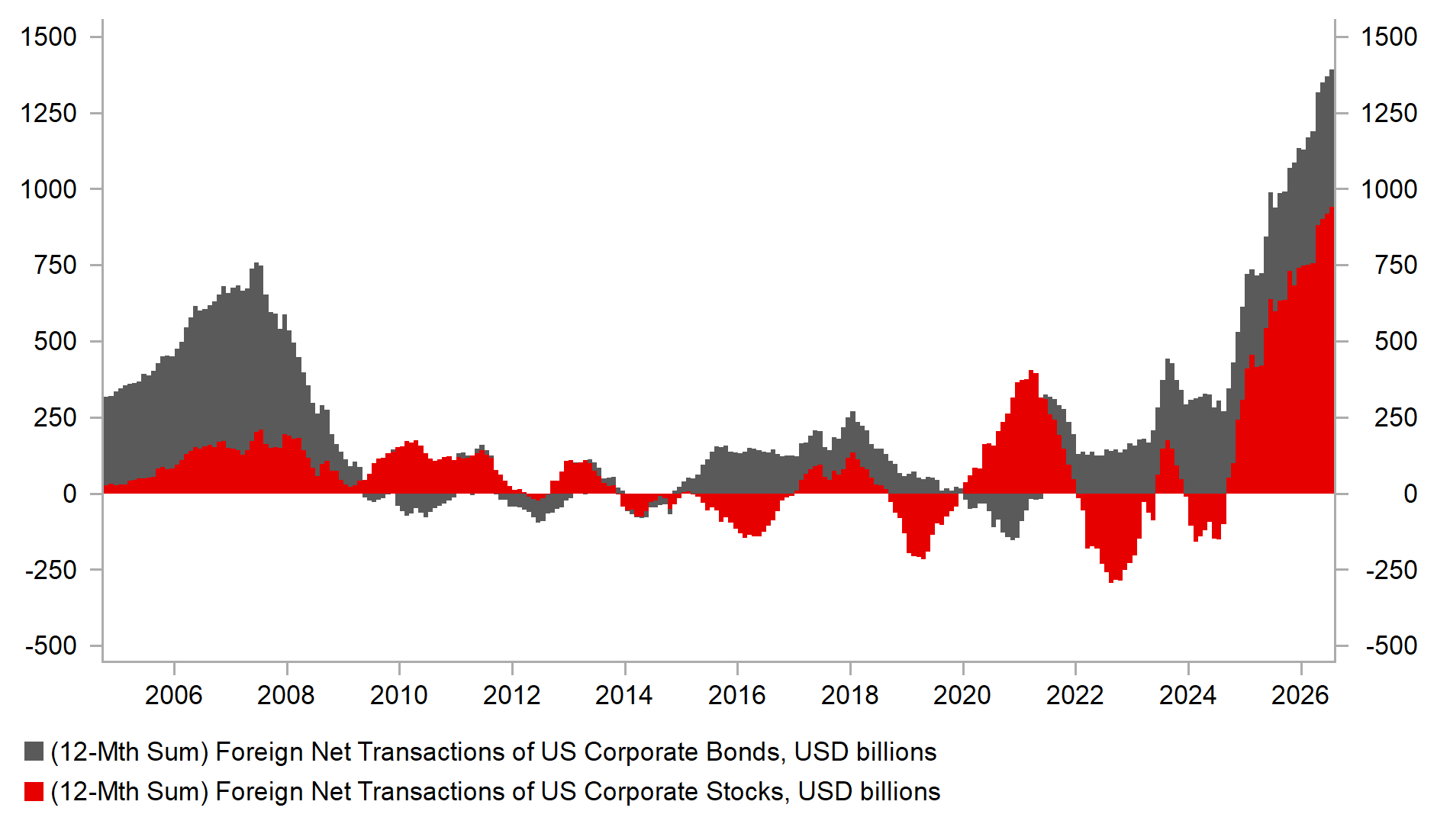
The IMF warned that the consequences of an AI-related market correction could be felt globally, although some jurisdictions appear more vulnerable than others. Its analysis showed that advanced Asian equity markets exhibit the highest betas to a proxy for global AI equity returns, indicating greater sensitivity to fluctuations in AI-related sentiment. In contrast, equity markets in the euro area, the UK and most emerging economies display significantly lower betas. US financial markets have been a major beneficiary of strong foreign investor demand driven by AI-related optimism. Foreign investors purchased USD942 billion of US equities in the twelve months to July, while purchases of US corporate bonds increased sharply to USD452 billion over the same period. These sizeable inflows highlight how the USD has become increasingly tied to investors’ search for higher returns in US financial markets, rather than benefiting from its traditional safe-haven status. However, this dynamic also leaves the USD more exposed to a reversal if sentiment towards AI deteriorates.
EQUITY RETURN BETA TO THE GLOBAL AI INDEX
Source: Bloomberg, Macrobond & MUFG GMR
HEAVY INFLOWS INTO RISKIER US ASSETS
Source: Bloomberg, Macrobond & MUFG GMR
USD: Will US politics impact the US dollar?
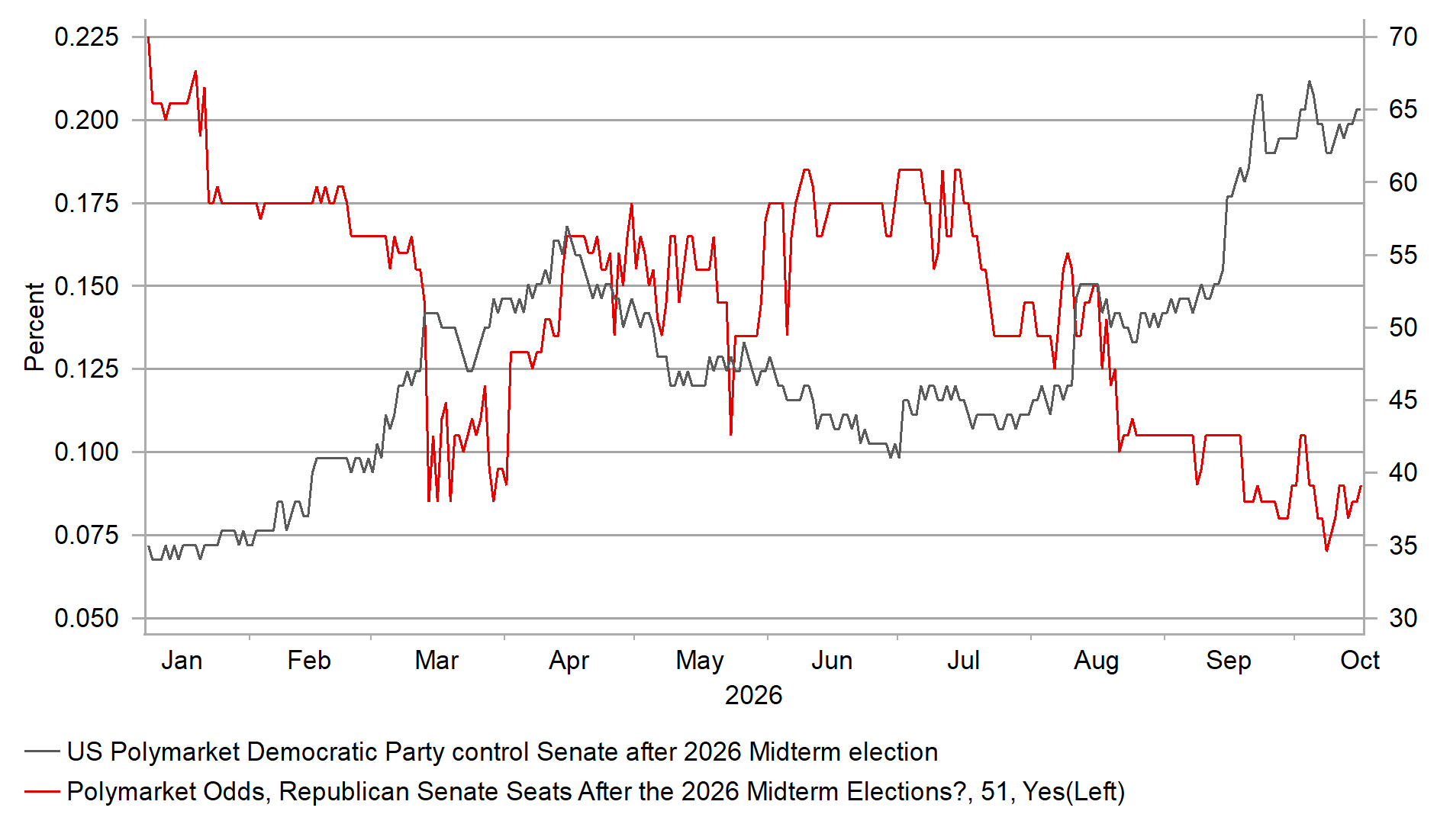
The US dollar remains well supported close to recent highs as US yields stabilise a little lower than recent highs as the AI-related selling weighs on investor risk appetite. An FT poll this week indicated President Trump’s popularity remains at around record lows with the cost of living the primary cause for the poor readings. Race to the White House polling currently predicts the Democrats winning not just the House but the Senate as well. It estimates the Democrats have a 71.6% chance of winning the Senate which would confirm a clean sweep and limiting any Trump attempt to increase spending further. Will the mid-term elections have any implications for the US dollar?
There are three most likely scenarios – 1) the Democrats win the House, but the Republicans hold the Senate; 2) the Democrats win both the House and the Senate; 3) or the Republicans keep hold of both the House and the Senate. The market consensus has been scenario 1) although the continued momentum in the polls suggest that consensus is shifting to Scenario 2). Looking at these scenarios through the potential reaction in the UST bond market, having the Democrats in control of one or both houses of Congress would likely be marginally supportive of lower yields. A result that takes away the ability of President Trump to increase government spending further would help weigh on yields. The IMF budget deficit projections show the US fiscal deficit remaining around the 7% level throughout the forecast period. Policy gridlock means fiscal gridlock – that’s not a particularly good backdrop for the fiscal outlook but its better than it might have been if the Republicans won. The Democrats would also be more sympathetic to pushing for greater regulations of AI. Pushing back against data centre buildouts could see the AI investment spending momentum slow and with valuations stretched that could form part of the catalyst for a bigger correction lower. That would be US dollar negative, certainly versus core G10 with higher beta G10 more likely to suffer as well. Scenario 2) would also likely see a big increase in investigations into the Trump White House that could fuel greater conflict in Washington and lead to more unpredictable policy announcements. This development would also be dollar negative as US dollar hedge-selling appetite increased.
Scenario 3) is the least expected and hence would likely result in the biggest move with the US dollar likely to strengthen as yields move higher on expected further deficit spending and continued AI freedom. But the FX moves will likely be contained with no clear strong impact on policy. Scenario 2) could see US dollar selling but of no more than 1% or so. Scenario 3) could see a bugger US dollar gain than that but ultimately the inflation data in November, Fed rate expectations and geopolitical developments and energy prices will continue to be more important FX drivers.
ODDS OF A REPUBLICAN VS DEM MAJORITY - SENATE
Source: Polymarket; Macrobond; MUFG GMR
FED MATTERS MORE FOR THE DOLLAR
Source: Macrobond; Bloomberg & MUFG GMR
Weekly Calendar
Ccy | Date | BST | Indicator/Event | Period | Consensus | Previous | Mkt Moving |
CNY | 19/10/2026 | 03:00 | GDP YoY | 3Q | 4.4% | 4.3% | !!! |
EUR | 19/10/2026 | 03:15 | ECB's Lane Speaks | !! | |||
CAD | 19/10/2026 | 13:30 | CPI YoY | Sep | -- | 3.0% | !!! |
USD | 19/10/2026 | 15:00 | NAHB Housing Market Index | Oct | 31.0 | 32.0 | !! |
CAD | 19/10/2026 | 16:30 | BoC Overall Business Outlook Survey | 3Q | -- | - 0.4 | !! |
GBP | 20/10/2026 | 07:00 | Average Weekly Earnings 3M/YoY | Aug | -- | 3.9% | !!! |
GBP | 20/10/2026 | 07:00 | Payrolled Employees Monthly Change | Sep | -- | -26k | !!! |
EUR | 20/10/2026 | 09:00 | ECB Current Account SA | Aug | -- | 27.6b | !! |
EUR | 20/10/2026 | 10:00 | Germany ZEW Survey Expectations | Oct | -- | 34.7 | !! |
EUR | 20/10/2026 | 10:00 | Construction Output MoM | Aug | -- | 0.0% | !! |
USD | 20/10/2026 | 13:30 | Housing Starts | Sep | 1300k | 1275k | !! |
JPY | 21/10/2026 | 00:50 | Trade Balance | Sep | -¥179.1b | -¥1111.9b | !! |
GBP | 21/10/2026 | 07:00 | CPI YoY | Sep | -- | 3.1% | !!! |
GBP | 21/10/2026 | 07:00 | Public Sector Net Borrowing | Sep | -- | 18.3b | !! |
GBP | 21/10/2026 | 07:00 | PPI Output NSA YoY | Sep | -- | 3.7% | !! |
GBP | 21/10/2026 | 14:00 | BoE’s Bailey Speaks |
|
|
| !!! |
EUR | 21/10/2026 | 17:00 | ECB's Lagarde Speaks | !!! | |||
NZD | 21/10/2026 | 22:45 | CPI YoY | 3Q | -- | 4.1% | !!! |
JPY | 22/10/2026 | 07:00 | Machine Tool Orders YoY | Sep F | -- | 60.4% | !! |
CHF | 22/10/2026 | 08:30 | SNB Summary of Sept Rate Decision | !! | |||
USD | 22/10/2026 | 13:30 | Initial Jobless Claims | -- | -- | !! | |
EUR | 22/10/2026 | 15:00 | Consumer Confidence | Oct P | -- | - 16.5 | !! |
JPY | 23/10/2026 | 00:30 | Natl CPI YoY | Sep | 2.1% | 1.9% | !!! |
GBP | 23/10/2026 | 07:00 | Retail Sales Inc Auto Fuel MoM | Sep | -- | 0.5% | !! |
EUR | 23/10/2026 | 09:00 | S&P Global Eurozone Manufacturing PMI | Oct P | -- | 52.9 | !! |
EUR | 23/10/2026 | 09:00 | S&P Global Eurozone Services PMI | Oct P | -- | 53.0 | !! |
GBP | 23/10/2026 | 09:30 | S&P Global UK Services PMI | Oct P | -- | 52.1 | !! |
GBP | 23/10/2026 | 09:30 | S&P Global UK Manufacturing PMI | Oct P | -- | 51.9 | !! |
CAD | 23/10/2026 | 13:30 | Retail Sales MoM | Aug | -- | -0.7% | !! |
USD | 23/10/2026 | 14:45 | S&P Global US Composite PMI | Oct P | -- | 58.4 | !! |
Source: Bloomberg & MUFG GMR
Key Events:
The main economic data releases in the week ahead will come from the UK, including the latest CPI and labour market reports. Market participants will be looking for confirmation that the BoE remains on course to begin raising rates next month. Headline inflation in the UK has generally undershot expectations since the US-Iran conflict began, allowing the BoE to take its time in assessing whether higher rates are warranted in response to the energy price shock. However, recent comments from BoE officials, including Governor Bailey, suggest that the window for keeping rates on hold is narrowing. Another reason the BoE has been reluctant to tighten policy is the persistent weakness in the labour market, which has helped to ease concerns about second-round inflation effects, such as stronger wage growth. Labour market conditions have remained soft despite the UK's robust economic growth this year. Evidence of an improvement in labour market conditions would add to pressure on the BoE to begin raising rates. Governor Bailey is scheduled to speak on Wednesday afternoon, following the release of both key economic reports, making his remarks particularly important for assessing the near-term policy outlook.
The release of the latest CPI reports from Canada, New Zealand and Japan will also be in focus in the week ahead. The BoC has recently signalled that upside risks to inflation have increased, fuelling expectations that policy will need to be tightened before the end of this year. However, the case for a rate hike as soon as this month has weakened following a second consecutive soft employment report for September. In Japan, we do not expect the September CPI report to materially alter market expectations that the BoJ will leave rates on hold at this month's policy meeting. By contrast, the CPI release in New Zealand could have a more significant market impact, given that another RBNZ rate hike this month is viewed as a much more finely balanced decision after back-to-back increases in July and September. At its September policy meeting, the RBNZ indicated that it wanted time to assess the impact of those earlier rate hikes. Since then, RBNZ Chief Economist Paul Conway has welcomed market pricing that aligns with his view that the upcoming policy decision remains "wide open", reinforcing uncertainty over whether rates will be raised again this month.