

What FX Signals Are Winning?
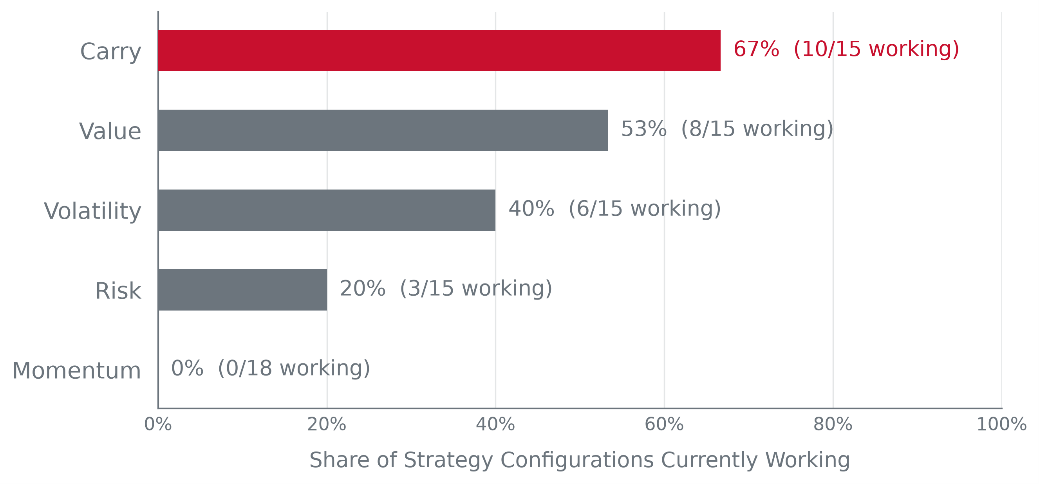
Carry remains a standout systematic signal, delivering relatively consistent performance in the current market environment.
JPY and CAD show the strongest bearish conviction vs. USD, supported by signals across valuation, carry and volatility strategies.
We are recommending short EUR/GBP (3W), long USD/JPY (9W) and long USD/CAD (9W) trade ideas.
Overview
Systematic trading strategies are rules and regime-based, they lack the instinct and feel for markets that sits at the heart of discretionary trading, replaced instead with a rigid set of rules that decides when to buy, when to sell and when to sit on the sidelines. Yet precisely because those rules remove emotion from the process, systematic strategies have become a well sought after incursion into markets by all manner of market participants.
The challenge however is no systematic strategy works in every environment, markets move through different macroeconomic, policy and volatility regimes, and the relationships that drive FX changes with them. A momentum signal that captures a persistent trend in one environment can become considerably less useful when markets become range bound. Likewise, differences in rates, valuation, risk sensitivity or volatility can move in and out of focus as the main forces driving FX change.
In this edition, we investigate the rotation in systematic strategies. Rather than beginning with a view on which strategy should work, we start with the question: Given the current environment, which FX strategies are winning now?
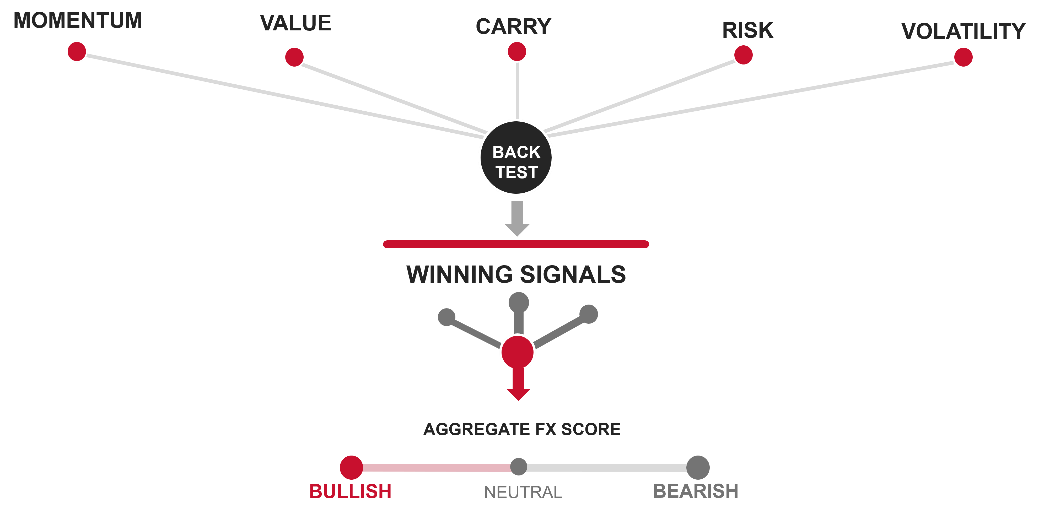
FROM STRATEGY BANK TO SYSTEMATIC FX VIEW
Source: Bloomberg, Macrobond & MUFG GMR
Winning Score
We test 26 strategies across our five strategy families: Momentum, Value, Carry, Risk and Volatility. Each is evaluated using 3-, 6- and 9-week holding periods, producing 78 unique strategy configurations.
To identify if a strategy is working in the current environment each configuration is attributed a winning score, this scoring rewards strategies whose performance is robust across recent periods, it is calculated using the following:
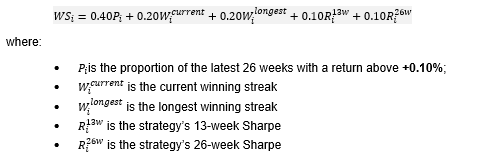
A configuration qualifies as “winning” when the score is greater than or equal to 0.5. This prevents a strategy from qualifying solely because of a single strong return. Winning strategies must exhibit recent persistence, repeatability and risk-adjusted performance.
What Strategies are Winning?
At the family level we identify the share of strategy configurations that are winning. Should recent success be broadly spread across the configurations in each family we say the family is working.
CARRY TAKES LEADERSHIP POSITION
Source: Bloomberg, Macrobond & MUFG GMR
Our carry-based strategies currently stand out as the most consistently successful group in recent periods. The strategies capture the level of 2Y yield differentials, changes in those differentials, their deviation from historical norms, inflation-adjusted rate differentials and potential mean reversion following unusually large rates moves. The results suggest that both the level and direction of relative rates have recently contained useful information for FX.
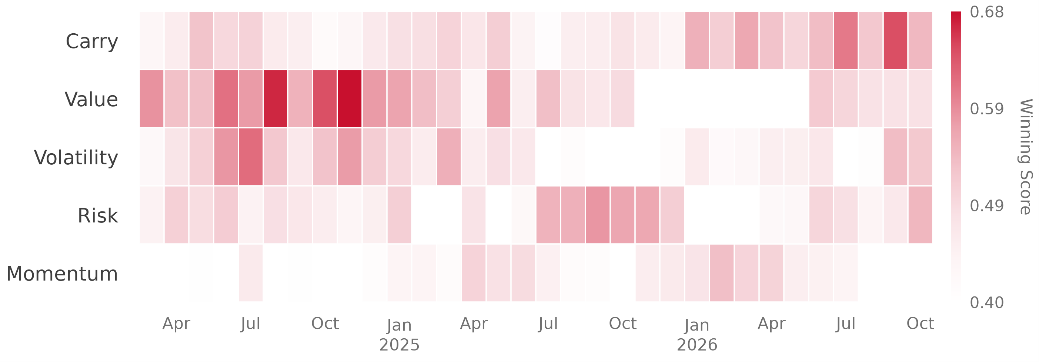
STRATEGY LEADERSHIP ROTATES WITH THE MARKET REGIME
Source: Bloomberg, Macrobond & MUFG GMR
Carry has re-emerged as a leading strategy family this year, the chart above identifies the rotation of leadership amongst systematic strategies we flag rotation has been particularly evident around periods of macro disruption. The “Liberation Day” tariff shock in April-2025 coincided with higher FX volatility and a deterioration in Carry performance, before the initial market reaction faded and carry positions were rebuilt to pre-event levels. The US-Iran conflict in early 2026 marked another shift in the systematic backdrop, as the energy shock and changing policy expectations generated stronger directional moves across G10 FX, this created a more supportive environment for momentum. As the geopolitical premium subsequently faded and market trends became less persistent, momentum trends weakened again.
What do the winners say about G10 FX?
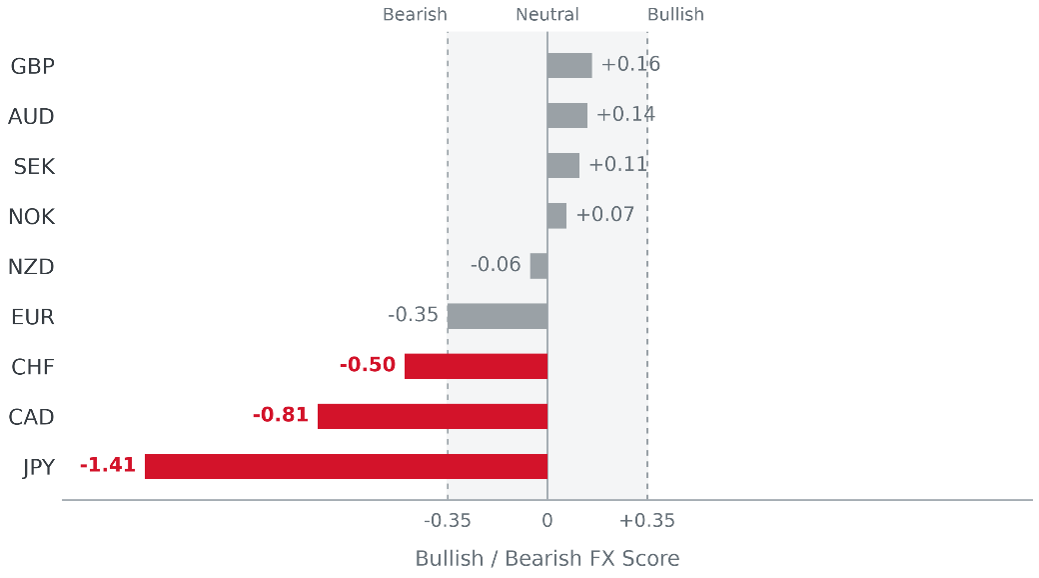
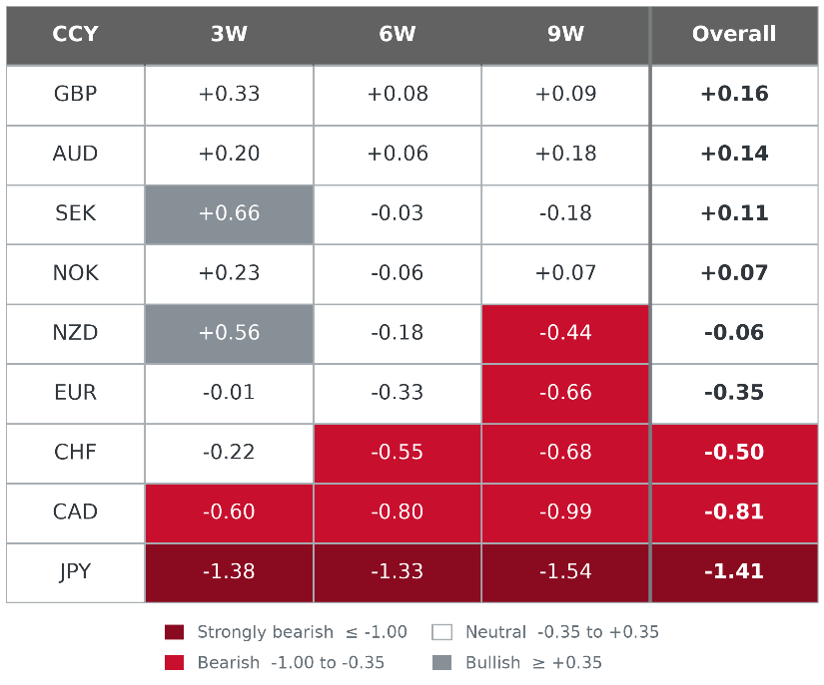
Having established which strategies are working, we now answer what those strategies imply for G10 FX. The first chart combines their directional preferences across all holding periods into a common bullish/bearish score for each G10 currency, with readings beyond +/-0.35 signalling stronger directional conviction. The table below looks beneath that headline signal, separating the views of winning 3-, 6- and 9-week strategies. This helps identify where directional conviction is persistent across horizons.
BULLISH/BEARISH AGGREGATE FX SCORE
Source: Bloomberg, Macrobond & MUFG GMR
BREAKDOWN OF BULLISH/BEARISH SCORE BY HOLDING PERIOD
Source: Bloomberg, Macrobond & MUFG GMR
Our analysis finds that winning strategies retain a bearish skew for G10 currencies against the USD. Bearish conviction is strongest where the signal is persistent across horizons. JPY and CAD register negative readings at the 3-, 6- and 9-week holding periods, with JPY flagging “strongly bearish” across all time horizons. CHF and EUR show a more gradual deterioration as the time horizon extends, with their strongest bearish signals concentrated at nine weeks. NZD and SEK display a different profile, with shorter-term (3 weeks) bullish signals giving way to neutral signals over 6-9 weeks. At the top of the overall ranking, GBP and AUD remain relatively resilient and positive across all three horizons, but neither generates sufficient conviction for an outright bullish overall signal.
What is driving the G10 FX view?
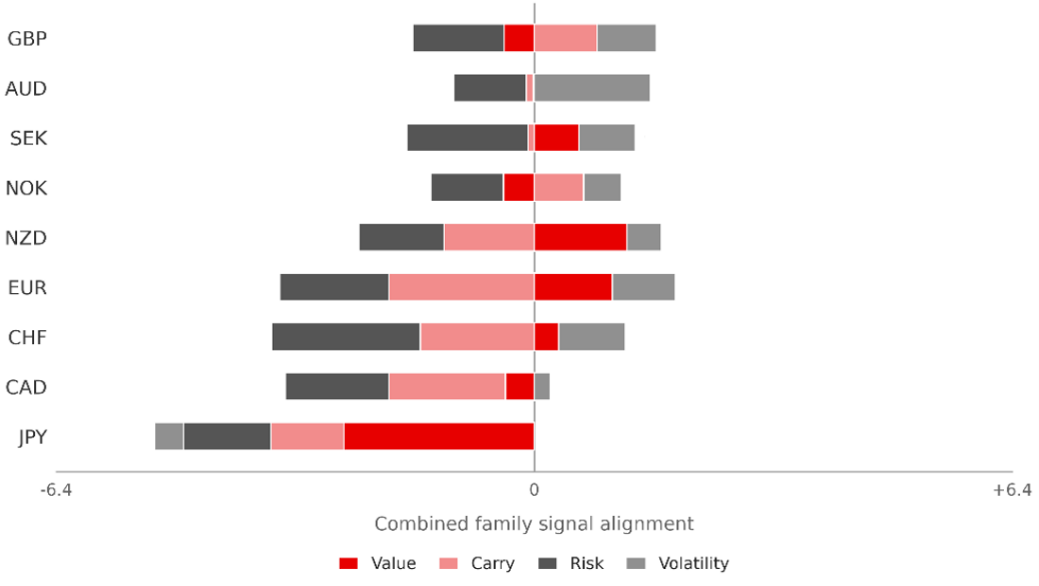
Decomposing the overall signal by strategy family reveals the underlying sources of directional conviction. Signals supported across several families indicate broader systematic agreement, while those driven by only one or two may be more dependent on a particular market dynamic and therefore more vulnerable to a change in the macro environment. Broad family alignment can therefore provide greater confidence in the headline signal, while the individual family scores allow clients to focus on the systematic view that most closely aligns with their own market thesis.
BREADTH OF SUPPORT ACROSS SYSTEMATIC STRATEGIES
Source: Bloomberg, Macrobond & MUFG GMR
JPY stands out as the clearest bearish signal in the G10 universe. Its headline FX score is reinforced by unanimous agreement across the contributing strategy families. CAD also shows relatively broad bearish conviction, with only a modest positive contribution from Volatility. CHF also remains bearish at -0.50, although its underlying composition is less uniform: strong negative Carry and Risk signals are partly offset by positive Value and Volatility readings.
Elsewhere, family disagreement helps explain why several currencies remain neutral despite large individual strategy-family signals. GBP (for all holding periods) receives positive Carry and Volatility signals but negative Value and Risk signals, producing a neutral overall score, this is also the case for AUD.
Systematic Trade Recommendations
We translate the strategy-selection framework into three current G10 FX recommendations, drawing on some of the strongest-performing signals in the strategy bank. Each recommendation reflects a different systematic driver, providing exposure to carry, valuation and risk.
1. Real Rate Differential:
Short EUR/ GBP (3-week holding period)
Opened @ 0.8380, Target @ 0.8200 & S/L @ 0.8480
Strategy Description: The real rate differential strategy favours currencies offering relatively attractive inflation-adjusted yields and turns bearish on currencies where real-rate support is weaker.
The strategy currently ranks as one of the strongest-performing systematic signals in the G10 universe. Recent performance has been particularly strong, its 13-week Sharpe ratio is 2.40, its 26-week Sharpe is 1.62, and it has generated positive returns in 16 of the past 26 weeks. This combination indicates that the strategy has exhibited both strong recent risk-adjusted performance and persistence.
The current cross-currency signal points most strongly towards GBP relative to EUR. For this strategy, GBP over a 3-week horizon has a strongly bullish score, meaning the inflation adjusted rate backdrop is amongst the most supported in G10. While EUR sits on the opposite end, giving rise to the short EUR/GBP signal.
2. Value Momentum:
Long USD/ JPY (9-week holding period)
Opened @ 157.00, Target @ 162.00 & S/L @ 154.00
Strategy Description: Value Momentum focuses on the direction of change in currency valuation. It favours currencies where valuation dynamics are becoming more supportive and sells those where they are deteriorating.
The strategy has been supported by strong recent performance, with its 13-week Sharpe ratio standing at 2.70, while its 26-week Sharpe is more moderate at 0.40. The current signal provides a particularly strong bearish view on JPY. JPY ranks bottom amongst G10 crosses carrying an exceptionally bearish score, indicating that it has deteriorated relative to valuation estimates. Expressing that JPY weakness against USD produces a long USD/JPY recommendation over a nine-week holding horizon.
3. VIX Sensitivity:
Long USD/CAD (9-week holding period)
Opened @ 1.4020, Target @ 1.4300 & S/L @ 1.3870
Strategy Description: VIX Sensitivity measures how currencies respond to changes in equity-market volatility, identifying which currencies are most exposed as global risk sentiment shifts.
The strategy has been supported by strong medium-term performance, with its 26-week Sharpe ratio standing at 1.75, the shorter 13-week Sharpe is more moderate at 0.69. The current signal points towards CAD weakness, with CAD carrying a negative directional score of -1.39. This suggests that its current sensitivity to changes in equity-market volatility is providing a less supportive signal for CAD. Expressing that weakness against USD produces a long USD/CAD recommendation over a nine-week holding horizon.
Conclusion
The current systematic landscape presents a clear directional message - winning strategies retain a broadly bearish G10 bias vs. USD, and that bias is not evenly distributed. JPY is the standout expression of the view where bearish conviction is unanimous across our strategy families and persistent across all three holding horizons, reflecting a macro environment where the rate differential, valuation gap and risk are all reinforcing the same signal simultaneously. CAD attracts the next broadest bearish conviction, where weak growth, tariff headwinds and an inflation-constrained central bank have created conditions favourable for systematic strategies.
CHF sits in bearish territory but with less certainty, the carry drag is structural and the SNB's retreat from intervention support is meaningful, yet residual safe-haven demand and a resilient growth outlook provide genuine offsets that prevent the signal from reaching the same conviction as JPY or CAD.
GBP and AUD remain neutral, not because the signals are weak, but because the signals are genuinely divided, hawkish central banks support carry, while fiscal risk, commodity sensitivity and stretched valuations push back. However, signals retain bullish momentum in shorter windows.
The systematic read today is clear: short JPY and CAD signal the broadest and most durable conviction.