

GBP: Riding the AI Wave?
The GBP has proved surprisingly resilient to the latest energy shock, supported by a much stronger UK growth performance than in 2022.
The AI boom is becoming an increasingly important tailwind for the UK economy.
Higher productivity growth if sustained allows the UK economy to grow faster without creating inflationary pressure. It should help to ease pressure on BoE to meet market expectations for 3-4 further hikes.
Stronger growth and relatively high UK yields are helping to attract foreign capital and support the GBP.
However, a deeper AI sell-off that threatens financial stability could trigger an unwind of GBP carry trades.
GBP continues to prove resilient to energy price shock
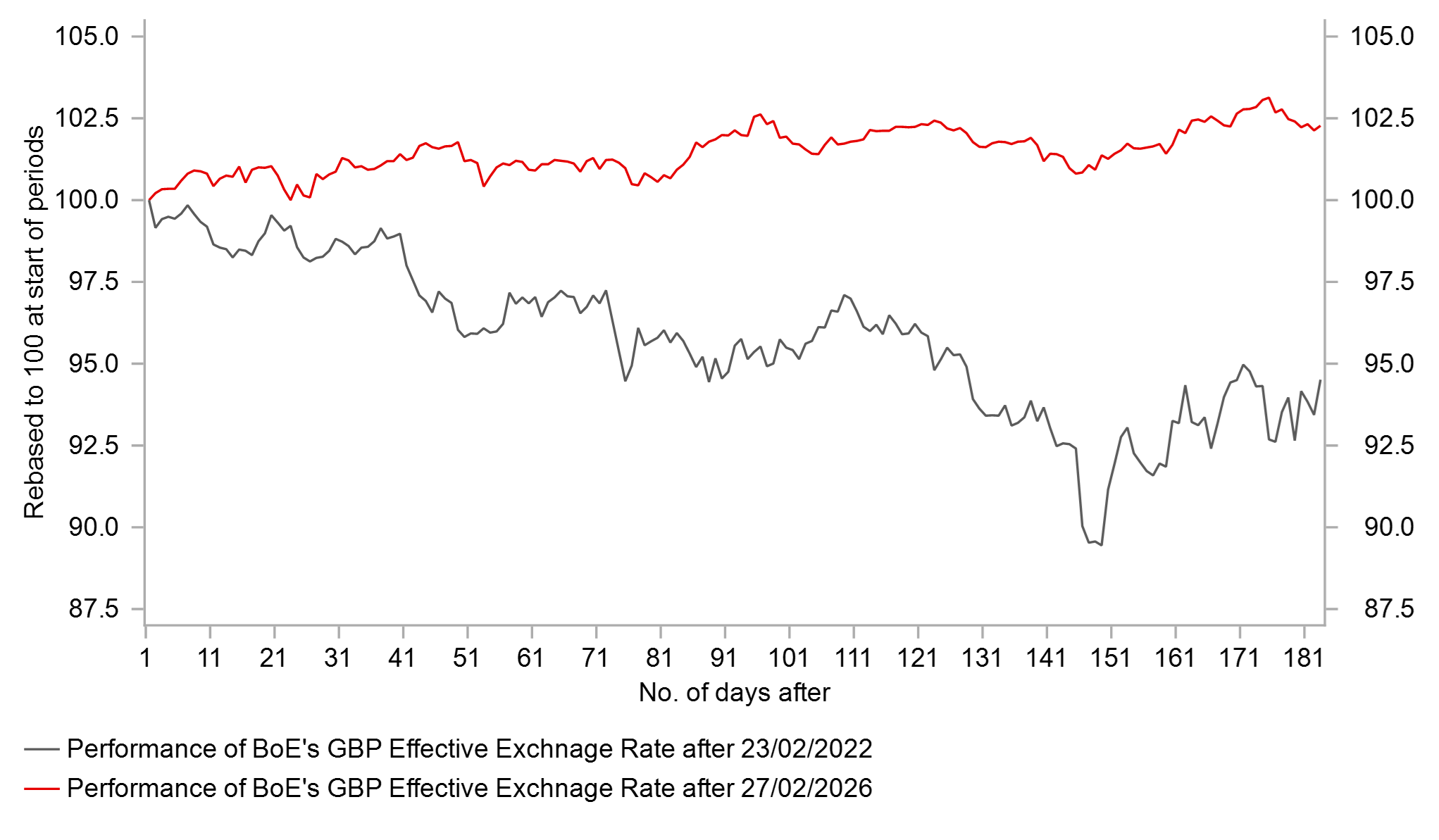
Performance of GBP vs. EUR during current energy price shock is almost mirror image of performance in 2022
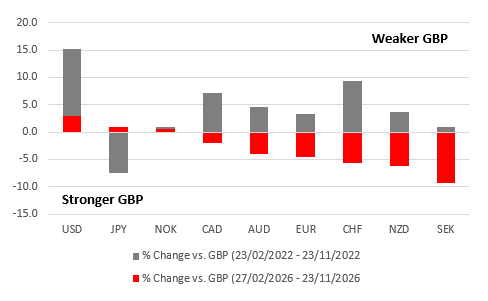
The GBP has proved surprisingly resilient to the latest global energy shock. Since the US-Iran conflict began in late February, it has been one of the best-performing G10 currencies. Only the USD, NOK and JPY have performed better. While the GBP has weakened by around 2.8% against the USD, it has strengthened sharply against the EUR (+4.7%), CHF (+6.0%) and SEK (+10.0%). EUR/GBP has consequently fallen from 0.8700-0.8800 at the start of the year to close to 0.8300, a level last seen in early 2025 before President Trump’s ‘Liberation Day’ tariff announcement. This resilience is striking when compared with the GBP’s performance during the 2022 energy shock. In the nine months following Russia’s full-scale invasion of Ukraine on 24th February, the GBP weakened by around 11.0% against the USD. Only the JPY (-17.6%) performed worse among G10 currencies. The GBP also underperformed both the CHF (-8.6%) and EUR (-3.2%), while EUR/GBP climbed from around 0.8200-0.8300 up to 0.8700-0.8800. Price action this year has therefore been almost a complete reversal of 2022. We had expected the GBP to underperform again during the latest energy shock, but that has not happened. In this report, we examine one of the main reasons behind sterling’s relative resilience and assess whether it can continue into next year.
GBP IS PROVING MORE RESILIENT TO ENERGY SHOCK
Source: Bloomberg, Macrobond & MUFG GMR
PERFORMANCE OF GBP DURING ENERGY SHOCKS
Source: Bloomberg, Macrobond & MUFG GMR
AI-related activity & stronger productivity supporting UK growth
UK economy has grown more strongly like the US despite headwind from energy price shock
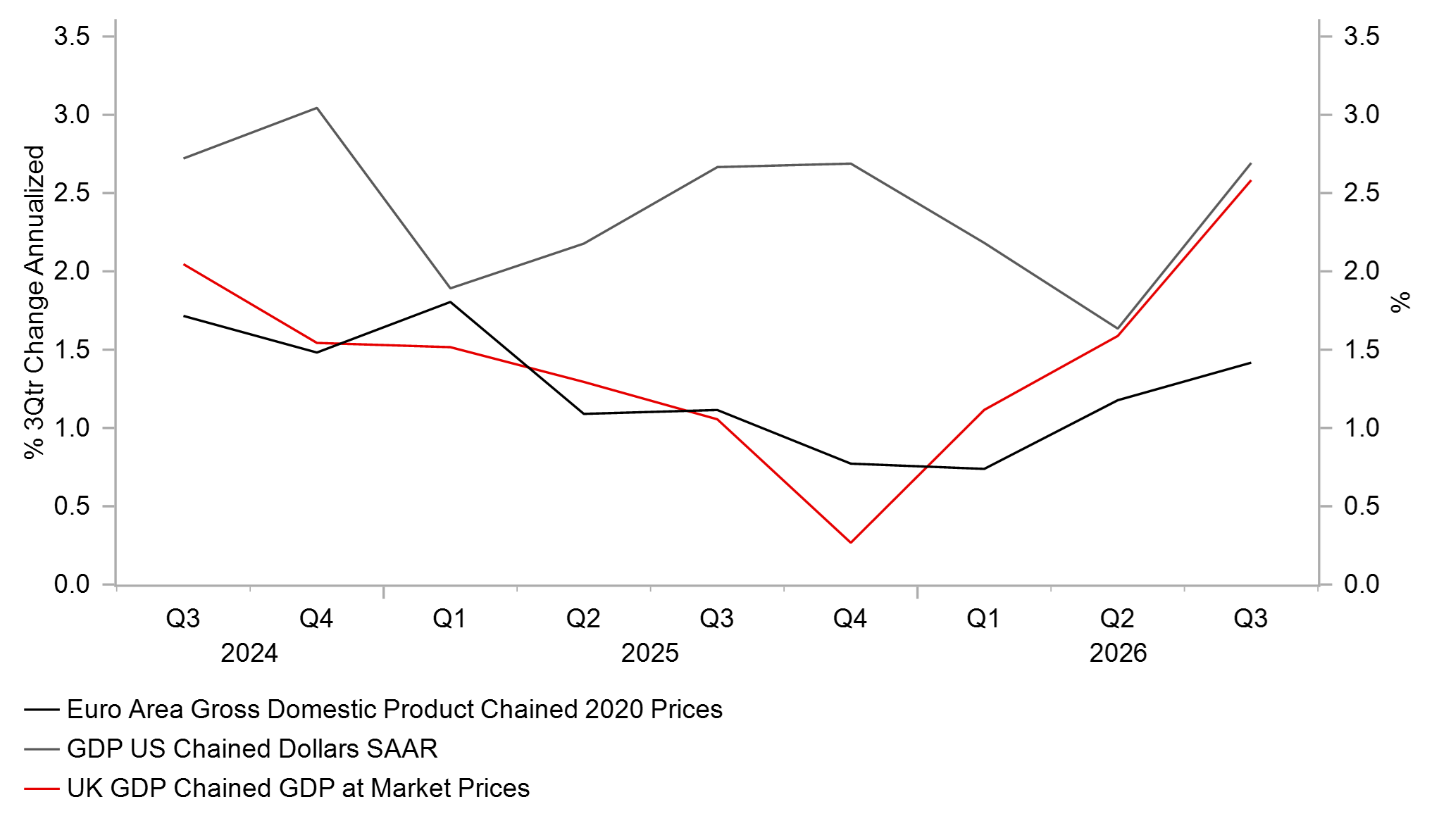
A key reason why the GBP has proved more resilient to the latest energy shock is that the UK economy has performed much better than it did in 2022. The UK entered 2022 growing robustly as the removal of COVID restrictions released pent-up demand. However, momentum subsequently faded rapidly as the energy shock intensified, with the weakness extending into 2023. This year has been markedly different. Despite the latest energy price shock, the UK economy has continued to grow more strongly than expected. GDP expanded at an annualised rate of 2.6% over the first three quarters. Even if growth stalls in Q4, the economy should still expand by at least 1.5% in 2026 as a whole. That would compare favourably with the Bloomberg consensus forecast of 1.1% at the start of the year and the low of just 0.6% reached in June. The UK's relative growth performance has also improved. Over the first three quarters, UK growth of 2.6% annualised was almost in line with the US at 2.7%, while significantly outpacing the euro area's 1.4%. The absence of a more significant negative growth shock helps explain why the GBP has performed very differently from 2022.
UK economy has benefitted from pick-up in AI-related demand
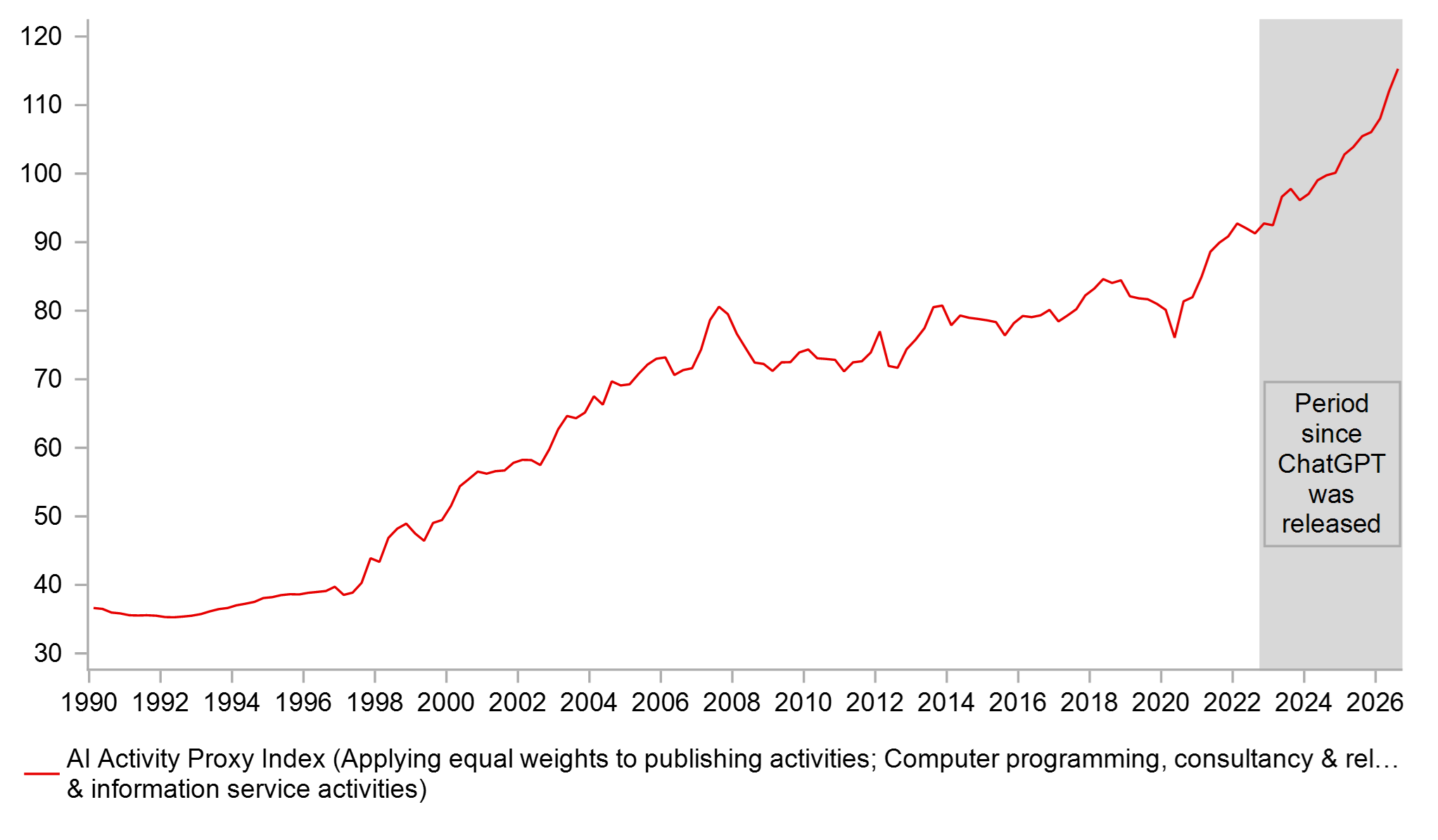
In its latest Monetary Policy Report from November, the BoE examined the UK economy’s surprisingly resilient performance in more detail. It attributed the strength to a combination of stronger global growth, increased domestic AI-related activity and potentially a faster-than-expected fading of the drag from previous monetary policy tightening. However, support from these factors is expected to weaken in the coming quarters as higher inflation, tighter financial conditions and ongoing fiscal consolidation weigh more heavily on domestic demand. The BoE highlighted that this year’s stronger growth has been driven primarily by the private sector, particularly services. One important tailwind has been the global AI build-out. Domestic AI-related activity has helped strengthen business-to-business services, which contributed around 0.4ppts to quarterly GDP growth in Q2 and 0.6ppts in Q3. To monitor the impact more closely, BoE staff have developed an AI proxy index combining output from computer programming and consultancy, information services, and publishing activities including the development of agents and application software. While not all activity in these sectors is AI-related, the ONS has noted that many of the businesses reporting the strongest turnover growth are involved in AI and cloud computing. The BoE’s proxy suggests that novel AI-related activity has accounted for just under a fifth of UK GDP growth since the start of 2026. Importantly, this contribution appears to reflect mainly the upstream development and implementation of AI technologies, rather than broader productivity gains from their adoption across the economy.
UK ECONOMY IS GROWING MORE STRONGLY LIKE US
Source: Bloomberg, Macrobond & MUFG GMR
AI-RELATED ACTIVITY IS PICKING UP
Source: Bloomberg, Macrobond & MUFG GMR
Revival in UK business investment after headwinds from Brexit & COVID uncertainty has eased. UK leading rest of pack in AI data centre build out but well behind the US.
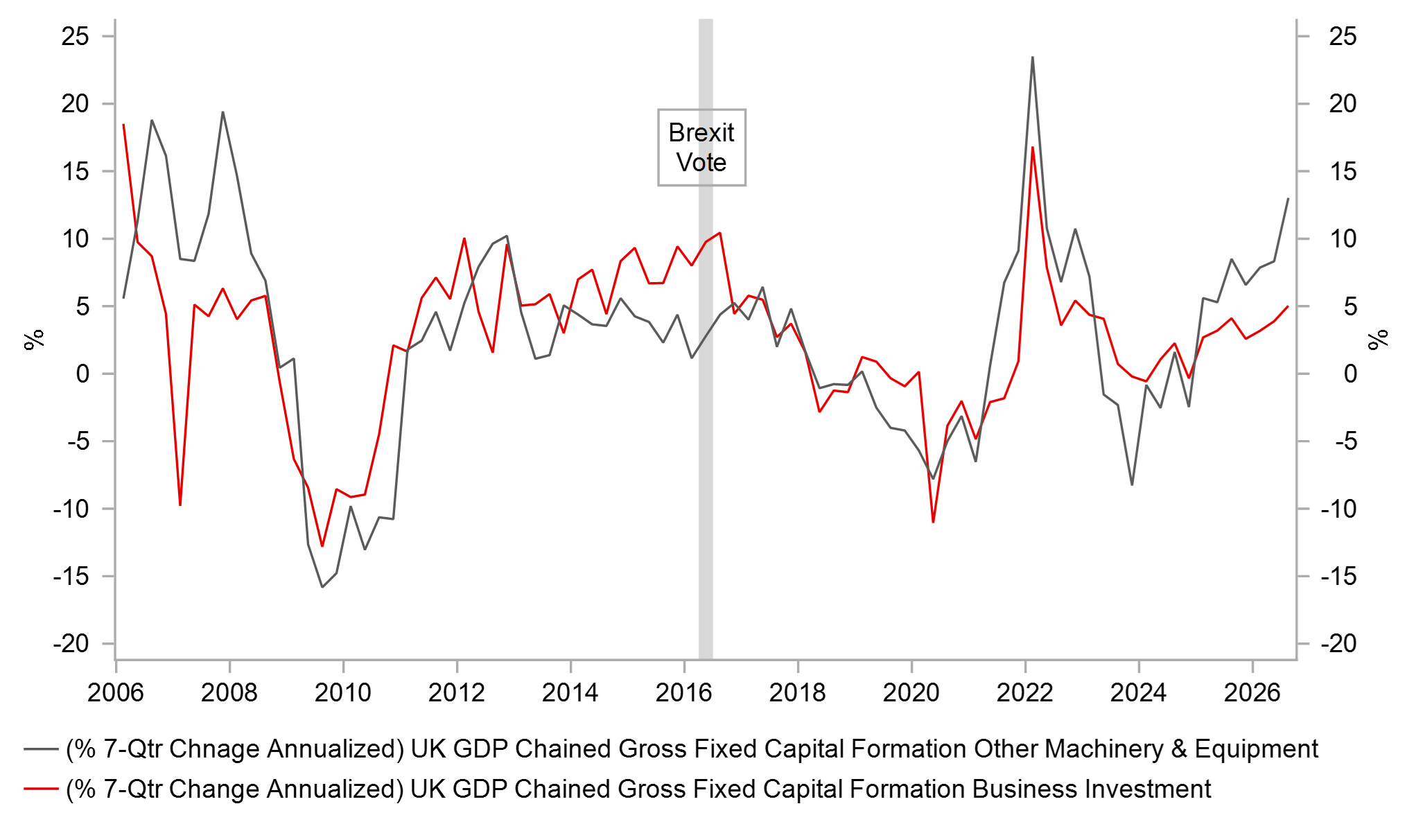
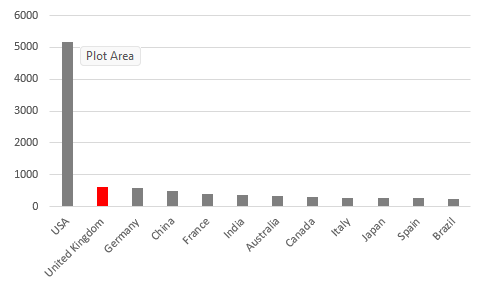
The improvement in the UK’s growth outlook is also becoming increasingly visible in business investment. After largely stagnating in the years following the Brexit vote, business investment has begun to recover more convincingly. Since the start of 2025, it has expanded at an annualised rate of 5.0%, accelerating to 7.1% this year and comfortably outpacing overall GDP growth. Excluding the exceptional volatility surrounding the COVID shock, this has been the strongest equivalent period for business investment since Q2 2017. While growth remains below the 8-10% rates typically recorded before the Brexit vote, the recent acceleration provides encouraging evidence that the UK economy may finally be moving beyond the prolonged period of weak investment and growth that followed Brexit. The AI investment boom appears to be an important part of this turnaround. Investment in information and communication expanded at an annualised rate of 18.0% over the six quarters to Q2 2026, while the UK has also experienced a fast build-out of data centres. Data Center Map currently lists 608 UK data centres, putting the UK second globally behind the US and ahead of Germany, China and France. This investment is feeding through to the broader capital stock. Since the start of 2025, gross fixed capital formation in other machinery and equipment has expanded at an annualised rate of 13.0%, while investment in other buildings and structures has increased by 6.5%. Together with the strength of AI-related services, the acceleration in capital spending provides further evidence that AI investment is delivering a meaningful boost to UK growth.
Productivity growth has been revised significantly higher adding to optimism over sustainability of stronger UK growth
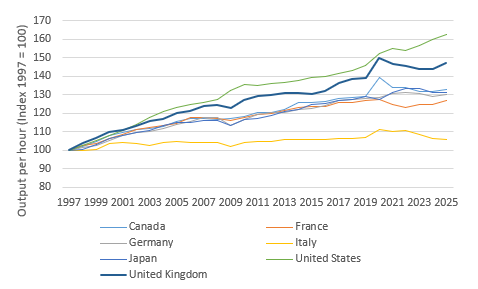
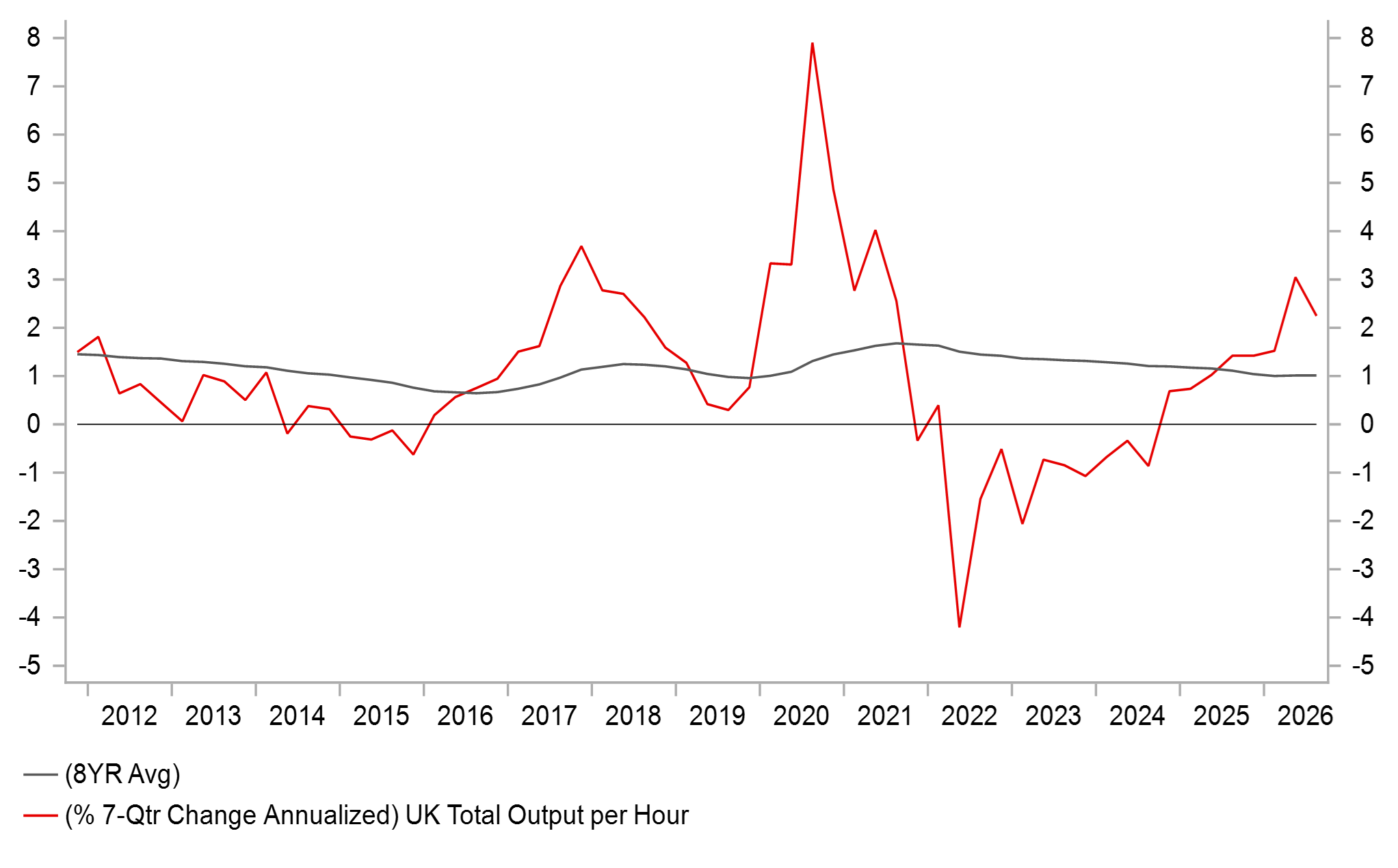
The improvement in the UK growth outlook is also being supported by a more encouraging productivity picture. This is potentially significant for the GBP because stronger productivity growth would allow the economy to sustain faster GDP growth without generating a corresponding increase in inflationary pressure. Recent ONS revisions suggest that the UK’s post-Global Financial Crisis productivity performance was not as weak as previously thought. Under its new “component approach”, output per hour worked is estimated to have increased at an average annual rate of close to 1.0% between 2009 and 2024, roughly double the 0.5% rate estimated using the previous methodology. The revised figures also suggest that UK productivity growth has been stronger than in many European peer economies, although it has continued to underperform the US. More encouragingly, productivity growth has accelerated further since the start of 2025 to an annualised rate of 2.3%. The BoE cautions that much of the recent acceleration probably reflects cyclical factors and is unlikely to be sustained. However, there is also tentative evidence that AI adoption is beginning to lift productivity, creating material upside risks to the longer-term outlook. The impact remains modest so far. Firms responding to the BoE’s DMP survey estimate that AI has increased productivity by around 0.5% over the past three years, implying a contribution of only around 0.1-0.2ppts to annual productivity growth since early 2024. Nevertheless, the BoE sees scope for this contribution to increase as AI adoption broadens across the economy.
BREXIT & COVID UNCERTAINTY IS EASING
Source: Bloomberg, Macrobond & MUFG GMR
Higher productivity to help dampen need for more aggressive BoE hikes but could also indicate rising neutral policy rate
A sustained improvement in productivity growth would have important, but potentially offsetting, implications for the BoE policy outlook. The BoE currently assumes underlying trend productivity growth of around 1.0% and expects the stronger recent readings to fade. If they prove more durable, the economy could sustain faster wage and GDP growth without generating as much inflationary pressure. With trend productivity growth of 1.0% and the inflation target at 2.0%, sustainable nominal wage growth would be roughly 3.0%. A higher productivity trend would raise that threshold and reduce the risk that the latest energy shock generates persistent second-round wage pressures. Recent labour-market data are also reassuring, with labour demand remaining weak despite stronger GDP growth. This gives us greater confidence that second-round inflation effects will remain contained in 2027 and could challenge current market pricing for three to four further BoE hikes over the year ahead. However, stronger productivity growth is not unambiguously dovish for rates. If it reflects a lasting improvement in the UK’s potential growth rate, it could also push up the neutral policy rate. The BoE described policy as restrictive after raising Bank Rate to 4.00% earlier this month, consistent with our estimate of a neutral rate of around 3.50%. A sustained rise in trend productivity above 1.0% could therefore justify a higher neutral rate even as it helps dampen inflation risks.
2ND STRONGEST PRODUCTIVITY AMONGST G7 AFTER US
Source: Bloomberg, ONS & MUFG GMR
WILL STRONGER PRODUCTIVITY BE SUSTAINED?
Source: Bloomberg, Macrobond & MUFG GMR
FX Implications:
GBP could remain stronger for longer against EUR if stronger UK growth is sustained
If the recent improvement in AI-related activity and productivity proves more persistent than widely expected, it would reinforce our view that the UK economy is becoming more resilient and provide a further tailwind for the GBP in 2027. In particular, EUR/GBP could remain at lower levels for longer than assumed in our current forecasts (click here). The GBP is also benefiting from the UK's relatively high yields, which continue to make the GBP one of the most high-yielding currencies in G10.
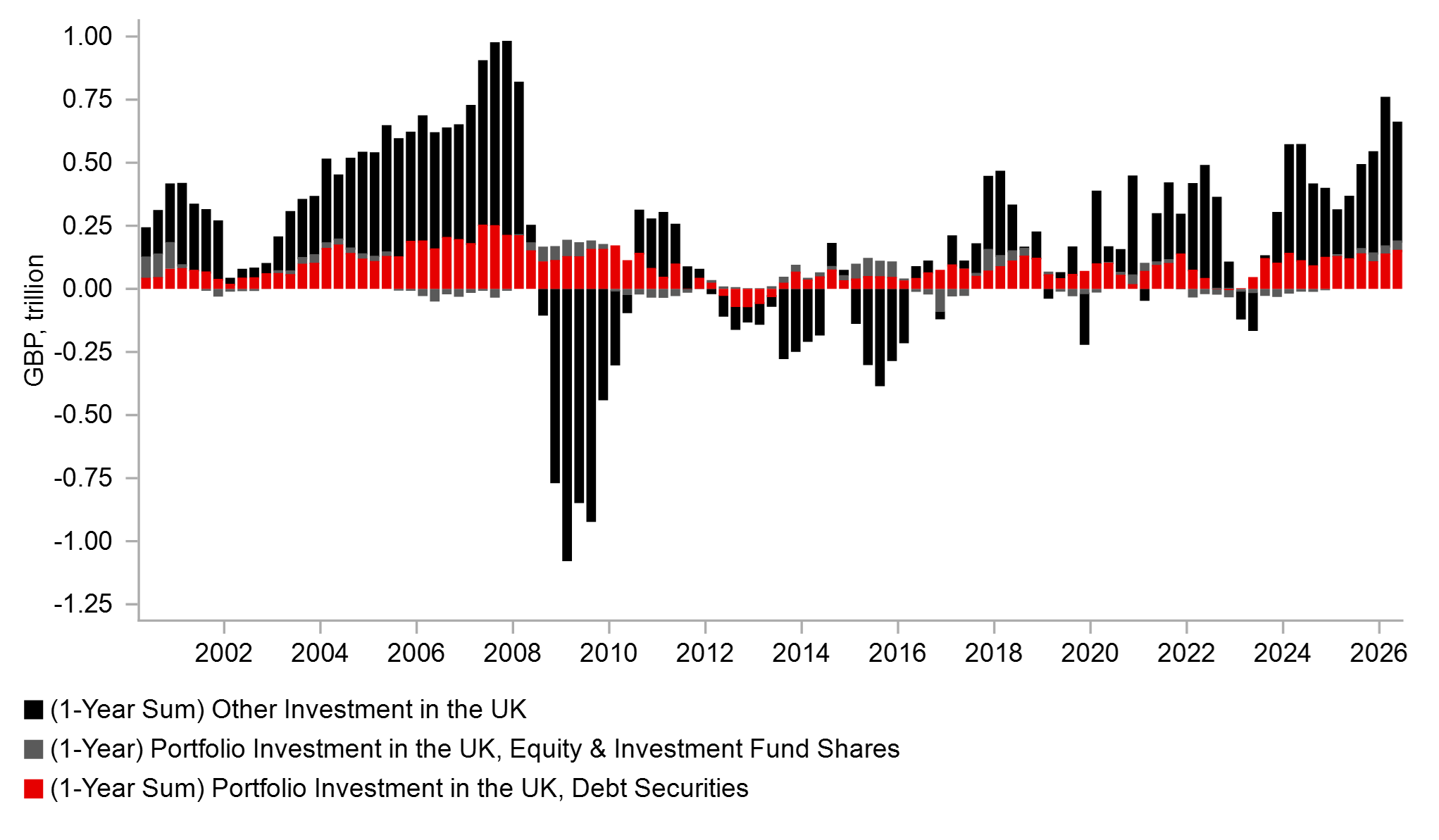
GBP supported by pick-up in capital inflows covering portfolio investment, FDI & other investment.
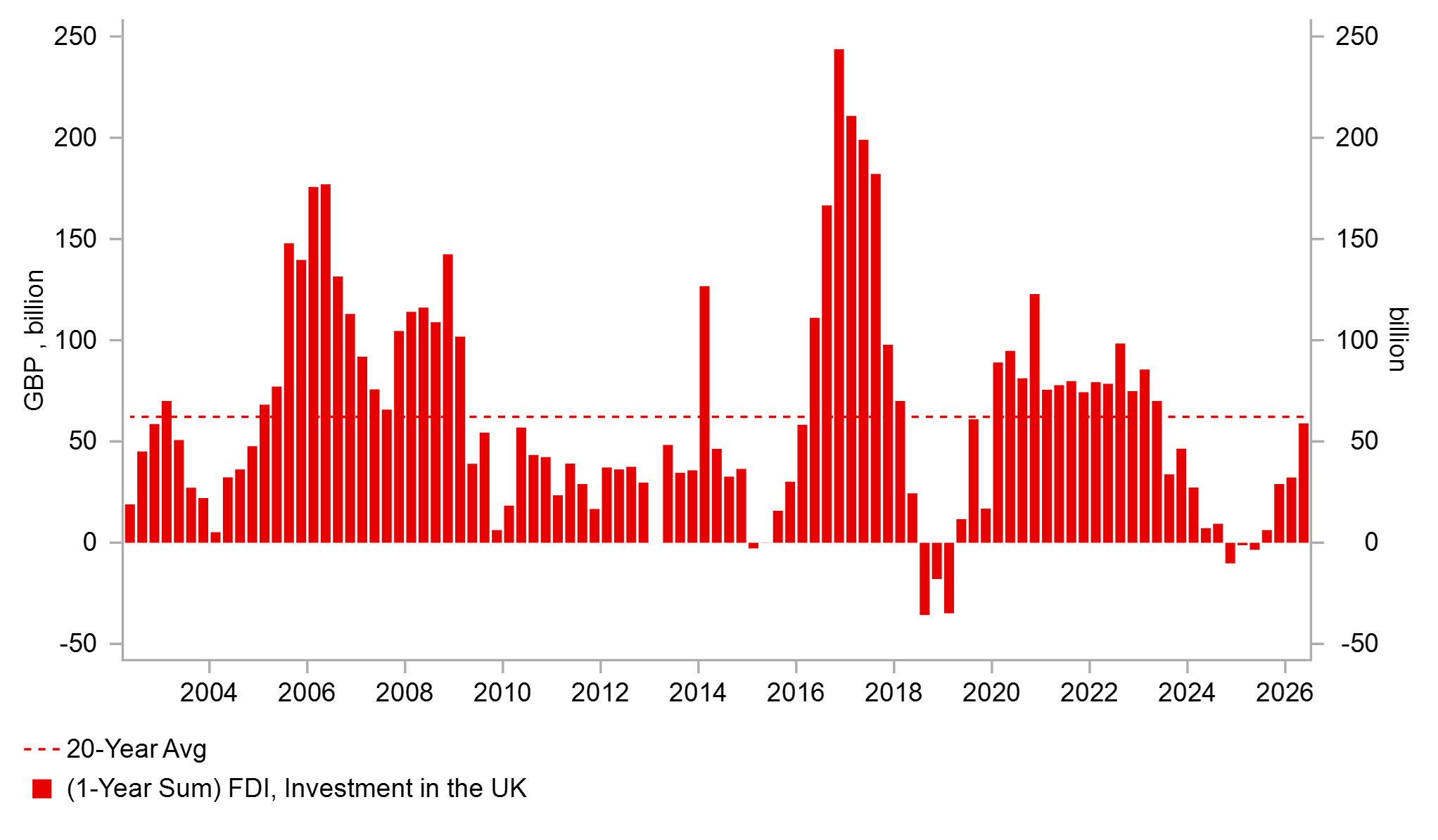
The combination of stronger UK growth and relatively high yields appears to be attracting more foreign capital, providing an additional source of support for the GBP. Portfolio investment inflows into UK debt securities increased to GBP154.8bn in the year to Q2 2026, up from GBP121.7bn over the previous 12 months. Foreign demand for UK equities has picked up as well, albeit from much lower levels. The improvement has been even more striking in other investment, where inflows increased to GBP471bn in the year to Q2 2026 from GBP247bn over the previous 12 months. Combined portfolio and other investment inflows have consequently climbed to their highest level since the Global Financial Crisis. Encouragingly, the recovery in foreign capital inflows is broad-based. Foreign direct investment inflows have risen to GBP59bn over the past year, moving closer to their average over the last 20 years.
PORTFOLIO & OTHER INVESTMENT FLOWS INTO UK
Source: Bloomberg, Macrobond & MUFG GMR
FDI INFLOWS INTO UK HAVE PICKED UP
Source: Bloomberg, Macrobond & MUFG GMR
Downside risks for GBP would increase if global equity market sell-off intensified threatening financial stability
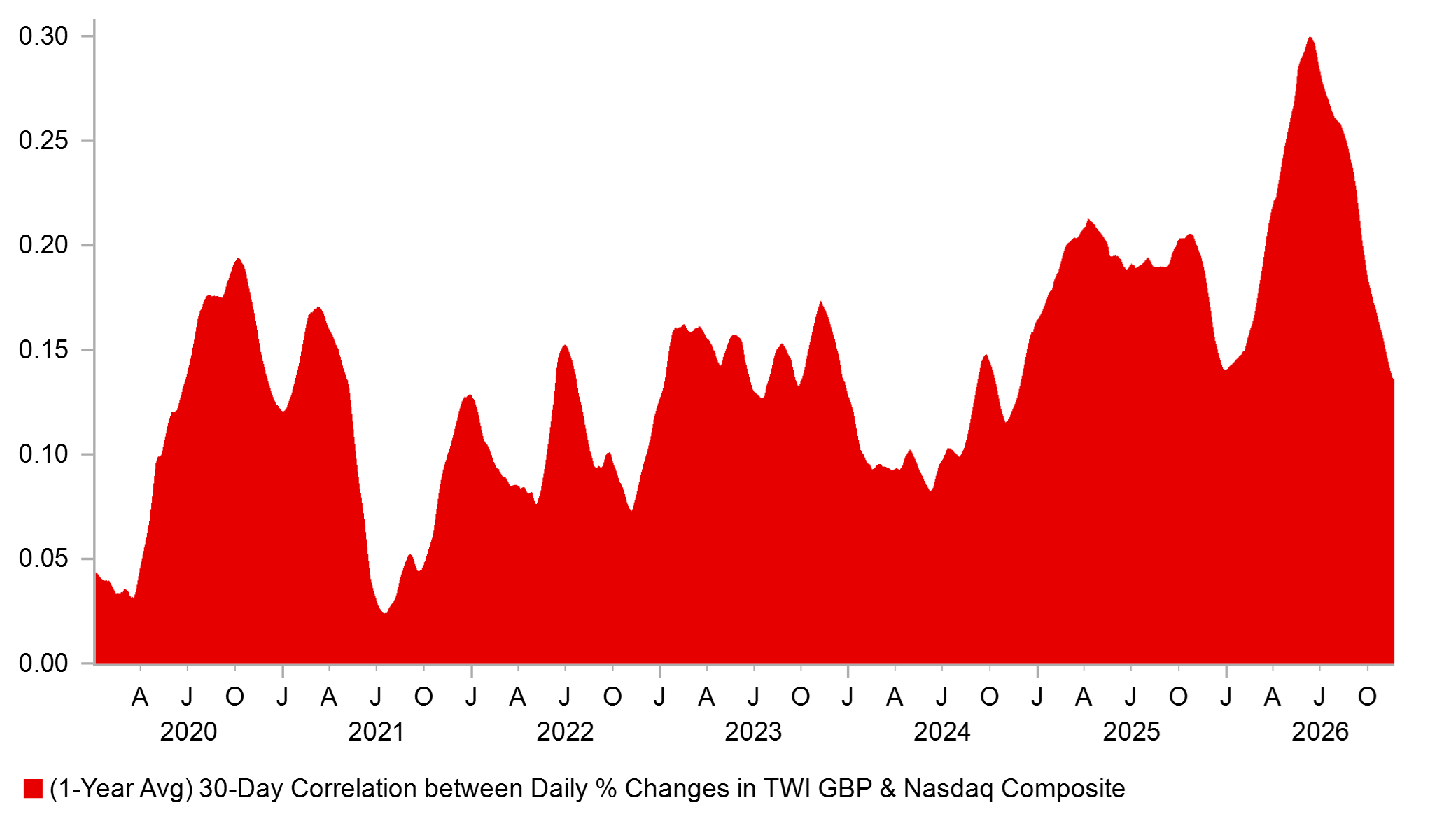
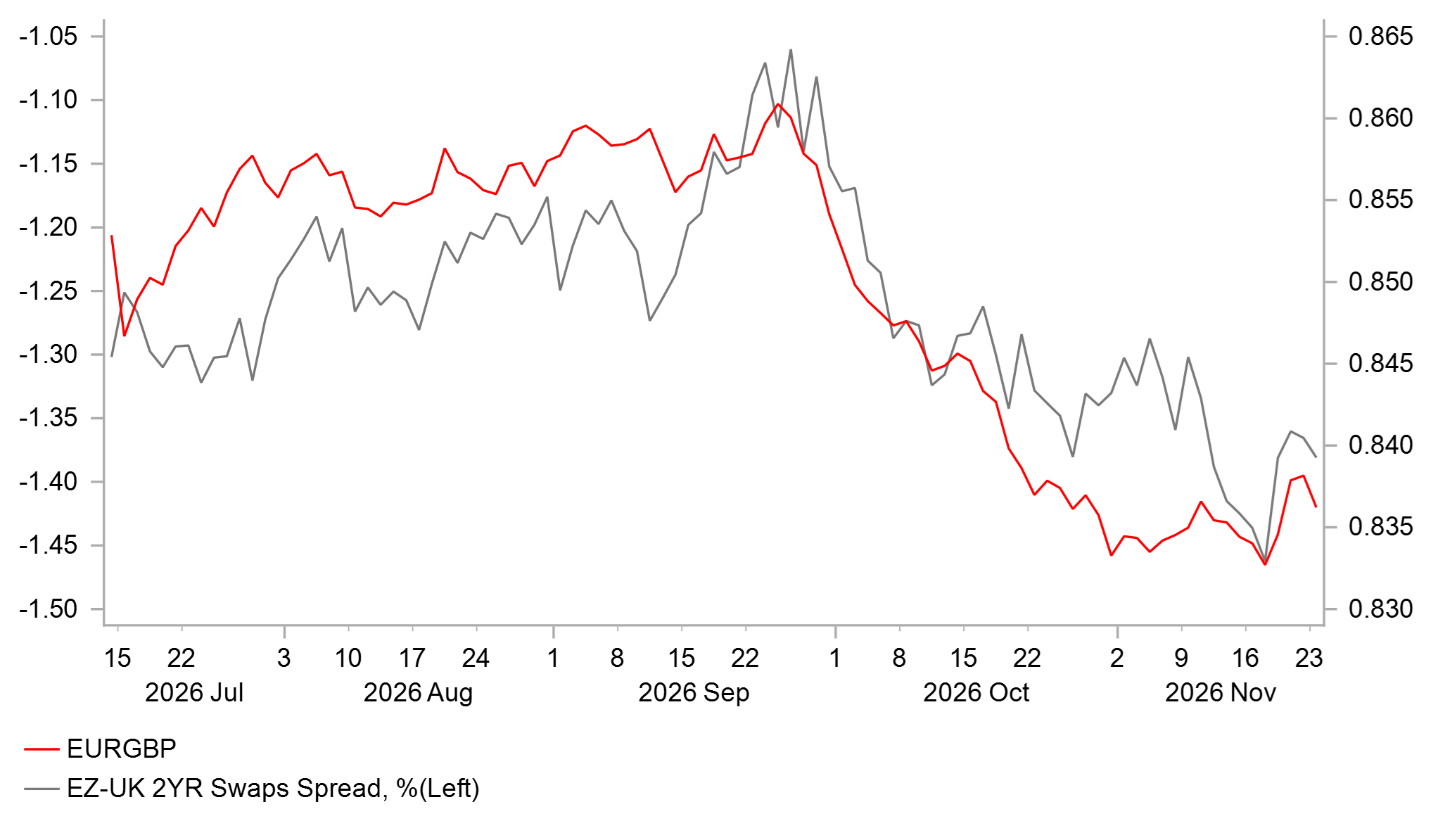
The recent sell-off in AI-related investments has again tested the GBP’s resilience this year but has yet to materially undermine it. Since US tech stocks peaked on 6th October, the GBP has weakened by around 1.8% against the USD while gaining around 1.2% against the EUR. However, there is a risk that the GBP could suffer a sharper sell-off if global equity markets undergo a deeper correction that threatens financial market stability. Higher-yielding currencies such as the GBP could be hit by the forced liquidation of carry trades. At the same time, UK yields would likely move lower as the market priced in a reduced likelihood of the BoE delivering the three to four rate hikes currently discounted into the UK curve.
STRONGER CORRELATION BETWEEN GBP & AI STOCKS
Source: Bloomberg, Macrobond & MUFG GMR
BOE RATE HIKE EXPECTATIONS LIFT GBP
Source: Bloomberg, Macrobond & MUFG GMR