

USD stages modest rebound ahead of NFP report
USD: FT report on Fed Chair Warsh’s thinking provides support ahead of NFP
The US dollar has staged a modest rebound ahead of the release today of the latest nonfarm payrolls report for July. It has helped to lift USD/JPY back above resistance from the 200-day moving average at around 158.00. The US dollar has derived support from a pick-up in US yields. The 2-year US Treasury yield has increased by around 7bps from yesterday’s low triggered in part by a report in the FT stating that Fed Chair Kevin Warsh “would be prepared to raise interest rates at September’s meeting if inflation readings released in coming weeks are hot, and markets ratchet up their expectations for increases in borrowing costs” according to people familiar with his thinking. At the same time, the report added that people close to Warsh said he acknowledged that he had made mistakes in his first 10 weeks as Fed Chair, including failing to reinforce his key messages on price stability and sowing confusions over whether his longer-term plans to reform the Fed could affect near-term policy decisions. The report suggests some unease from Fed Chair Kevin Warsh over the initial market reaction to the July FOMC meeting which triggered a sharp steeping of the US yield curve as market participants scaled back expectations for rate hikes and priced in a larger term premium into the long end of the curve. The FT report could be viewed as a form of pushback against those initial moves and an attempt to help anchor the long end of the US yield curve after the 30-year yield hit a high at the end last month at 5.28%.
It also follows closely on the heels of the US Treasury’s decision to intervene alongside Japan by selling euros rather US dollars alongside the indication that Japan can use the Fed’s FIMA repo facility to avoid selling US Treasuries to fund future yen buying. The joint intervention and potential use of the Fed’s FIMA facility by Japan also indicate that US policymakers are concerned about US Treasury market instability risks and upward pressure for US yields. The weekly balance sheet data released by the Fed overnight revealed that the FIMA repo facility was unused last week suggesting that Japan did not use the tool in its latest bout of intervention. US dollar funding is available through the facility overnight at the top of the Fed’s target range for the Fed fuds rate at 3.75% or for one week at the OIS rate plus 25 basis points. It has raised doubts over why Japan would incur the cost of using the facility rather than selling US Treasuries.
The FT report has not significantly altered market expectations for a September Fed hike which is currently priced at around 14bps compared to fully priced prior to the July FOMC meeting. The probability of a hike in September will depend heavily upon incoming economic data including today’s nonfarm payrolls report for July and next week’s US CPI report for July, ii) ongoing developments in the Middle East, and iii) price action in the US Treasury market. If the long end of the US Treasury market becomes unanchored with yields marching higher ahead of the September FOMC meeting it would increase pressure on the Fed to hike rates to reinforce their inflation fighting credibility. In that regard yesterday’s FT report may have been intended to dampen those risks by reiterating the importance of the price stability part of the Fed’s mandate. The focus today will shift to the latest nonfarm payrolls to see if the US dollar can build on yesterday’s gains. Market participants are expecting a second consecutive month of softer employment growth after the ADP survey estimated earlier this week that private payrolls increased by 44k. For comparison, nonfarm private payroll growth averaged 88k/month in the first half of this year up from -7k/month in the second half of last year. The improvement has contributed to the Fed placing more focus on the inflation side of their mandate. The Fed is unlikely to be concerned by inflation risks from the labour market. The combination of stronger productivity growth and slowing wage growth has resulted in unit labour costs increasing by just 1.4% over the past year to Q2.
Finally, the US dollar has derived some support overnight from higher energy prices. The price of Brent has risen back above USD84/barrel after hitting a low yesterday at around USD79/barrel. The price of oil has been supported by fresh reports of Iran attacking “hostile targets” in the Strait of Hormuz near Qeshm Island. At the same time, local media reports have suggested that Iran will seek to bar US and Israeli ships from the Strait and require compensation from hostile countries before they’re allowed to sail through it as part of the proposed Iran-Oman deal to manage the waterway. Still, President Trump expressed optimism overnight that the war will end “pretty soon” and said things are “moving along good” on a potential deal to re-open the Strait.
SLOWING UNIT LABOUR COST GROWTH IS REASSURING FOR FED
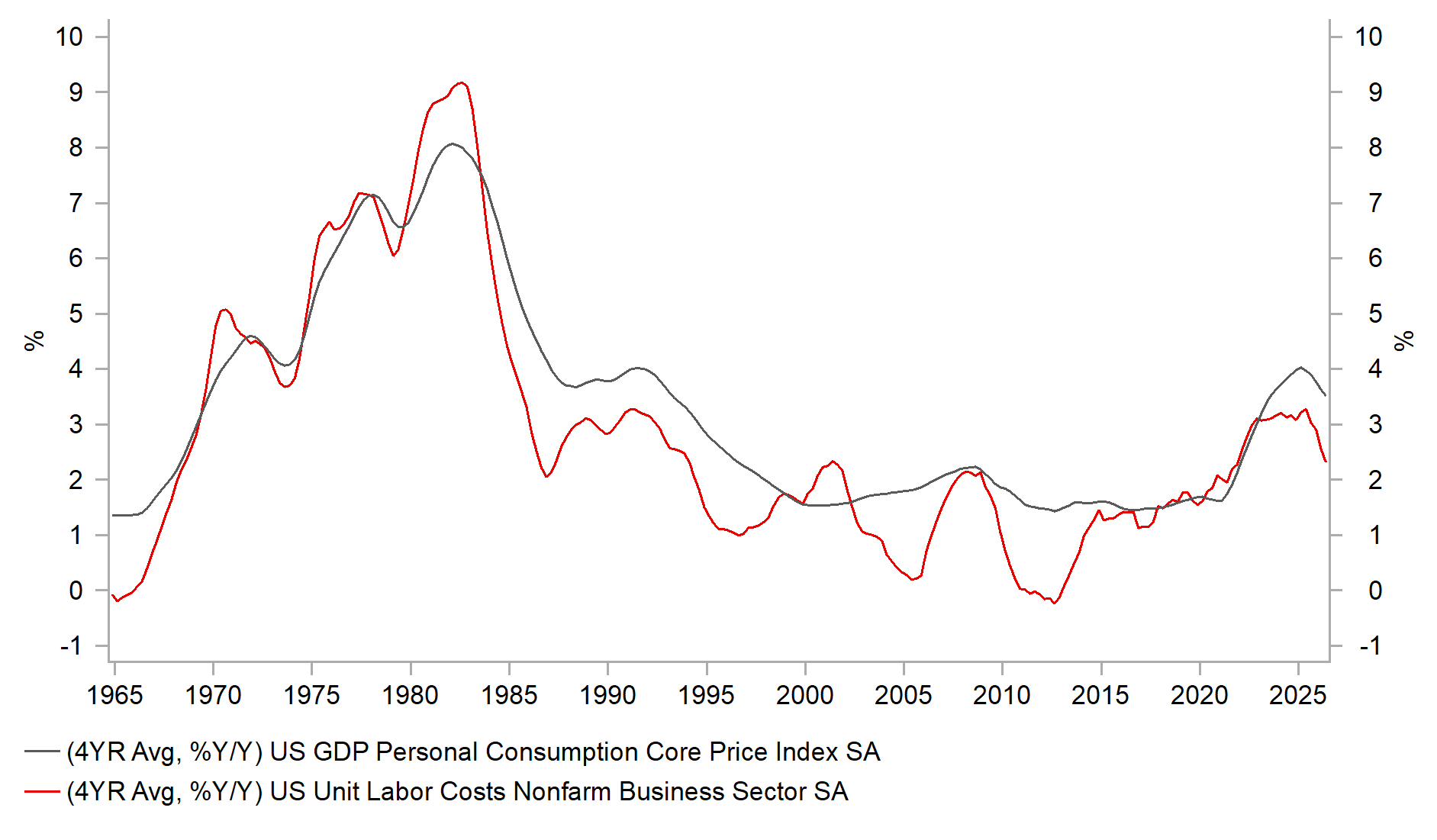
Source: MUFG Research, MUFG Research, Financial Futures Association of Japan
KEY RELEASES AND EVENTS
Country | BST | Indicator/Event | Period | Consensus | Previous | Mkt Moving |
US | 13:30 | Nonfarm Payrolls | (Jul) | 88K | 57K | !!! |
US | 13:30 | Unemployment Rate | (Jul) | 4.2% | 4.2% | !!! |
CA | 13:30 | Unemployment Rate | (Jul) | 6.5% | 6.5% | !! |
CA | 13:30 | Employment Change | (Jul) | 15.0K | 18.2K | !! |
Source: Bloomberg & Investing.com