

Joint intervention threat acting as deterrent to yen selling
JPY: Threat of further joint intervention is helping to curtail yen selling
The yen has weakened modestly during the Asian trading session resulting in USD/JPY rising back up to within touching distance of the 200-day moving average at around 158.00 after hitting a low yesterday at 157.18. The yen has strengthened sharply since late last week on the back of joint intervention by Japan and the US. It has been estimated that Japan likely purchased around USD 34 billion of yen on Friday on top of around USD 53 billion on Thursday. It would be a record amount of intervention by Japan if confirmed at the end of this month. In comparison, it has been reported that the US may have purchased between USD 5-10 of yen on Friday according to a picture of US Treasury Secretary Scott Bessent’s notepad although that estimate is much more speculative. Looking back at previous periods of US intervention, the actual amount could have been even smaller for example in March 2011 the US sold only USD1 billion of yen alongside Japan and other G7 countries. The importance of US taking part is more symbolic with the scale of yen purchases likely to remain much smaller than those undertaken by Japan with the aim more to send a stronger deterrent to speculative yen sellers.
At the same time, the announcement that Japan plans to use the Fed’s FIMA repo facility to acquire US dollars without having to sell down more of its holdings of US securities has helped to ease selling pressure in the Treasury market as well. Even the threat of further joint intervention could also help to reduce the need for further intervention and thereby need for further sales of US securities. However, the credibility of the threat is likely to be questioned by market participants given doubts over how much the US is willing and able to intervene to support the yen. The Treasury’s Exchange Stabilization Fund (ESF) held USD13.131 billion of euros at the Q1, and even if the Fed jointly funded intervention through the System Open Market Account (SOMA) that would add only a further USD13.131 billion of euros that are available for sale to purchase yen. The US decision to sell euros for yen suggests that they are reluctant to sell US dollars. The latest balance sheet data for the ESF revealed that it held USD24.452 billion of nonmarketable US Treasury securities at the June. It has been suggested that to open up more capacity to intervene the US could consider utilizing their holdings of Special Drawing Rights (SDR) which totalled USD172.06 billion at the end of June.
On balance, we expect US intervention to support the yen to remain relatively small in scale. While joint intervention may prove more effective at helping to provide support for the yen in the near-term, we still believe that it can only buy time. There will need to be a change in fundamentals as well to encourage a sustainable reversal of the yen weakening trend that has been in place over the last five years. More US pressure on Japan to allow a faster pace of BoJ policy normalization as part of the joint intervention arrangement would an important step to help reverse yen weakness. The Japanese rate market has moved to price in a higher probability of a September hike which is currently priced at closer to 50:50.
JPY PERFORMANCE DURING US-IRAN CONFLICT
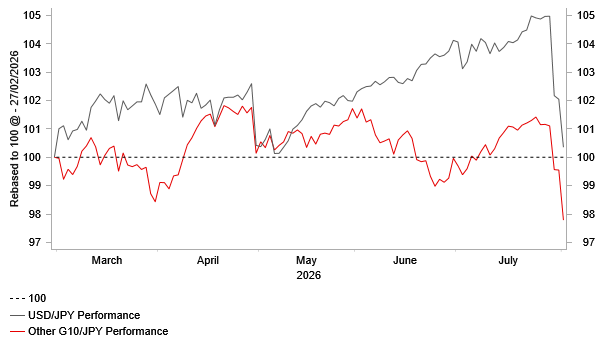
Source: Bloomberg, Macrobond & MUFG Research
USD: Fallout from FOMC meeting continues to curtail near-term strength
The US dollar has come under more selling pressure since last week’s FOMC meeting with the dollar index back below the 100.00-level after hitting a high at 101.64 last week. The US dollar was initially undermined by the Fed’s decision to leave rates on hold and the less hawkish than expected guidance from Fed Chair Kevin Warsh which has cast doubts on market expectations for multiple Fed rate hikes from as soon as the next FOMC meeting in September. There are now 16bps of hikes priced in for September compared to around 25bps a week ago. Fed Chair Warsh has also been criticized for not sending a stronger signal that higher rates will be needed to dampen upside inflation risks. The sharp steepening of the US yield curve since last week’s FOMC meeting has fuelled concerns over the Fed’s inflation fighting credibility although one should never over-react to the immediate market fall out. New York Fed President John Williams told Reuters yesterday that he is optimistic that “inflation will come down in the second half of this year and come down further next year”. He believes that the Fed’s policy stance is currently “well positioned” and strongly supported the decision to leave rates on hold last month.
Our latest forecasts (click here) for a gradual re-weakening of the US dollar later this year are built on the assumption that the Fed does not hike rates this year. We acknowledge that the US dollar could remain stronger for longer if the Fed pulls the trigger. The lack of clear forward guidance from Fed Chair Kevin Warsh is making it more difficult assess how the Fed is likely to react which could contribute to more volatility in financial markets. It has been reported that Kevin Warsh has raised the probability of changing the frequency of FOMC meetings according to people familiar with the matter. One idea floated is for the Fed to meet six times a year to decide on monetary policy settings, and twice a year for discussion of a substantive economic topic. The FOMC currently meets eight times a year to monetary policy.
KEY RELEASES AND EVENTS
Country | BST | Indicator/Event | Period | Consensus | Previous | Mkt Moving |
US | 13:30 | Trade Balance | (Jun) | -73.00B | -77.60B | !! |
CA | 13:30 | Trade Balance | (Jun) | 3.00B | 4.24B | !! |
US | 15:00 | JOLTS Job Openings | (Jun) | 7.420M | 7.594M | !!! |
US | 15:00 | Factory Orders (MoM) | (Jun) | 0.0% | -1.3% | !! |
US | 15:00 | Durables Excluding Transport (MoM) | (Jun) | - | 0.6% | ! |
US | 15:00 | IBD/TIPP Economic Optimism | (Aug) | 47.5 | 45.5 | ! |
US | 16:30 | Atlanta Fed GDPNow | (Q3) | - | - | !! |
NZ | 23:45 | Employment Change (QoQ) | (Q2) | 0.1% | 0.2% | ! |
Source: Bloomberg & Investing.com