

Hawkish BoJ update provides support for JPY
JPY: BoJ strikes a hawkish tone teeing up a December hike
The yen has been volatile overnight with USD/JPY hitting a low of 157.12 after the BoJ’s policy decision, but it has since quickly given back those gains rising up to 157.70. At today’s policy meeting the BoJ decided to leave the policy rate at 1.25% with only one dissenter. Hajime Takata voted in favour of a hike considering that that with underlying inflation having reached the price stability target, the situation had shifted to a new phase in which the Bank needs to step up the pace of policy tightening to bring the policy rate closer to the neutral rate. The main surprise in the policy statement was that the BoJ unanimously decided to sped p the pace of ETF sales. The annual pace of equity ETF sales will increase from JPY330 billion to JPY860 billion on a book-value basis from January 2027. As a share of total stock market trading value the sales will increase from 0.05% to 0.1% while the estimated period required to complete the sales of all ETF holdings will shorten from around 112 years to 43 years. It remains unclear why there was a need to suddenly increase the pace of selling.
At today’s policy meeting, the BoJ also acknowledged officially for the first time that underlying inflation is now at a level that is generally consistent with the price stability target of 2% and is expected to remain at around that level. The BoJ presented four categories of indicators related to measuring underlying inflation with each category indicating that underlying inflation had reached their 2% target. A view backed up by the BoJ’s updated economic forecasts. The median projections for core inflation (less fresh food and energy) were revised modestly higher to 2.7% for FY2027and 2.3% for FY2028. Furthermore, the BoJ believes that risks are skewed to the upside for prices while the risks to growth are judged as generally balanced. The BoJ also highlighted the risk that medium- to long-term inflation expectations could rise and underlying inflation could deviate upward to a level above the price stability target of 2%, given that firms’ behaviour has been shifting more toward raising wages and prices and there are various factors that could drive up prices.
The BoJ’s increased policy focus on the risk of an inflation overshoot was one reason why the BoJ decided to speed up the pace of rate hikes at the last policy meeting in September when they signalled that policy had entered a new phase. We expect the faster pace of tightening to continue with the BoJ delivering another quarterly hike in December. In the press conference, Governor Ueda was more explicit stating that they will keep mulling the need for a rate hike at each meeting including the next. Her emphasized that it was undesirable for the new price trend to rise clearly and will respond to upside risks appropriately. He added there is still work left to do as the policy rate remains below neutral. Overall, the BoJ’s updated policy communication struck a hawkish tone. The relatively muted market response with USD/JPY largely unchanged on the day is more a reflection that it is already well priced in. There are 20bps of hikes priced in for December.
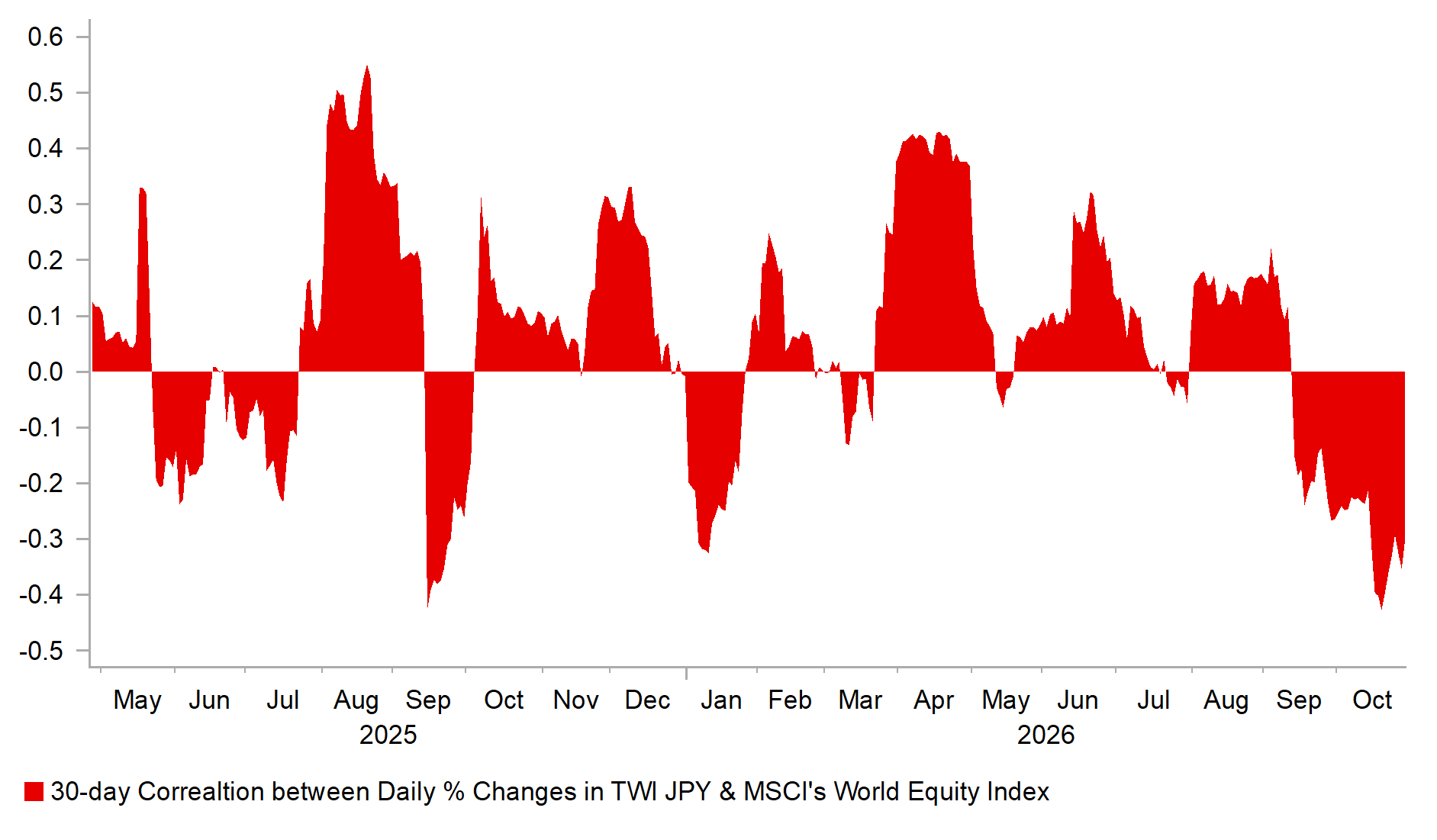
NEGATIVE CORRELATION BETWEEN JPY & EQUITIES HAS STRENGTHENED
Source: MUFG Research, Macrobond, Bloomberg
USD: AI angst persists as ECB holds off hiking
We have written a reaction piece (here) to the ECB monetary policy announcement and press conference and it looks to us like the ECB could well have hiked were it not for the tightening of financial conditions that ECB President Lagarde acknowledged. A discussion to hike did take place and were it not for financial conditions (and perhaps the lack of pricing for a hike) the ECB could well have been persuaded to act. Tighter financial conditions were also acknowledged by Fed Chair Warsh on Wednesday and given the description of the US economy and inflation by the Fed, those tightening financial conditions may well have played a role in the Fed keeping rates on hold. The ECB and the Fed are priced at about 80% to hike in December so it will be interesting to see how these expectations evolve if financial conditions tighten further. The equity market channel rather than the rates channel is where the dangers appear to lie now with another bad day for AI yesterday. Alphabet close down 12.6% yesterday, the worst market cap vale decline on record. Weaker advertising revenues, impacted by AI, was the driver of the drop.
AI seems to be driving everything, including the US economy. UST bond yields declined yesterday despite another very strong GDP report. Q3 GDP expanded by 3.4% Q/Q SAAR after a 2.2% gain in Q2 and stronger than expected. The personal consumption gain of 3.8%, the same pace as in Q2 underlining the sustained period of strong consumption. We see this as AI-related with the likelihood that unrealised in equity holdings are helping drive consumption amongst wealthier households. The driver is certainly not income with real after-tax income growing at just 1.0% YoY – growth this year has been weak. The 6mth average for YoY real after-tax income is at the weakest since 2014 (1.1%). AI was also evident in the fixed investment data.
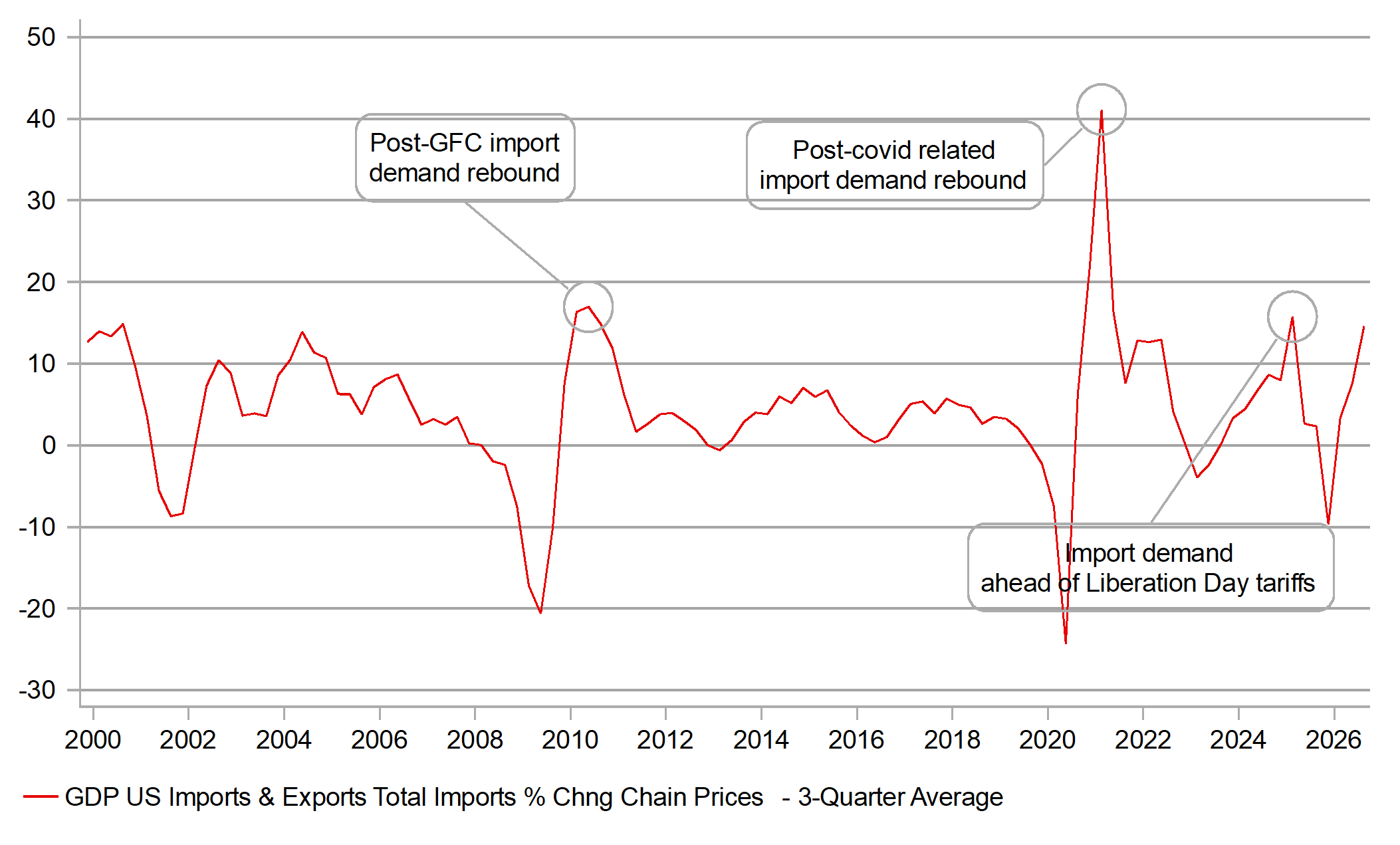
The negative aspect for the economy from AI is the surging trade deficit. In Q3 net exports shaved 3.3ppts off total GDP growth as goods imports surged 26.4% after a 15.3% gain in Q2 and 17.2% gain in Q1. The US trade deficit is expanding rapidly. Separate trade data shows the US trade deficit with South Korea, Taiwan and Mexico surging due to demand for AI/tech-related products.
But if we continue to see signs of increased volatility in equities due to growing doubts over AI valuations it may well weigh on US dollar performance. The US is at the heart of the AI phenomenon, and the strength of the economy is highly dependent on it. This leaves the dollar vulnerable to a turn in AI momentum. US dollar strength this month is very much a euro story with the dollar weaker versus all other G10 currencies.
UNPRECEDENTED IMPORT DEMAND OVER LAST THREE QUARTERS AS AI/TECH DEMAND SURGE CONTINUES
Source: Bloomberg, Macrobond, MUFG Research
KEY RELEASES AND EVENTS
Country | GMT | Indicator/Event | Period | Consensus | Previous | Mkt Moving |
DE | 08:55 | German Unemployment Rate | (Oct) | 6.4% | 6.4% | !! |
DE | 09:00 | German GDP (QoQ) | (Q3) | 0.1% | 0.3% | !!! |
EU | 10:00 | GDP (QoQ) | (Q3) | 0.2% | 0.6% | !! |
EU | 10:00 | Unemployment Rate | (Sep) | 6.4% | 6.4% | !! |
US | 12:30 | Employment Cost Index (QoQ) | (Q3) | 0.8% | 0.9% | !! |
CA | 12:30 | GDP (MoM) | (Aug) | 0.0% | 0.0% | !! |
DE | 13:00 | German CPI (YoY) | (Oct) | 3.0% | 3.3% | !! |
US | 16:00 | FOMC Member Daly Speaks | - | - | - | !! |
EU | 16:10 | ECB's Lane Speaks | - | - | - | !! |
US | 22:30 | Dallas Fed PCE | (Sep) | - | 1.90% | ! |
Source: Bloomberg & Investing.com