

When Jackson Hole Moves the Dollar
USD: Is Jackson Hole Ever a Live FX Event?
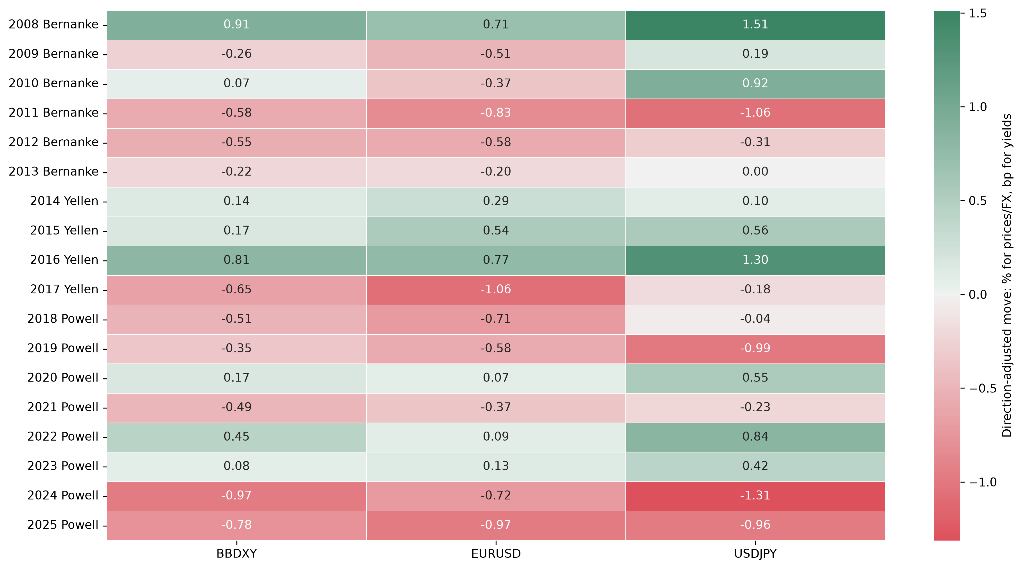
Jackson Hole has a reputation for creating headlines, but history suggests it only becomes a market FX event under specific conditions. Looking back as far as Bernanke's tenure and analysing episodes where the Bloomberg Dollar Index (BBDXY) moved more than 0.5% on the day, three common themes emerge.
First, the Chair delivers a clear policy signal in an uncertain environment. Large moves tend to occur when markets are unsure about the policy outlook and the Fed Chair materially shifts expectations. In 2008, with the Fed already having cut rates aggressively in response to a deteriorating economic backdrop, investors still expected further easing. Bernanke's speech was interpreted as more hawkish than anticipated, prompting markets to price out additional cuts and driving a stronger dollar. Second, the Chair signals a willingness to act in the future. In both 2011 and 2012, Bernanke stopped short of announcing new QE measures but made clear that the Fed remained willing to expand its balance sheet if necessary. That alone was weakened the USD as investors priced in a more accommodative policy path. Third, other speakers can amplify the move. In 2016, Yellen's speech initially pushed the dollar lower.
However, it was Vice Chair Fischer's subsequent interview, interpreted as more hawkish, that created the sustained dollar rally. The quieter years were typically those in which policymakers told markets what they already knew. Without a surprise or a shift in policy, FX reactions remained relatively subdued.
For today's Warsh speech, the closest historical comparisons are probably 2008 or 2016. Markets are operating in a high-uncertainty environment under a relatively new Chair, unlike previous cycles, the latest options flow data does not show positioning building up definitively in one direction. The key difference is that Warsh has repeatedly argued against using forward guidance as a policy tool. He has made clear that he does not intend to pre-commit markets to future policy decisions. In theory, that should significantly reduce the potential for a Jackson Hole surprise. The record is clear, every major Jackson Hole-driven USD move has involved either an explicit change in the expected rate path or a commitment to future action. Warsh has effectively ruled out the first option. Which leaves the following scenarios:
Scenario 1: Warsh sticks to his principles. He avoids sending a policy signal and instead focuses on broader economic themes. This would resemble episodes such as 2017, when markets anticipated a policy message and received very little new information. In that case, the most likely outcome would be a modestly softer dollar as expectations are unwound. Scenario 2: He offers framework guidance rather than policy guidance. Warsh could discuss the Fed's reaction function, productivity trends, inflation tolerance without committing to a September decision. This appears to be the consensus expectation. Market reactions in this scenario would probably remain contained. Scenario 3: He breaks from his stated approach. This is the lowest-probability event. Any explicit signal on the policy path, whether hawkish or dovish, would represent a genuine surprise and could trigger an outsized USD move seen in 2022 or 2024.
JACKSON HOLE: EVENT-DAY DAILY MARKET RESPONSE (%)
Source: MUFG Research, Macrobond, Bloomberg
GBP: Contained crude oil prices – FX risks ahead
The official schedule for Jackson Hole today and tomorrow is quite light on other central banks speaking but immediately after Fed Chair Warsh’s speech, BoE’s Catherine Mann will speak on “Financial Innovation & the International Monetary System” at 15:30 BST and then Isabel Schnabel is scheduled to speak on “Innovation in Tokenized Finance” at 16:55 BST. So beyond Fed Chair Warsh’s opening remarks there might not be much in terms of monetary guidance. Fed President Hammack will be on Bloomberg TV (14:00) and Goolsbee is on CNBC.
Schnabel has already spoken and it was clear that her focus remains firmly on upside inflation risks that indicated to us that the risks of a further rate hike by the ECB beyond the expected September hike is becoming more realistic. For the BoE, the backdrop does not look as urgent and the data provides continued scope for the BoE to remain more patient than the ECB. Today’s panel topic does not suggest Catherine Mann will use this opportunity to provide an update on her monetary policy views but given her hawkish leanings any comment would likely focus on the potential need to act.
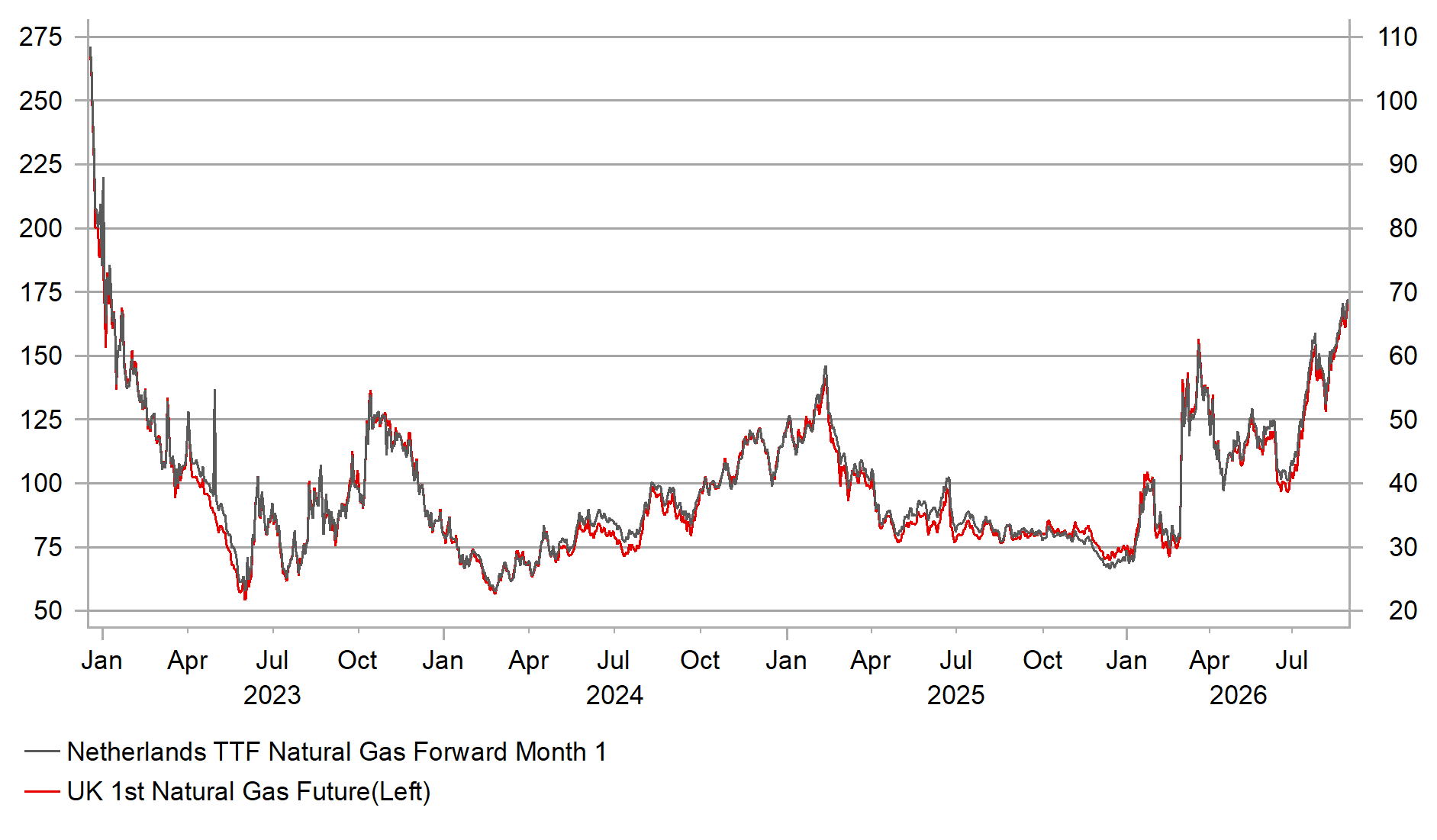
As we have highlighted this week, the natural gas backdrop in Europe is certainly pointing to upside inflation risks. Crude oil prices have been more contained but the UK natural gas front future price has gained 62.5% since the start of July and the close yesterday was the highest since January 2023 following the surge in price after the start of the Russia-Ukraine conflict. In the July Monetary Policy Report the BoE as always used the futures curve in a 15-day period to a certain date prior to the release (in July’s report it was 20th July) which basically had the natural gas futures prices peaking at a little over 123p in Q4 before declining to under 60p at the end of the forecast period. Today’s natural gas price is around 34% higher than the assumption made just a month ago.
The good news is that OFGEM cap is adjusted only every three months so whether this current wholesale price feeds into household bills is not clear. OFGEM recently announced the adjustment to the cap scheduled for October, which will be a 4% increase. That was exactly what the BoE had assumed so for now the natural gas development is a risk to higher than expected inflation. Still, the hawks on the MPC, like Catherine Mann, will no doubt highlight the energy-related inflation risks that have actually worsened and therefore makes it more difficult to ignore due to the offsetting weaker domestic economic conditions. The Citi-YouGov inflation expectations reading this week revealed a pick-up in expectations over the next 12mths from 3.4% to 3.9%, the highest since May and highlights the sensitivity of changes in energy prices to changes in inflation expectations. BoE Governor Bailey is at Jackson Hole so there is a chance we hear from him too. A hike by the BoE is priced by year-end and that is looking more realistic given the natural gas price backdrop. The natural gas price moves in Europe will fuel divergence and provide support for the euro and pound.
UK & EUROPEAN NAT GAS PRICES AT HIGHS NOT SEEN SINCE JAN 2023
Source: Bloomberg, Macrobond, MUFG Research
KEY RELEASES AND EVENTS
Country | BST | Indicator/Event | Period | Consensus | Previous | Mkt Moving |
EZ | 12:30 | Economic Confidence | Aug | 97.5 | 96.9 | !! |
EZ | 13:30 | Services Confidence | Aug | 4.9 | 4.7 | !! |
EZ | 13:30 | Consumer Confidence | Aug F | -15.5 | -15.5 | !! |
CA | 13:30 | Quarterly GDP Annualized | 2Q | 3.40% | -0.10% | !!! |
CA | 13:30 | GDP MoM | Jun | 0.20% | 0.30% | !! |
US | 15:00 | Fed Chair Warsh speaks | !!!!! | |||
US | 15:00 | U. of Mich. Sentiment | Aug F | 51 | 51 | !! |
US | 15:00 | U. of Mich. Current Conditions | Aug F | 52 | 51.8 | !!! |
US | 15:00 | U. of Mich. 1 Yr Inflation | Aug F | 4.4% | 4.3% | !! |
US | 15:00 | U. of Mich. 5-10 Yr Inflation | Aug F | 3.3% | 3.3% | !! |
US | 15:00 | Prelim. Benchmark Payrolls Revision | 2026 | 183k | -911k | !!!! |
Source: Bloomberg & Investing.com