

No end in sight as fixed income selling continues
USD: Higher US yields across the curve helps the dollar
The US dollar has advanced further with the sell-off in US fixed income leading the way for global bond markets. A number of factors came together to reinforce the recent negative sentiment. The move has the hallmarks of a pain trade and forced selling by investors at these more elevated levels and could have further to run. The jump in the 2-year this month is now around 60bps, close to surpassing the scale of the move in March following the start of the conflict. That remains a factor in this sell-off as well and Brent crude oil is up close to 6% from the lows yesterday. The speech by President Pezeshkian of Iran at the UN yesterday did not suggest prospects for imminent peace were good. There has also been a notable pick-up in reports that the US administration will soon announce an export ban on diesel. This would likely lead to further rises in diesel on international markets and could also lift gasoline prices in the US with the surplus diesel in the US causing crude oil refiners to cut production of not just diesel but gasoline as well.
The worsening fixed income sentiment was reinforced by a poor 5-year UST bond auction yesterday. The USD 70bn worth of bonds sold at a yield of 5.033%, the highest level since June 2006. The bid-to-cover was 2.21, lower than the 6mth average of 2.33. The 10-year yield had its biggest increase since the turmoil following the Liberation Day tariffs.
The incoming data also hasn’t helped reverse the worsening sentiment. Both the Manufacturing and Services PMIs for September surged which will encourage the Fed to maintain the current hawkish rhetoric. The strength wasn’t US specific either with the data stronger than expected in Europe as well. The Global Composite PMI increased to 58.4 in September, the highest level since July 2021. Fed Governor Barr spoke yesterday stating that “further policy adjustments are likely to be needed” adding to the wave of hawkish comments this week.
Japan returned after a three-day vacation with USD/JPY higher and having fully retraced the drop triggered by reports that Japan checked rates. Finance Minister Katayama stated today that “FX principles remained intact following joint intervention” suggesting further action could be taken if USD/JPY retraces back to the 160-level.
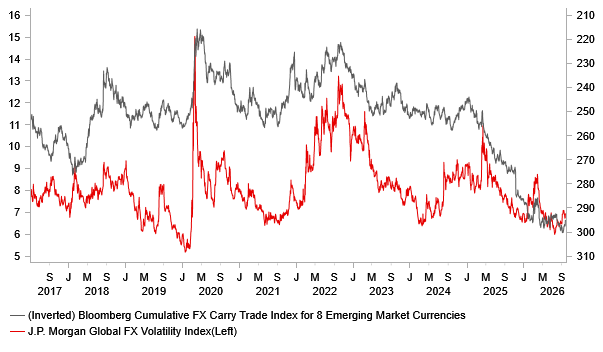
The focus today will be on the Trump/Xi summit and in particular on what may be agreed in terms of guardrails on AI going forward. But for FX the moves in fixed income will remain key. The losses being suffered by investors, in particular amongst fast money accounts could start to have repercussions for the broader market as investors look to offset these losses by closing out other profitable positions. That leaves FX more vulnerable to a carry unwind given how well these trades have done in this incredible low FX vol environment. Periods of low FX volatility always end with a bang and current market conditions are certainly consistent with an increased risk of that scenario materialising. High yielders across EM would suffer most while the yen and Swiss franc would outperform.
LOW VOL & STRONG CARRY PERFORMANCE MUST BE UNDER THREAT
Source: MUFG Research, Macrobond, Bloomberg
EUR: OAT/Bund spread blowout adds to negative EUR momentum
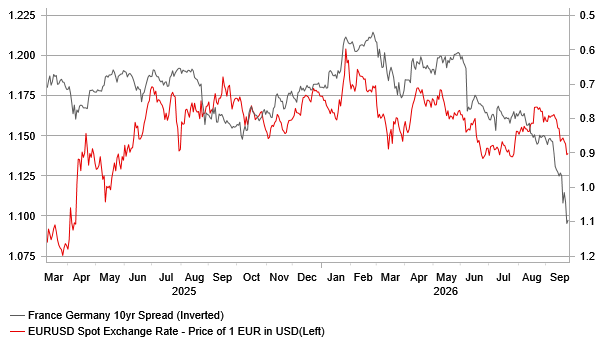
Yesterday we touched on French and German political risks as factors that could serve to weigh further on EUR performance and the spotlight yesterday was certainly on France with the OAT/Bund spread widening out to 110bps, the highest level since 2012 during the euro-zone debt crisis. Has anything changed to explain this spread widening? In France specifically, no, not really. The elections are still happening in April 2027 and there remains a consensus that Marine Le Pen and RN will win the election. That brings with it increased uncertainties of course but there hasn’t been any recent development to intensify those uncertainties. This to us is simply an illustration of the worsening global fixed income sentiment. Global investors are selling duration, and this global backdrop is forcing a higher level of risk aversion that sees fixed income markets with the greatest risks performing worse. There was a ratings downgrade over the weekend from a smaller ratings agency – Scope – but that cut merely brough its rating in line with S&P and Fitch at A+. S&P and Fitch both confirmed a stable outlook earlier this year (May and August respectively).
Parliament reopened this week which may be a factor in fiscal risks returning to the fore in France and there are clear risks of problems in getting the 2027 budget passed. There is a EUR 54bn fiscal consolidation implied in the plan to bring the budget deficit down to 5.0% of GDP, down from a deficit of 5.4% this year, which was revised up from 5.0% due to weaker GDP growth. Whether the budget passes will be very much down to the approach taken by Marine Le Pen. There has been mixed messaging from RN but it is certainly feasible that RN’s preference will be to avoid any financial market turmoil ahead of the French election next year. Marine Le Pen has stated that she would prefer a “flawed” full budget over a Special Law version.
However this plays out over the coming weeks what is clear is that the global fixed income backdrop makes the market risks around the budget that much greater. As a result, downside risks for the euro will continue. It was notable yesterday that on a day in which the advance PMIs were stronger than expected EUR/USD continued to slide. The 38.2% retracement support level from the move higher in EUR/USD from the February 2025 low to the January 2026 high comes in at 1.1340 and that to us is the next key support. A test and breach of that level would likely see the move lower in EUR/USD extend into a 1.10-1.12 range.
OAT/BUND SPREAD WIDENING IS ADDING TO NEGATIVE EUR SENTIMENT
Source: MUFG Research, Macrobond, Bloomberg
KEY RELEASES AND EVENTS
Country | BST | Indicator/Event | Period | Consensus | Previous | Mkt Moving |
EZ | 08:15 | ECB's Schnabel Speaks | - | - | - | !! |
CH | 08:30 | SNB Interest Rate Decision | (Q3) | 0.00% | 0.00% | !!! |
CH | 08:30 | SNB Monetary Policy Assessment | - | - | - | !!! |
GE | 09:00 | German Ifo Business Climate Index | (Sep) | 89.1 | 88.8 | !!! |
NO | 09:00 | Interest Rate Decision | - | 4.50% | 4.25% | !!! |
US | 09:10 | FOMC Member Williams Speaks | - | - | - | !!! |
CH | 09:30 | SNB Press Conference | - | - | - | !!! |
UK | 10:30 | BoE MPC Member Dhingra Speaks | - | - | - | !! |
US | 13:30 | Initial Jobless Claims | - | 201K | 196K | !! |
US | 13:30 | Current Account | (Q2) | -258.0B | -226.8B | !! |
US | 13:30 | Building Permits | (Aug) | 1.394M | 1.433M | !! |
CA | 13:30 | Retail Sales (MoM) | (Jul) | -0.8% | 0.6% | !! |
CA | 13:30 | Core Retail Sales (MoM) | (Jul) | -0.5% | 0.5% | !! |
GB | 14:30 | BoE Breeden Speaks | - | - | - | !!! |
US | 15:00 | New Home Sales | (Aug) | 615K | 607K | !! |
Source: Bloomberg & Investing.com