

Yen performance more tightly linked to risk appetite
USD: Mixed FX performance amidst more risk-off trading conditions
The yen has continued to trade at stronger levels at the end of this week encouraged by more risk-off trading conditions. USD/JPY fell to a low overnight of 156.08 but has since risen back up towards the 157.00-level as the sell-off in Asian equity markets reversed. The yen initially strengthen in response to the sell-off overnight in US tech stocks with the Nasdaq composite equity index falling by -2.6% to the lowest levels cine September. The sell-off was driven by Meta Platforms Inc. shares which closed down by around 7%. It follows the earnings announcement on Wednesday that they have boosted their capital spending plans for the year up to USD135 billion to USD145billion and provided an update on future spending commitments totalling USD825billion including leases, computing deals and energy agreements. The scale of the updated spending plans have triggered some initial unease amongst investors even though CEO Mark Zuckerburg stated that “our investments are paying off, the core business is strong, and we’re seeing velocity across the board”. Alongside the recent paring back of investor optimism over AI-related investments, market participants appetite for taking on more risk in the near-term is also being tested by the rising energy prices and the bond market sell-off in France.
The price of oil has continued to strengthen this week hitting the highest level since the peak from earlier this year in April. Higher energy prices have been encouraged by media reports from the New York Times at the end of this week stating that the US and Israel are developing plans for major strikes on Iran after the US mid-term elections in early November. According to the New York Times, US Defence Secretary Pete Hegseth discussed the possibility of renewed strikes on Iran with Israeli Prime Minister Benjamin Netanyahu in Israel this week. Possible targets of the strikes include Iran’s energy infrastructure, nuclear facilities, and missile and drone arsenal. Some officials have reportedly argued that resuming attacks for an intense but limited campaign would hasten Iran’s economic collapse and hopefully make Iran more amendable to negotiations. At the same time, intensified fighting between the Houthi rebels and the Saudi and Yemeni governments has threatened to create a broader regional crisis that could potentially further disrupt energy supplies in the region. Recent unfavourable developments are increasing the likelihood of energy prices remain at higher levels for longer. A bigger/more prolonged energy price shock reinforces the case for a stronger US dollar in the foreign exchange market.
At the same time, market participants are becoming more concerned that the ongoing sell-off in French government bonds could become more disruptive for global economy and financial markets. French government bonds continued to sell-off sharply yesterday resulting the 10-year yielding rising above 5.00% and hitting a high of 5.14%. the ongoing move higher in French government bond yields stands in contrast to the correction lower for yields in other major bond markets. 10-year yields in the US, UK and Germany have all fallen by around 39bps, 20bps and 30bps respectively from recent highs. The price action highlights that higher yields are attracting more demand after the sharp sell-off in recent months. Government bonds have also been supported by more risk-off trading conditions in recent days which could reflect investor concerns that the tightening in financial conditions will put more of a damper on global growth going forward especially if higher yields persist.
In the foreign exchange market this week, the best performing G10 currencies have been the commodity-related currencies of the Norwegian krone, Australian dollar and Canadian dollar. The Norwegian krone continues to benefit from rising energy prices and it’s relative appeal has been boosted further by rising fiscal risks in Europe given Norway’s strong government balance sheet. The Canadian and Australian dollars have been driven more by the hawkish repricing of the outlook for domestic central bank policies. Market participants have moved to price in higher probability that the BoC and RBA will both raise rates at their next policy meetings on 28th October and 3rd November. It has helped to lower USD/CAD back towards the 1.4000-level and lifted AUD/USD back above 0.7000-level.
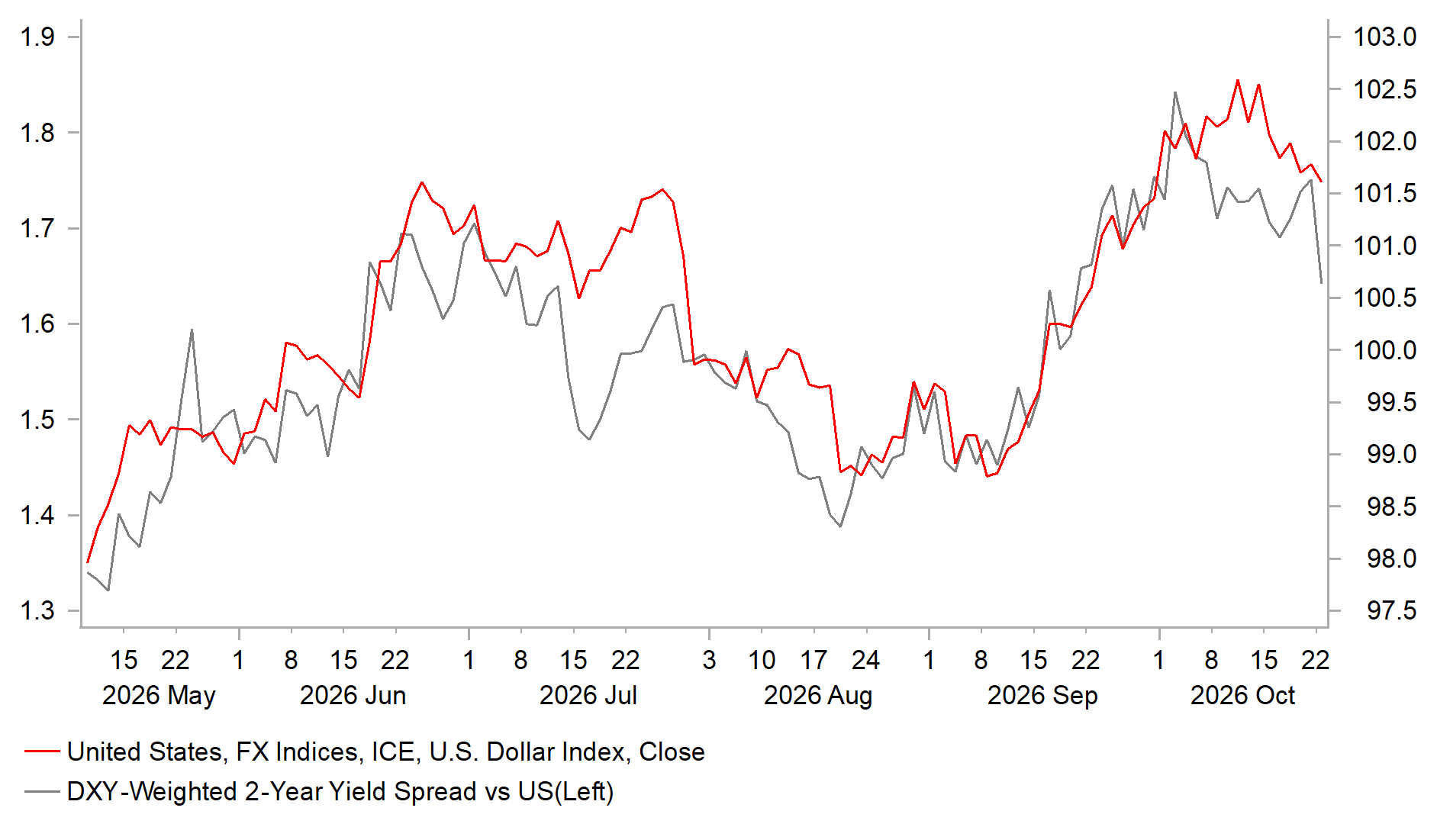
RECENT DROP IN US YIELDS HELPING TO DAMPEN USD STRENGTH
Source: MUFG Research, Macrobond, Bloomberg
KEY RELEASES AND EVENTS
Country | BST | Indicator/Event | Period | Consensus | Previous | Mkt Moving |
EU | 09:00 | Services PMI | (Oct) | 52.6 | 53.0 | !! |
EU | 09:00 | Manufacturing PMI | (Oct) | 52.7 | 52.9 | !! |
GB | 09:30 | Services PMI | (Oct) | 51.8 | 52.1 | !!! |
GB | 09:30 | Manufacturing PMI | (Oct) | 51.8 | 51.9 | !!! |
CA | 13:30 | Retail Sales (MoM) | (Aug) | 1.3% | -0.7% | !! |
US | 14:45 | Services PMI | (Oct) | 57.9 | 58.8 | !!! |
Source: Bloomberg & Investing.com