

Risk sentiment continuing to drive FX market performance
USD: Deepening equity market sell-off in focus during holiday shortened week
The main focus in financial markets at the start of this week is the deepening correction lower for global equities which has been led by AI-related investments. The sharp sell-off in US equity markets on Friday has spilled over into Asian equity markets overnight although they have staged a rebound heading into the close. At the worst point today the South Korean Kospi equity index had fallen by around -5.8% but it has since trimmed its losses to around -3.3%. It follows the heavy sell in US tech stocks on Friday when the Nasdaq composite equity index by a similar amount of -5.3%, and extended the decline from last month’s record high to -18.4% as it moved closer to bear market territory. The sell-off in AI related/tech stocks has also started to spillover more into broader equity market weakness with the S&P500 equity index closing sharply lower by -3.7% on Friday and extending the decline from last month’s high to -11.9%.
On the other hand, the sharp tightening of financial conditions and pick-up in safe haven demand has helped global government bond markets to rebound. The yield on the 10-year US Treasury bond has fallen back below 5.00% hitting a low on Friday at 4.90% as it moves further below last month’s high of 4.14%. Yields at the short end the US curve also moved sharpy lower on Friday falling by 11bps as market participants moved to pare back expectations for faster Fed rate hikes in the coming months. Even after the recent repricing, market participants still expect the Fed to hike back-to-back in December and January although further equity market weakness heading into year-end would more seriously challenge those expectations. US Treasury Secretary Scott Bessent warned over the weekend that the Fed risks jeopardizing the US economy by overtightening in response to the latest inflation data while pointing to signs of fragility in the financial system. He told CBS’s Face The Nation that “many people believe that they maybe making a policy mistake if they overtighten” highlighting that “we’ve seen a substantial tightening in financial conditions over the past few months”.
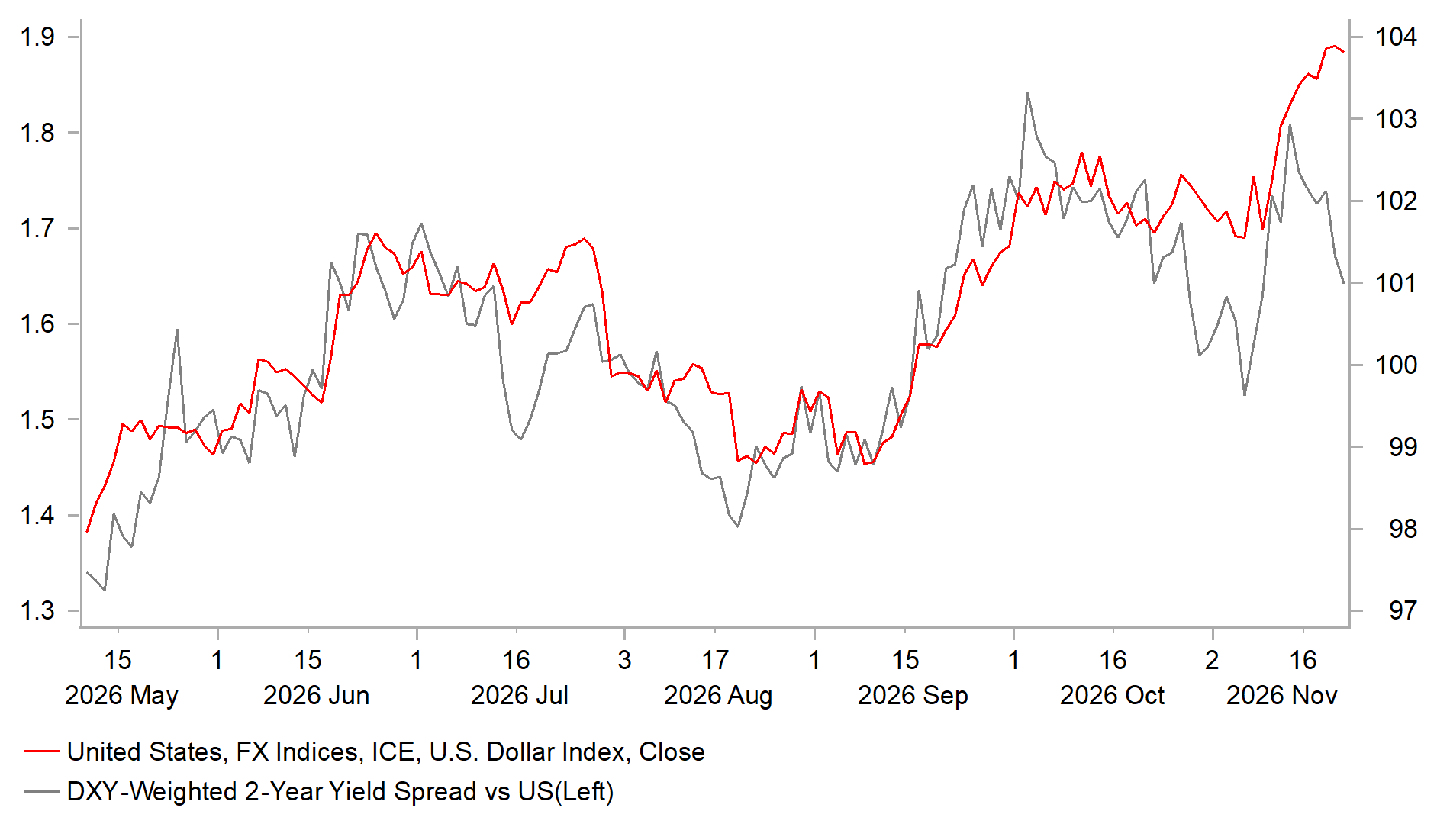
In the foreign exchange market, price action over the past week shows that performance has been mainly driven by risk off trading conditions. The traditional safe haven currencies of the yen and Siss franc have outperformed to a lesser extent the more liquid euro. In contrast, the high beta G10 currencies have underperformed such as the Australian dollar, Swedish krona, and Norwegian krone. We expect the performance of G10 currencies to remain tightly liked to global investor risk sentiment in the week ahead. The US dollar strengthened last week amidst more risk-off trading with the dollar index hitting a fresh year-to-date high just below the 104.00-level although it has lost some upward momentum late last week. In our latest FX Weekly, we recommended a new short USD/CHF trade idea to reflect the risk that the US dollar could correct lower if Fed rate hike expectations are pared back further in response to the sharp tightening in financial conditions and lower commodity prices.
YIELD SPREADS HIGHLIGHT RISK OF CORRECTION LOWER FOR USD
Source: MUFG Research, Macrobond, Bloomberg
Commodity FX: Spillovers for FX market from reversal in commodity prices
The worst-performing G10 currencies over the past week have been the commodity-related NOK and AUD. However, not all G10 commodity currencies have sold off as sharply, with the CAD and NZD holding up better. At the other end of the spectrum, EM commodity currencies have been hit even harder, with the BRL, COP and ZAR all recording outsized sell-offs this week. Last week’s price action extends the bearish trend for commodity currencies that has been in place throughout this month.
The sell-off in commodity currencies is being driven primarily by the deepening correction in commodity prices. After peaking in mid-September, Bloomberg’s Commodity Price Index has since fallen sharply by around 14%, breaking below support at its 200-day moving average for the first time since the summer of last year, when the recent upswing in commodity prices began. The index peaked at just above the 140 level, similar to the peak reached during the previous upswing in commodity prices between 2020 and 2022. On that occasion, commodity prices subsequently lost around a third of their value over the following two years. This suggests there is still scope for commodity currencies to correct further in the year ahead if commodity prices continue to fall. Looking more closely at FX performance since commodity prices began rising last summer, the AUD, COP, NOK and ZAR have been among the best performers and are therefore more exposed to downside risks as commodity prices reverse course.
It marks a reversal from earlier this year, when the Fed’s inflation-fighting credibility was being questioned ahead of President Trump’s decision to nominate Kevin Warsh as the new Fed Chair in March. The popularity of USD debasement trades peaked just before the US-Iran conflict triggered another energy price shock, which has since encouraged a stronger USD. Precious metals were viewed as key bellwethers of the popularity of the USD debasement trade, with gold and silver prices surging by around 70% and 230%, respectively, between August 2025 and January 2026 to record highs. Those bull runs have now almost completely reversed, with gold and silver falling back towards USD3,500/ounce and USD40/ounce, respectively. This highlights how precious metals have led the broader reversal in commodity prices currently under way. The ZAR has had the strongest correlation with the gold price and has come under more intense selling pressure over the past couple of weeks. USD/ZAR has consequently risen back to levels last seen in August 2025, just above 17.500, mirroring the reversal in gold.
The correlation between gold prices and US real yields has clearly strengthened this year. USD debasement trades have unwound as threats to the Fed’s monetary policy independence have eased. Kevin Warsh has so far proved more hawkish than expected since taking over at the Fed, while the Democrats’ victory in the US midterm elections and their control of Congress have further reduced concerns over Fed independence. Together, these developments have dampened fears that monetary policy could be kept too loose to bring inflation back under control. The resulting reduction in the US policy risk premium priced into the USD has likely contributed to its recent strength, while putting greater downward pressure on commodity currencies. Please see our latest FX Weekly for more details (click here).
KEY RELEASES AND EVENTS
Country | GMT | Indicator/Event | Period | Forecast | Previous | Mkt Moving |
FR | 08:15 | French Services PMI | (Nov) | 47.4 | 46.2 | !! |
FR | 08:15 | French Manufacturing PMI | (Nov) | 49.8 | 49.5 | !! |
DE | 08:30 | German Manufacturing PMI | (Nov) | 54.1 | 54.2 | !! |
DE | 08:30 | German Services PMI | (Nov) | 52.4 | 52.5 | !! |
EU | 09:00 | Manufacturing PMI | (Nov) | 52.7 | 52.7 | !! |
EU | 09:00 | Services PMI | (Nov) | 51.8 | 51.4 | !! |
GB | 09:30 | Manufacturing PMI | (Nov) | 53.0 | 52.8 | !!! |
GB | 09:30 | Services PMI | (Nov) | 53.0 | 52.8 | !!! |
GB | 13:00 | BoE MPC Member Pill Speaks | - | !! | ||
US | 13:30 | Chicago Fed National Activity | (Oct) | 0.07 | ! | |
CA | 14:30 | BoC Gov Council Member Lane Speaks | - | !! | ||
US | 14:45 | Services PMI | (Nov) | 55.6 | 56.1 | !!! |
US | 14:45 | Manufacturing PMI | (Nov) | 54.5 | 54.9 | !!! |
US | 21:00 | FOMC Member Williams Speaks | - | !! |
Source: Bloomberg & Investing.com