

Energy price shock continues to weigh on JPY as rate hike expectations build
JPY: Intensifying energy price shock creates more challenging backdrop
The low yielding currencies of the Swiss franc and yen have continued to underperform this month. It has resulted in USD/JPY rising to fresh year-to-date highs above the 163.00-level while EUR/CHF has risen back up to the 0.9300-level where it was last trading at the start of this year. The Swiss franc and yen have been two of the worst performing G10 currencies since the US-Iran conflict started in late February. The negative energy price shock and building expectations for ECB and Fed rate hikes has weighed on both currencies. The energy price shock has re-intensified this month with the price of Brent moving back to within touching distance of USD100/barrel. The reaction in the European natural gas market has been worse with prices jumping to new highs since the US-Iran conflict began. The renewed upward momentum for energy prices has been encouraged by reports that the Houthis, a militant group in Yemen, said they had targeted two oil tanker sin the Red Sea widening global energy supply disruption beyond the Strait of Hormuz. It followed their threat earlier this week to impose a maritime blockade on Saudi Arabia. It is an important development for the oil market given that around 4 million barrels/day are currently headed to market on routes exposed to Houthi attacks. Saudi Arabia has been using it as alternative channel to divert oil trade through while the Strait of Hormuz remains blocked.
In response to rising energy prices, market participants have been moving to price in more hawkish expectations for major central banks including the ECB and Fed resulting in short-term yields rising to fresh year-to-date highs. The euro-zone rate market is now pricing in two to three further ECB rate hikes in the year ahead while the US rate market is pricing in around two Fed hikes over the same period. Short-term yields have risen more recently in Europe than in the US resulting in yield spreads moving against the USD. It is one reason hy the USD has not strengthened further yet in response to higher energy prices even though a bigger energy price shock is likely to hurt Europe’s economy more than the US.
The combination of rising energy prices and yields outside of Japan is creating a more challenging backdrop for Japanese policymakers by encouraging the yen to weaken further. Finance Minister Katayama has again attempted to dampen yen weakness overnight by repeating that they will take decisive action as needed but the comments have had limited impact on the yen as they did not mark a significant step up in the risk of imminent intervention. At the same time, Bloomberg reported yesterday that BoJ officials are open to raising rates at a faster pace than the consensus amongst economists, as the yen’s continued weakness adds to upside inflation risks according to people familiar with the matter. The report added that central bank officials are aware that many BoJ watchers expect the bank to move roughly once every six months, but they’re open to moving earlier than that timeframe if needed, with no present course in mind. Among other factors that open the door to faster action are signs that inflation is becoming more entrenched with growing evidence that companies are passing higher costs on to customers more quickly than in the past.
The report could be viewed as another form of verbal intervention to provide support for the yen. It follows on recently as well from comments Japanese officials encouraging Japanese investors to increase exposure to domestic assets in the GPIF. Taken together it indicates growing concern amongst policymakers over the ongoing yen and JGB sell-offs. The Bloomberg report supports our forecast for the BoJ to hike rates as soon as in September. While rising yields in Japan would offer more support for the yen, we are not convinced another BoJ hike on its own will reverse the weakening trend. The yen would likely benefit more from an unwind of carry trades if global financial conditions were destabilized by the intensifying energy price shock putting pressure on major central banks like the Fed to deliver tighter policy.
HIGHER ENERGY PRICES ARE ENCOURAGING WEAKER JPY
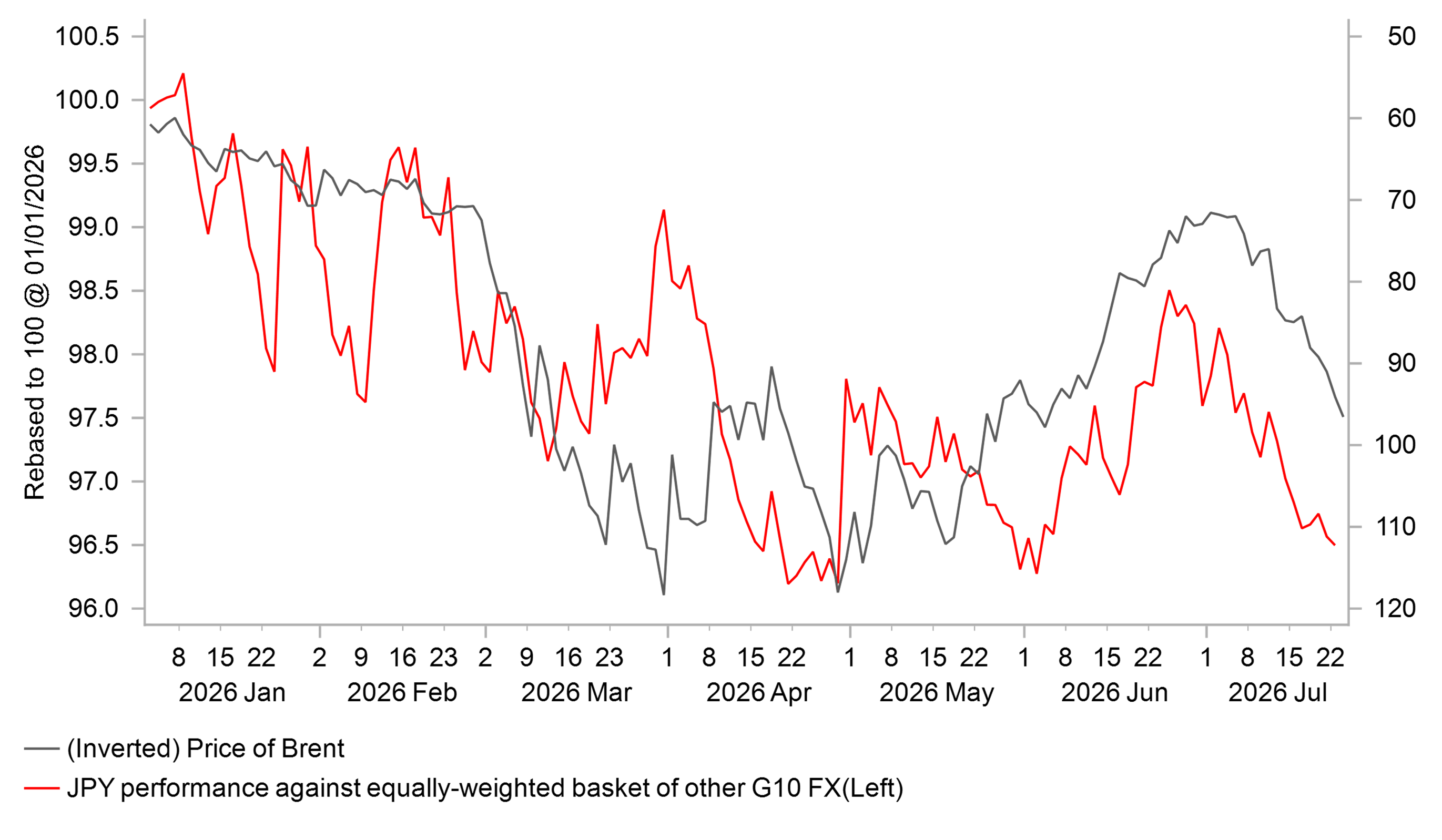
Source: Bloomberg, Macrobond & MUFG Research
EUR: ECB rate hike expectations are building ahead of policy meeting
The main event risk today will be the ECB’s latest policy meeting. As highlighted above, yields in the euro-zone have risen to fresh year-to-date highs ahead of today’s meeting highlighting in part that market participants are expecting hawkish policy guidance from the ECB today. The European rate market has moved to price in 2-3 further ECB hikes in the year ahead. Another hike as soon as the following policy meeting in September is almost fully priced in. It fits with our own forecast for one final hike in September, although we acknowledge that the risk of an additional hike later this year would is increasing if higher energy prices are sustained during the second half of this year. We see little scope today for President Lagarde to push back strongly against market expectations for multiple rate hikes given inflation risk are increasing. Higher energy prices will add to downside risks for growth in the euro-zone as well. Like in the US, the euro-zone economy has held up better than expected so far to the energy price shock providing some reassurance. We would still expect the euro to weaken more in response to a bigger energy price shock posing downside risk to our forecasts (click here). However, rising euro-zone yields are helping to provide support in the near-term.
KEY RELEASES AND EVENTS
Country | BST | Indicator/Event | Period | Consensus | Previous | Mkt Moving |
GB | 11:00 | CBI Industrial Trends Orders | (Jul) | -40 | -45 | !! |
EU | 13:15 | Deposit Facility Rate | (Jul) | 2.25% | 2.25% | !!! |
US | 13:30 | Initial Jobless Claims | - | 211K | 208K | !!! |
CA | 13:30 | Retail Sales (MoM) | (May) | 1.0% | 0.5% | !! |
EU | 13:45 | ECB Press Conference | - | - | - | !!! |
Source: Bloomberg & Investing.com