

Debt crisis. What debt crisis?
USD: Yields impacting the economy would garner more attention
We mentioned here yesterday that there was zero appetite in the US for tackling the worsening fiscal outlook and the danger is that yields move to levels that trigger greater economic weakness and trigger asset price corrections as financial conditions tighten excessively. In that context, it was interesting to see the US data releases yesterday on housing. Housing starts fell 12.4% in July but followed a near 20% gain in June so we are not suggesting yields have hit the market in this data. But the 30-year mortgage rate is now close to a one-year high and at 6.75% has a ways to go before retesting the 2023 high of over 8%. Pending home sales data for July saw a 2.3% MoM drop after a 4.8% fall in June and affordability is starting to have an impact. If UST bond yields remains at multi-decade highs US households will start to notice quickly.
There was a very interesting article in FT Alphaville yesterday highlighting an NBER paper where economists ran a survey on the US government debt burden aimed at ordinary voters, bond investors and those with an economic or a finance background. The FT highlighted some of the key conclusions – that across these groups the estimated probability of a debt crisis in the US over the next decade was high at around 50%. However, the survey also found that 91.2% of voters stated this was not decisive in voting decisions while 72% of investors reported no concrete portfolio alterations. This gets to the root cause of the fiscal position to get to today’s state; nobody really cares as there have been limited negative consequences.
The call for Japan to use the FIMA repo window to finance future US dollar selling intervention is perhaps a sign that the administration is starting to focus on this risk. Worsening housing market data is likely over the coming months as higher yields feed into mortgage rates and hit activity and that could materialise just as the mid-terms approach. It still appears a tall order for the Democrats to take the Senate in November but a worsening economy under tightening financial conditions due to higher yields voters will blame on the Middle East conflict would give the Democrats a real chance.
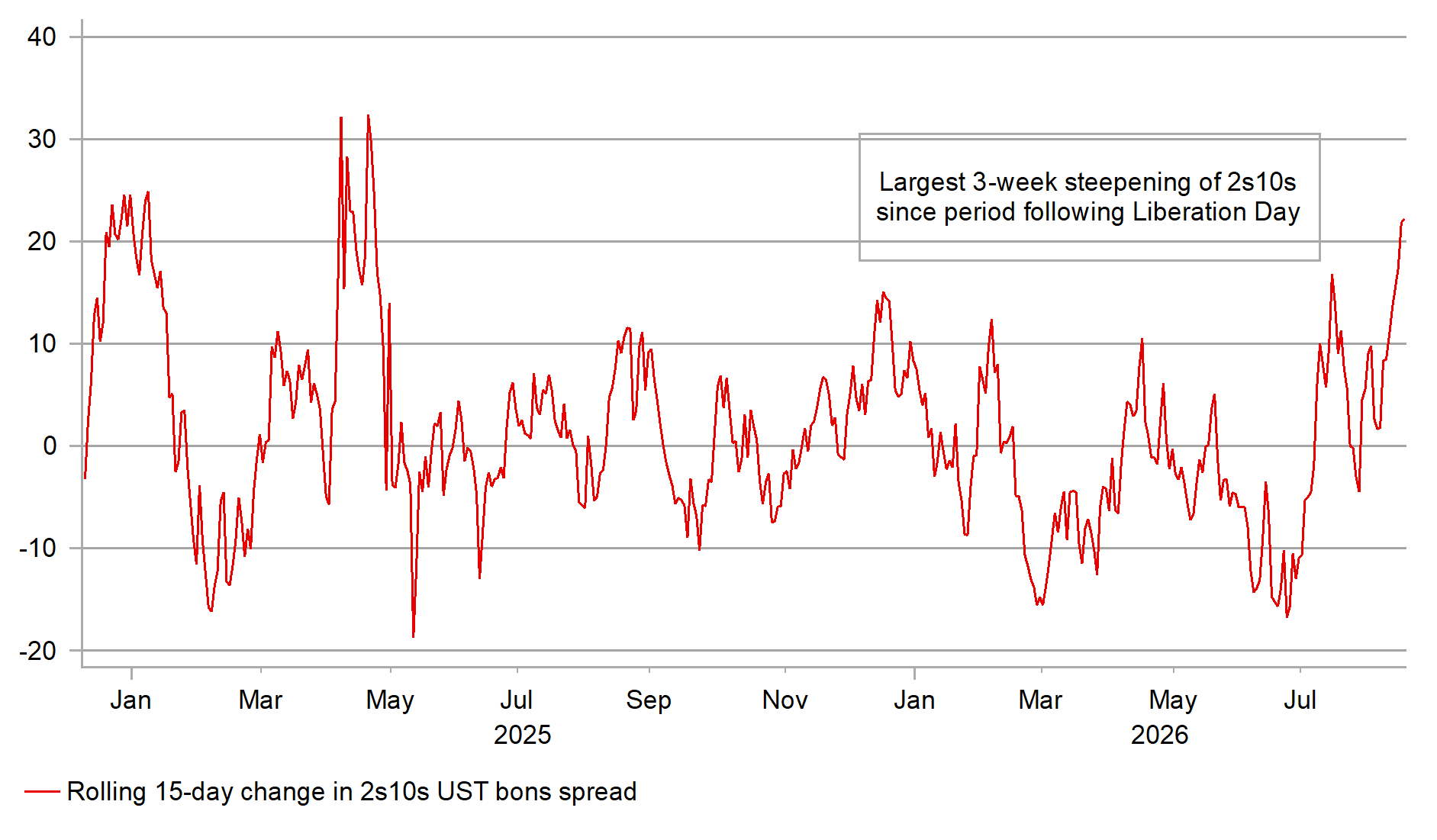
There is also a risk that President Trump in turn will blame Fed Chair Warsh. The FOMC minutes of the meeting in July will be released this evening, and the Fed is an important factor in driving this flight from duration. While the fiscal outlook and inflation concerns are ever present, when it comes to the specific trigger to the latest sell-off it was the FOMC meeting on 29th July. As stated here, breakevens do not indicate an upturn in inflation concerns and measures of fiscal risks have been relatively stable. So the rise in real long-term yields reflects the term premium and specifically the greater uncertainty over monetary policy fuelled by unclear communication from Chair Warsh.
Hence, the minutes will be important given this meeting contributed to triggering the sell-off (it was more the press conference admittedly). But there were three dissents, and the shift in Fed strategy toward less guidance is not helpful when you have a divided FOMC. The caveat tonight, as is often the case, is that we have had data since then that can’t be ignored. Weaker NFP, CPI and retail sales will all help counter any hawkish reaction. We’d expect limited FX fallout until we start to see more compelling evidence that higher rates are transmitting to a broader volatility spike.
ROLLING 15-DAY (PERIOD SINCE JUL FOMC) CHANGE IN 2S10S SPREAD
Source: MUFG Research, Macrobond, Bloomberg
GBP: UK CPI as expected limiting market reaction
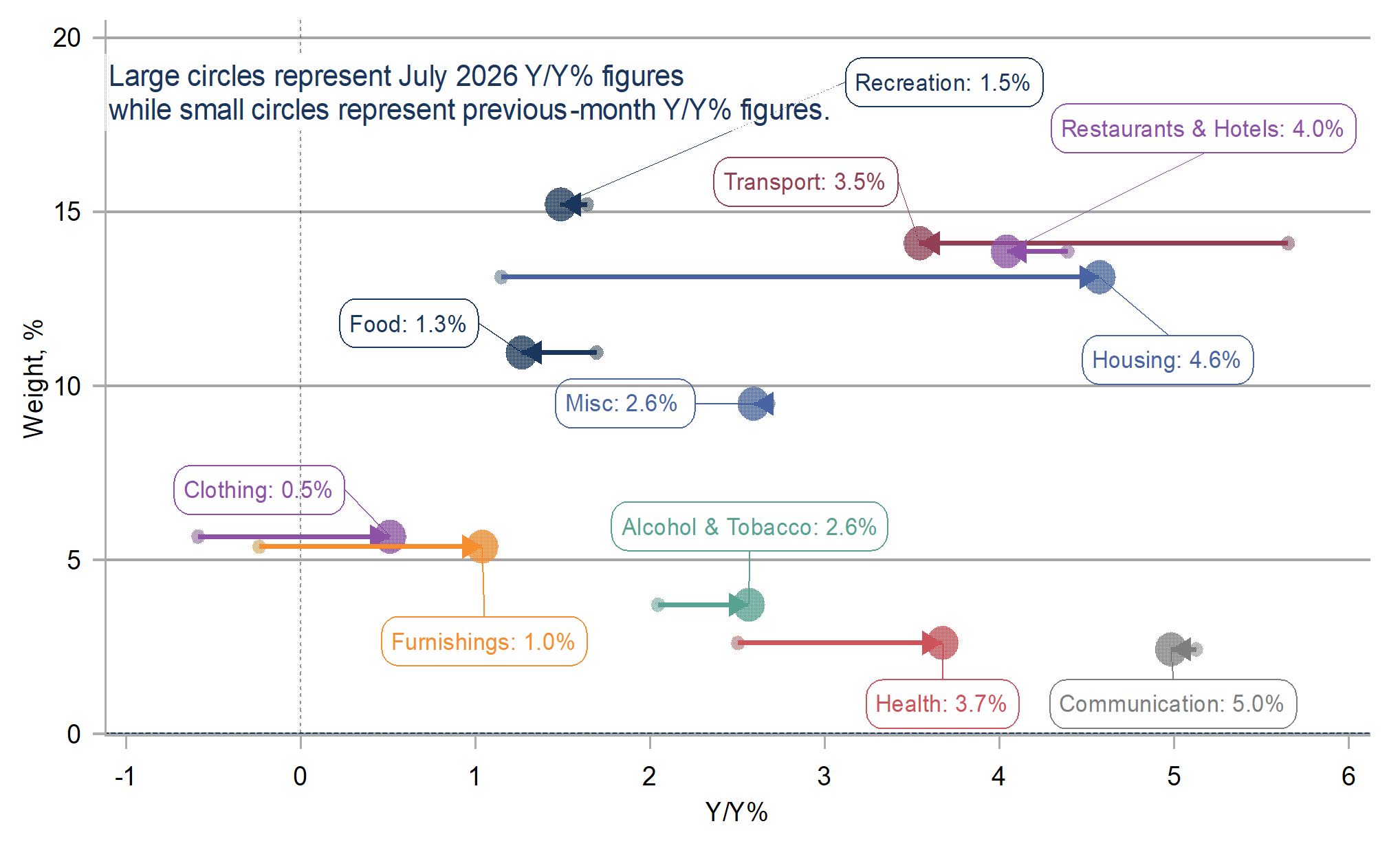
The July CPI data has just been released in the UK and was widely as expected, with the annual rate accelerating from 2.6% to 2.9% largely due to the rise of utility bills reflecting the 13% increase in the OFGEM price cap due to rising energy prices. That was by far the largest contributing factor to the pick-up in the headline CPI rate and when looking beyond that factor rents, and furniture & household goods were the next largest factors pushing the annual rate higher. The rise in gas prices, at 14.7% was the largest since October 2022. While natural gas prices increased, the price of diesel and petrol fell by 8.8p and 3.1p per litre respectively resulting in the annual rate slowing from 21.3% to 15.5%. The good news was that services prices fell as expected from 3.6% to 3.4% which paints a favourable picture of domestically generated inflation. The headline increase of 2.9% is a little higher than the 2.8% expected from the BoE but that’s close enough to view this data as broadly neutral from a markets perspective. The BoE assumes a peak of 3.2% in Q4. There was also good news in the PPI data with the PPI Input MoM change falling 1.7% - the consensus was unchanged highlighting softer than expected pipeline inflation pressures.
The data followed the employment data yesterday that showed slightly stronger headline wage growth although the private sector ex-bonus earnings increase slowed from 2.9% to 2.8%. With demand for labour still weak (PAYE employment fell 13k) the data still paints a picture of easing inflationary risks coming from the UK labour market.
Combining the jobs and inflation data, this data is unlikely to alter the dial much in terms of BoE thinking. The MPC will remain divided and the risks ahead will still be determined more by the external Middle East factor driving energy prices with domestic conditions still likely viewed as offsetting those risks. If there is no resolution to getting the Strait of Hormuz reopened and energy prices rise further from here and stay elevated then the BoE may well have to hike by year-end. If energy prices fall, the BoE will be able to hold off. A hike is priced by year-end and hence the limited reaction in both the rates and FX markets.
UK CPI SUBCOMPONENTS YOY CHANGES JULY RELATIV EOT JUNE
Source: Bloomberg, Macrobond, MUFG Research
KEY RELEASES AND EVENTS
Country | BST | Indicator/Event | Period | Consensus | Previous | Mkt Moving |
EZ | 09:00 | ECB Current Account | Jun | 25.1bn | ! | |
UK | 09:30 | UK House Price Index YoY | Jun | 2.70% | ! | |
EZ | 10:00 | Labour Costs YoY | Q2 | 3.20% | ! | |
EZ | 10:00 | CPI MoM | Jul F | 0.20% | 0.20% | !! |
EZ | 10:00 | CPI YoY | Jul F | 2.90% | 2.90% | !! |
EZ | 10:00 | Core CPI YoY | Jul F | 2.50% | 2.50% | !! |
EZ | 11:15 | ECB's Lagarde speaks | !!! | |||
US | 19:00 | FOMC Minutes | !!!! |
Source: Bloomberg & Investing.com