

USD remains close to year-to-date highs amid AI and energy market sell-offs
USD: Spillovers from falling energy prices and AI sell-off remain in focus
The major foreign exchange rates have remined relatively stable overnight with the US dollar continuing to trade close to year-to-date highs around 103.50. The main focus point yesterday for market participants were comments from Fed Chair Kevin Warsh who spoke at a conference held at the San Francisco Fed. However, he refrained from offering any direct comment on monetary policy limiting any market impact overnight. The US dollar is continuing to derive support market expectations for faster Fed rate hike alongside evidence of softer than expected economic growth in Asia at the start of this week. The US rate market has moved to price in more fully back-to-back rate hikes in December and January, and possibly in March as well over the past week injecting fresh upward momentum into the US dollar.
The main developments in financial market at the start of this week were fresh sell-offs for US tech stocks and the price of oil amidst more risk-off trading conditions. The Nasdaq composite index closed down by -2.5% falling back closer to recent lows from earlier this month. Market participants are eagerly awaiting the latest quarterly earnings report from Nvidia tonight after last week’s resignation from co-founder, President and CEO Jensen Huang triggered a further loss of confidence in the company. Nvidia’s share price has already fallen sharply by around 35% from last month’s peak.
At the same time, the price of Brent has dropped back towards recent lows closer to USD90/barrel. Vice Presdeint JD Vance told Fox News in a recorded interview that “we are not going to allow this to become a 10- or 15-year commitment, or frankly, even a two-year commitment” while adding that “I have full confidence the President will get us out of this thing with great results”. Oil prices have correctly sharply lower this month driven in part by renewed optimism over the potential for a US-Iran deal. However, even without a deal the improving balance between demand and supply in the oil market is helping to ease upward pressure on prices.
The IEA highlighted in their latest Oil Market Report released on Friday that global supply is now exceeding demand for the first time since the outbreak of war in Iran. They the market to move back into surplus in Q4 and larger surpluses to emerge in 2027, subject to supply disruption risks. Global oil supply surged by 2.3mb/d to 105.4mb/d in October and has risen by 5.3mb/d since August. The improving supply-demand balance should help to moderate the global energy price shock, thereby easing inflationary pressures and reducing the need for central banks, including the Fed, to raise rates more aggressively in 2027.
The sharp decline in energy prices has been an important driver of FX performance this month with the currencies of exporters such as the Norwegian krone and Australin dollar underperforming while currencies of importers such as the yen and euro have performed relatively better. However, lower energy prices have not prevented the US dollar from strengthening further.
HAVE THE PRICE OF OIL & NOK PEAKED?
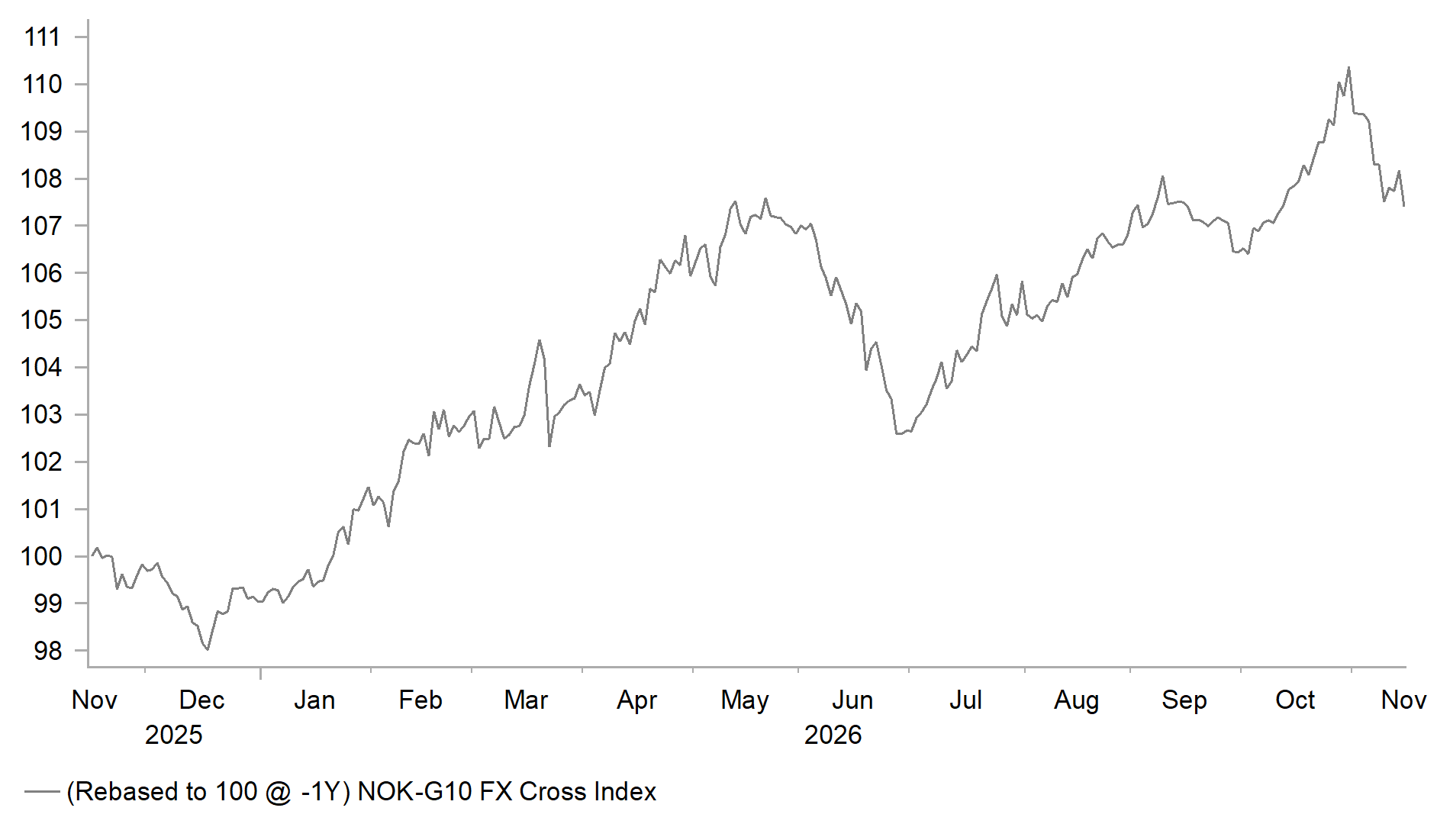
Source: MUFG Research, Macrobond, Bloomberg
GBP: UK labour market setback triggers short-lived sell-off
The pound initially weakened this morning following the release of the latest labour market report from the UK. However, the sell-off proved to be short-lived with cable rising back up towards the 1.3200-level. the latest report revealed that private payrolls growth unexpectedly fell by a further 34k in October following on from an upwardly revised increase of 20k in September. It was the largest monthly decline in private employment since late in 2020 although the monthly figures volatile and are frequently revised. At face value the latest reading casts some doubt on other tentative signs of improvement in labour demand. At the MPC’s last policy meeting, the BoE appeared less concerned by downside risks from the labour market which contributed to a more hawkish policy update.
The UK economy has been growing more strongly than expected this year while employment growth has remined weak indicating that it has been driven mainly by higher productivity growth. The ONS is scheduled to release a new measure of productivity data later this morning which could shed more light on the topic. Higher productivity growth would allow the economy to grow more strongly without creating inflationary pressure. So far there is little evidence of second round inflation effects from higher energy prices in the labour market. Private earnings growth excluding the volatile bonus component has slowed to 3.1% from 4.2% a year ago. It is one of the reasons why we still believe that market expectations for more aggressive BoE hikes (3-4 in the year ahead) are overdone. Recent hawkish comments from BoE officials have indicated that a couple more hikes are likely, and the next hike could be delivered as soon as next month helping to support the pound heading into year end.
KEY RELEASES AND EVENTS
Country | BST | Indicator/Event | Period | Consensus | Previous | Mkt Moving |
UK | 09:30 | UK Publishes New Measure Productivity Data for Q3 | !! | |||
GE | 10:00 | ZEW Survey Expectations | Nov | 28.8 | 28.1 | !! |
US | 13:30 | Retail Sales Advance MoM | Oct | 0.1% | 0.8% | !! |
US | 14:10 | Fed's Waller Speaks on Payments | !! | |||
US | 14:15 | Industrial Production MoM | Oct | 0.1% | 0.7% | !! |
EC | 18:30 | ECB's Lane Speaks at Harvard | !!! | |||
US | 19:25 | Fed's Williams Speaks in Fireside Chat | !!! |
Source: Bloomberg & Investing.com