

Renewed fiscal concerns impacting yen
JPY: Growth Strategy Minister attempts to dampen renewed fiscal concerns
The yen has strengthened modestly overnight resulting in USD/JPY dropping back to a low of 161.68 after hitting a high of 162.18. The yen has derived some support from comments from Japan’s Growth Strategy Minister Minoru Kiuichi who stated that “there’s absolutely no truth to reports suggesting that the government is encouraging low interest rates as part of its fiscal expansion policy. If our intentions haven’t been accurately conveyed, we intend to make even greater efforts to promote the understanding”. Speculation has increased recently that the government is putting pressure on the BoJ to maintain loose monetary policy after the draft of the government’s basic policy guidelines published on 30th June included the phrase that the “appropriate conduct” of monetary policy is important according to local media reports. The draft also reported omitted a reference to fiscal “consolidation” pointing towards looser fiscal policy as well.
However, Growth Strategy Minister Minoru Kiuichi has provided some clarification emphasizing that “it wasn’t a matter of intentionally including or omitting the term ‘fiscal consolidation’. I would like to reiterate that this is by no means intended to weaken fiscal discipline. Rather, I hope you will understand that we are clearly demonstrating fiscal sustainability in a more concrete and verifiable manner”. The government has decided to focus lowering the ratio of debt to GDP rather than the long-held target based on the primary budget balance. He added that “by steadily reducing the debt-to-GDP ratio, we will achieve fiscal sustainability and secure the confidence of the markets. We are by no means pursuing as reckless fiscal policy”.
Price action at the ultra-long-end of the JGB curve was volatile overnight with the 30-year JGB yield trading within a range of around 12 basis points. The yield is currently on track to close slightly lower on the day bringing an end to five consecutive days when yields closed higher. It follows the latest 30-year JGB auction overnight that drew the strongest demand since 2019. Investor unease over fiscal policy in Japan has picked up after the government has unveiled a new multi-year investment framework targeting JPY370 trillion in cumulative public and private investment over a 14-year period. It will focus on 17 key strategic sectors including AI, semiconductors, economic security, and crisis preparedness. Public investment is estimated to total around 20% of JPY2370 trillion (JPY74 trillion) which works out at just over JPY4 trillion/year in inflation adjusted terms. According to Bloomberg, it represents a net increase from existing plans of around JPY2 trillion/year, and the new fiscal burden excluding financial support instruments are likely to be no more than JPY1 trillion/year. While the new fiscal burden excluding financial support instruments is more modest, the plans have created some renewed unease over fiscal policy.
The backdrop for the yen was already challenging given the negative impact from the energy price shock and recently the hawkish shift in Fed policy communication. As a result, market participants increasingly view the yen as a one-way bet anticipating further weakness. Even if Japan intervenes again to support the yen, it is judged as unlikely to reverse the weakening trend unless there is a change in fundamentals as eident by the price action in late April/early May when Japan carried out record intervention. Bloomberg has highlighted in a report today that leveraged funds have continued to ramp up short yen positions in the week ending 30th June. When including futures and options, the net short yen position has increased to the highest level since the middle of 2007 just before the big unwind of yen-funded carry trades triggered by the Global Financial Crisis. The ongoing build-up of short yen positions highlights the potential for the yen to strengthen sharply when the tide turns. However, there is currently no clear catalyst to trigger a stronger yen.
The main economic data release in Japan overnight was the latest labour cash earnings report for May. The report revealed that labour cash earnings slowed to an annual rate of 3.2% in May down from 3.6% in April. There were two fewer week days in May this year than in the same month last year which was the main reason for slower wage growth. The slowdown was more modest for the BoJ’s preferred wage measure, full-time pay stripping out sample changes, which increased by an annual rate of 2.4% in May down from 2.5% in April. Overall, the calendar affected report is unlikely to change the BoJ’s view that stronger wage growth continues to support the case for further policy normalization. We expect the BoJ to deliver the next rate hike as soon as September providing more support for the yen.
LEVERAGED FUNDS’ YEN SHORTS REACH HIGHEST LEVEL SINCE 2007
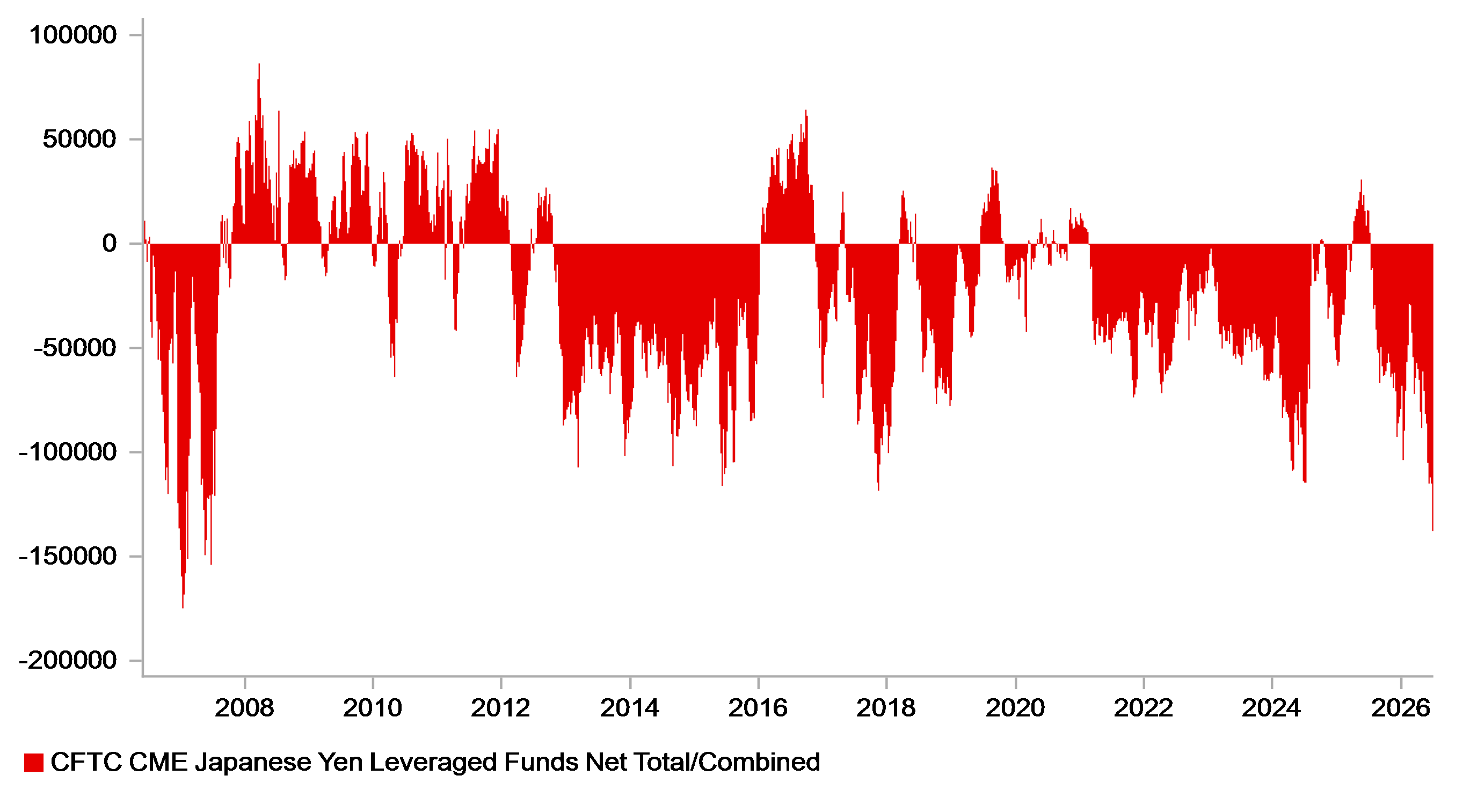
Source: Bloomberg, Macrobond & MUFG Research
KEY RELEASES AND EVENTS
Country | BST | Indicator/Event | Period | Consensus | Previous | Mkt Moving |
GB | 10:30 | BoE Financial Stability Report | - | - | - | !! |
GB | 11:30 | BoE Gov Bailey Speaks | - | - | - | !!! |
US | 12:00 | FOMC Member Bowman Speaks | - | - | - | !! |
US | 13:30 | Trade Balance | (May) | -78.30B | -55.90B | !! |
Source: Bloomberg & Investing.com