

JPY stands out as strength extends as BoJ hike expectations build
JPY: BoJ pricing starting to look stretched
The yen is the top performer again in G10 today with the pricing of BoJ rate hikes continuing to build in the aftermath of the speech by policy board member Hajime Takata when he hinted that the BoJ could decide to hike by a larger size than 25bps. The market has responded with 30bps of tightening now priced for the meeting this month. The year ahead pricing is now close to 100bps. While we see it as plausible that the BoJ could hike by that amount over 12mths we do not see it as likely at all that the BoJ will hike by a larger amount than 25bps. A hike this month will only just confirm a pick-up in the pace from every six months to every three months. There is still scope to pick-up the pace further if required before considering outsized moves. We even doubt we will get back-to-back moves but that’s more plausible.
It’s not just Takata’s speech (and Ueda’s in which he essentially endorsed a hike this month) but also the continued speculation that the US is pressuring Japan to act more forcefully. We’ve had that before but the difference this time is that the US just provided support via its EUR/JPY selling intervention and it would be rare for the current administration to provide favours without anything in return. The G20 central banker and finance ministers meeting is taking place and the sudden sharp drop in USD/JPY yesterday did raise speculation of possible intervention – the price action was certainly not consistent with previous bouts of intervention so it seems unlikely. The Japan Times today reported Scott Bessent’s comment to Governor Ueda in which he “expressed strong support for Japan’s decisive market and monetary steps to address the substantial undervaluation of the yen”. Yesterday Bessent acknowledged the benefits of ‘Abenomics’ but said Japan now needed to “stop the reflation”. Finance Minister Katayama appeared to agree stating that given Japan’s economic changes (ie : inflation) “it’s natural to come up with a different remedy”.
Katayama’s comment therefore gives further credence to the story of the GPIF having held an unusual meeting in August that was likely in part to focus on possible asset composition changes given the surge in JGB yields. Katayama has previously publicly called for more domestic asset purchases by Japanese investors so we may well be heading for a sooner than expected formal increase in the composition for domestic bonds (25% currently).
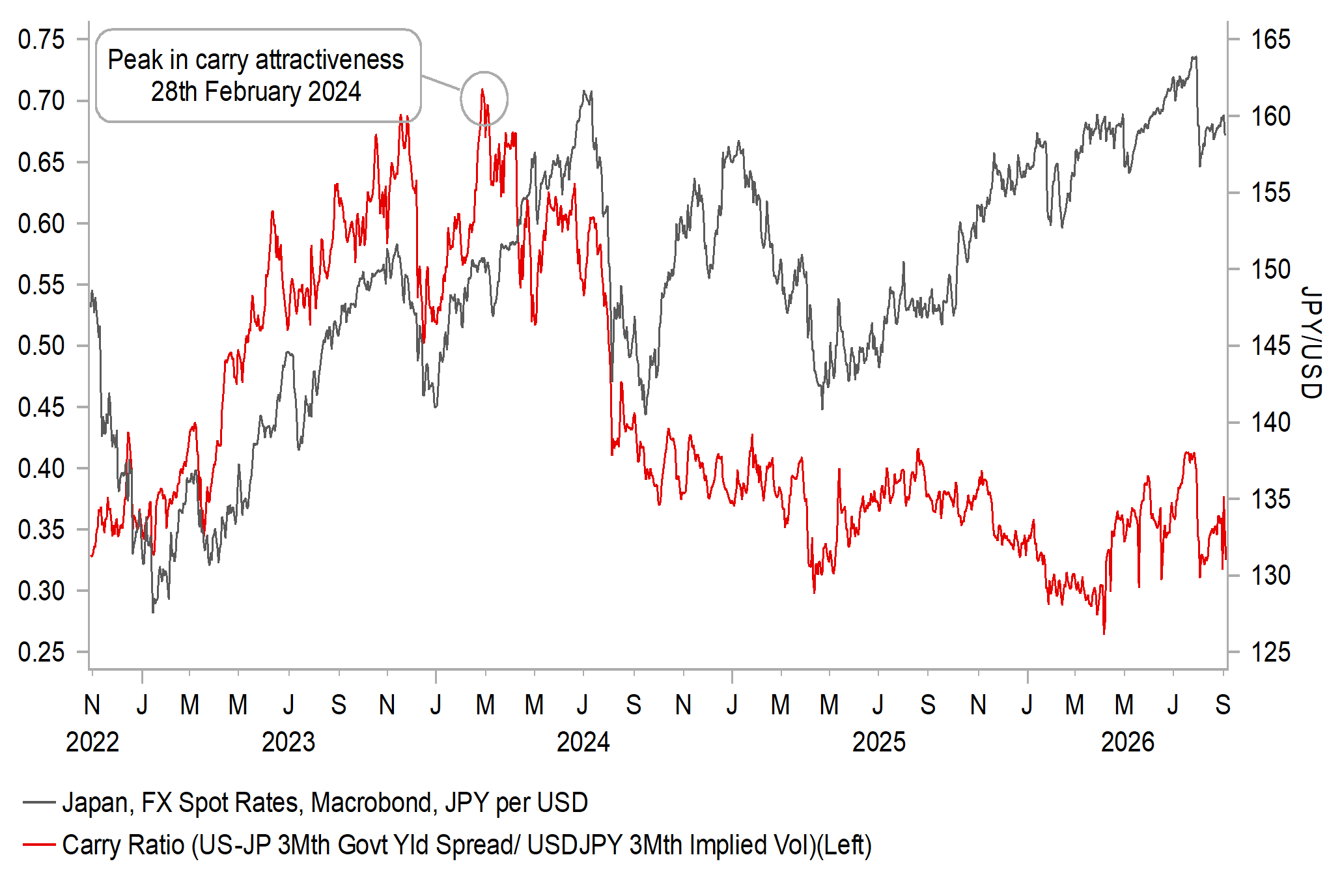
Momentum is certainly turning in USD/JPY as a result. The key change in our view is the more obvious US influence and the more hawkish BoJ. Weak US data this week (JOLTS & ADP) is helping and certainly a weak NFP and CPI data that reduces the prospect of a Fed hike this month would reinforce that downside momentum. We know carry remains a draw in USD/JPY. Even though spreads have narrowed, volatility is incredibly low volatility but 1mth implied vol has now jumped sharply and that change along with a further narrowing of the short-term spread could see a bigger positioning unwind. NFP is suddenly a much more data point for near-term direction in USD/JPY.
USD/JPY CARRY INDEX IMPLIES USD/JPY SHOULD BE A LOT LOWER
Source: MUFG Research, Macrobond, Bloomberg
CAD: BoC focus is more inflation than tariffs
The Canadian dollar advanced immediately yesterday in response to the decision of the Bank of Canada to leave its monetary stance unchanged at 2.25% with the rhetoric accompanying the decision indicating a greater concern over the inflation outlook than market participants were expecting. Those market expectations appeared reasonable when you consider that the latest set of CPI data for July revealed YoY rates for Core, Trimmed and Median of 1.9%, 1.9% and 2.0% respectively. That’s a very favourable underlying inflation backdrop that suggested to us that the BoC has further time to assess conditions before needing to respond.
However, the communications were certainly indicative of a possible rate hike coming much sooner. The reference to the policy stance being appropriate to achieving the inflation goal was omitted and the emphasis certainly shifted more to the upside inflation risks. Even with underlying inflation well contained there was a “heightened risk” that energy prices would spill over into broader measures of inflation. In the press conference the impact of tariffs on the economy was certainly the focus from a growth risk perspective but Governor Macklem added that the tariffs were applied to a “relatively narrow base” and because of that the BoC did not expect a “big ongoing impact on overall economic activity”. With economic activity more resilient of late the BoC may have felt more comfortable with the economic downside risks being less than the inflation upside risks.
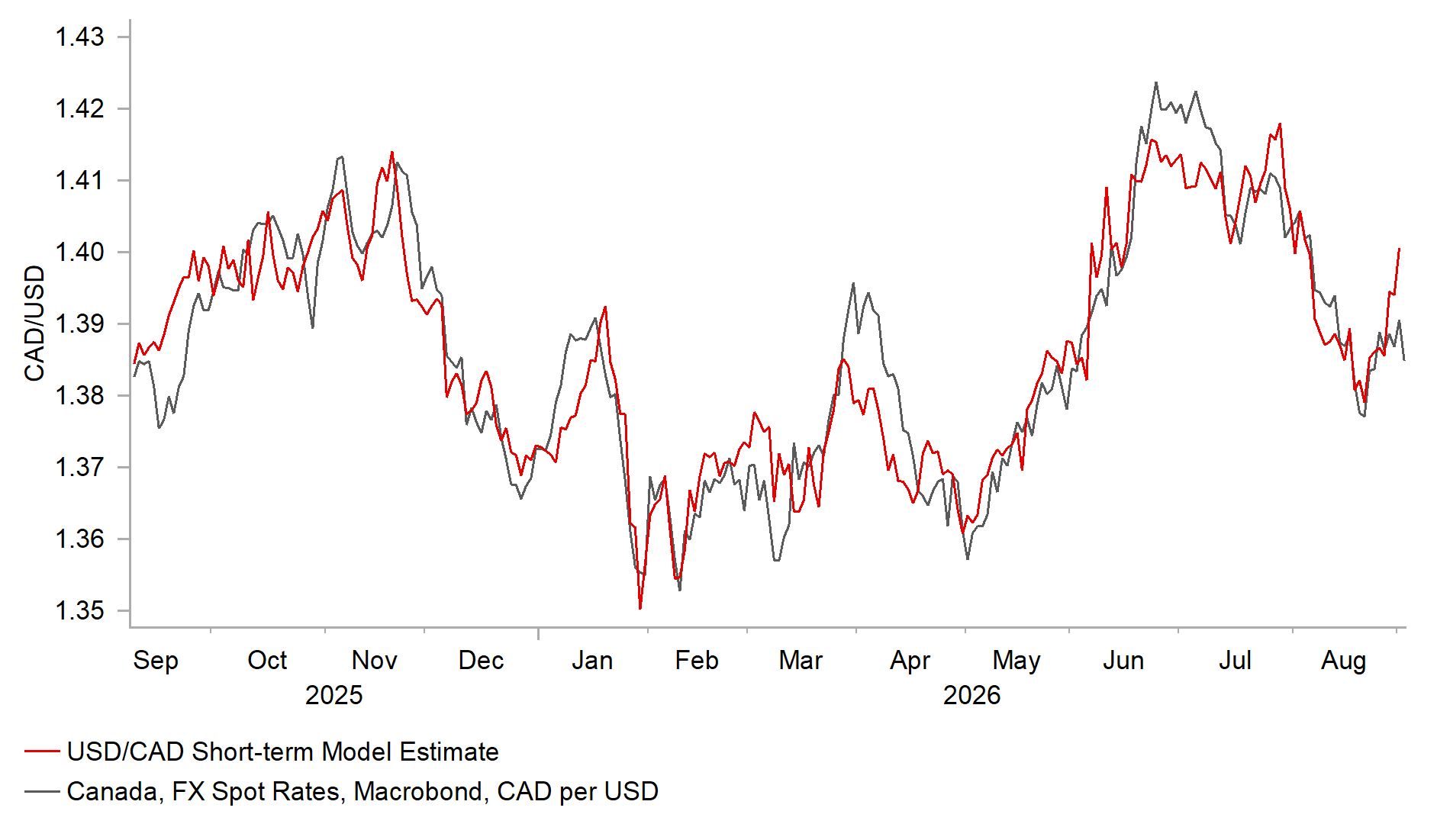
The market reaction was as you would expect with the emphasis on upside inflation risks. The 2-year yield jumped 8bps and that helped provide support for CAD. However, we do not see this policy announcement as triggering a sustained rebound of CAD. Our short-term valuation model for USD/CAD points to the USD/CAD level currently undershooting which is similar to the current divergence on the co-movement between USD/CAD and the 2-year swap spread. Both indicate USD/CAD should be trading between 1.40-1.41.
That valuation estimate could well change if the Fed on 16th September decides to leave the policy stance unchanged and ahead of that there are also risks related to the NFP and CPI data points. Furthermore, the divergence could be in part explained by the renewed upward momentum in crude oil prices and expectations of further gains now with the escalation of the conflict in the Middle East. That risk may well be curtailing appetite to sell CAD at this point. That CAD upside risk related to oil is now more relevant given it also now appears to up the prospect of a BoC rate hike and that will help strengthen the CAD/Oil correlation given it’s now more closely associated to the BoC’s reaction function.
SHORT-TERM VALUATION MODEL SUGGESTS USD/CAD UNDERSHOOTING
Source: Bloomberg, Macrobond, MUFG Research
KEY RELEASES AND EVENTS
Country | BST | Indicator/Event | Period | Consensus | Previous | Mkt Moving |
GE | 08:55 | German Services PMI | (Aug) | 48.5 | 49.8 | !! |
GE | 08:55 | German Composite PMI | (Aug) | 51.0 | 51.3 | !! |
EZ | 09:00 | Services PMI | (Aug) | 51.7 | 51.7 | !! |
EZ | 09:00 | S&P Global Composite PMI | (Aug) | 52.1 | 52.0 | !! |
UK | 09:30 | Composite PMI | (Aug) | 52.5 | 52.2 | !! |
UK | 09:30 | Services PMI | (Aug) | 52.8 | 52.1 | !! |
EZ | 10:00 | PPI (YoY) | (Jul) | - | 4.6% | ! |
EZ | 10:00 | PPI (MoM) | (Jul) | 1.2% | -0.3% | ! |
US | 13:30 | Initial Jobless Claims | - | 205K | 203K | !! |
US | 13:30 | Nonfarm Productivity (QoQ) | (Q2) | 1.4% | 0.8% | !! |
US | 13:30 | Trade Balance | (Jul) | -86.40B | -73.30B | !! |
US | 13:30 | Fed Waller Speaks | - | - | - | !!!! |
US | 14:45 | Services PMI | (Aug) | 56.8 | 54.6 | !! |
US | 14:45 | S&P Global Composite PMI | (Aug) | 56.0 | 54.5 | !! |
US | 15:00 | ISM Non-Manufacturing PMI | (Aug) | 54.2 | 54.1 | !!! |
UK | 16:00 | BoE's Pill speaks | !!! | |||
US | 20:00 | Fed's Hammack speaks | !!! | |||
US | 20:55 | Fed's Goolsbee speaks | !!! |
Source: Bloomberg & Investing.com