

Jackson Hole shifts balance of risks but USD gains muted
USD: Jackson Hole speech prompts a market rethink
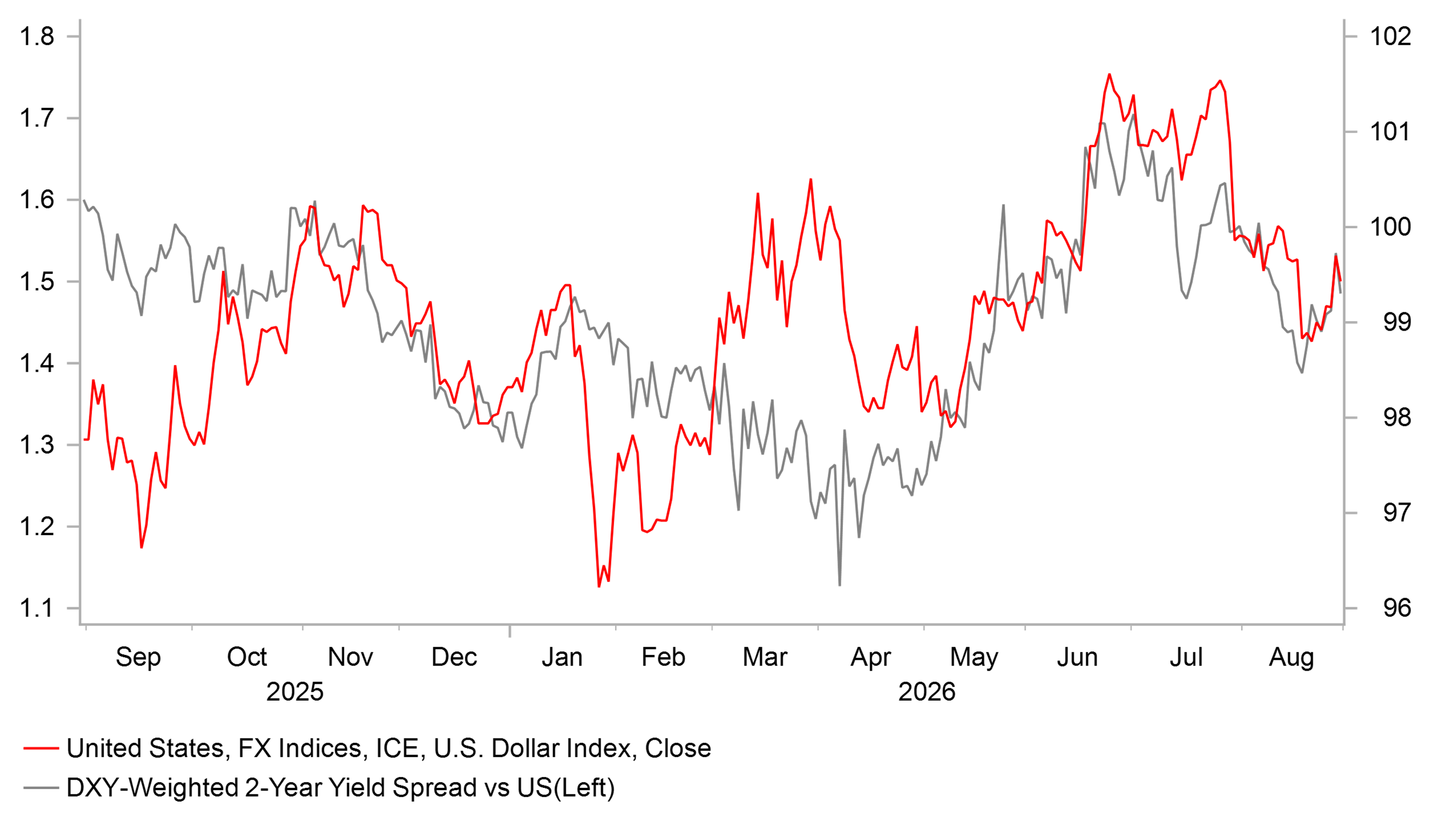
The US dollar advanced 0.5% on Friday (DXY basis) in response to the speech by Fed Chair Warsh at Jackson Hole but some of that move retraced yesterday and the dollar’s gain since Friday’s open is now a more modest 0.3% with front-end yields across G10 also rising, in part on a renewed increase in energy prices following the renewed escalation in hostilities between the US and Iran. The 2-year UST bond yield jumped 11bps on Friday in response to the speech.
The more modest US dollar reaction makes sense from a number of perspectives. Firstly, as laid out below, every G10 central bank is meeting this month and some will be hiking, some may surprise and hike and some will remain on hold. But if energy prices remain elevated and/or grind higher the tone of rhetoric from most central bankers is likely to be hawkish and this could well be curtailing the appetite to buy the US dollar at this stage. Secondly, while Fed Chair Warsh was hawkish on Friday in Jackson Hole the gist of his speech was similar to his previous speeches – he talked tough on inflation and was clear that if inflation did not decline at “sufficient speed” that the Fed had “work to do”. The reference to “sufficient speed” certainly shifts the balance of risks toward a hike given how sticky the inflation levels have been in recent months. The core PCE YoY rate remained at 3.3% in July and has been above the 3.0% level now for seven months. The rate has been above the 2.0% level since March 2021.
But Warsh and the FOMC haven’t hiked at the previous two meetings under the leadership of Warsh and it remains the case that the Board of Governors have a more dovish tendency than the regional Presidents. Hence, the data points over the coming few weeks ahead of the FOMC remain key and could once again shift the balance of risks back in favour of a hold. The NFP report this week and then the CPI data on 11th September will be crucial. Those data points will need to be on the weaker side in order for the FOMC to justify a hold. But remember what Chair Warsh stated at the start of his speech on Friday – when offering a synopsis of what he will say he stated “You can call it an outline….. you can call it a trail map…. just don’t call it forward guidance”. Why did he say that if he wanted to give a signal on what will happen on 16th Sept?
So the decision remains a close call ahead of NFP and CPI and hence with front-end yields moving higher globally and with an elevated degree of uncertainty given the busy month of central bank meetings, the dollar buying has been curtailed. It was only very recently too that “USD debasement” were the busswords and the impression of the US wanting a weaker US dollar will also curtail dollar buying enthusiasm
US DOLLAR PERFORMANCE REMAINS ALIGNED WITH RATE SPREAD MOVES
Source: MUFG Research, Macrobond, Bloomberg
G10: Middle East escalation underlines inflation risks
The exchange of fire between the US and Iran marks a renewed escalation in the conflict that will have implications for the markets at the start of a month in which every G10 central bank will meet. The Fed is not the only central bank where the decision at the September meeting is finely balanced. The probability of a Norges bank rate hike is similar to the Fed at around 60% while the RBA decision is around 50%. The Norges bank, Riksbank and SNB will all meet on 24th September with the RBA meeting last amongst G10 on 29th September.
Some decisions are priced more clearly and hence the developments in the Middle East could impact the communications on the potential for additional hikes beyond expected hikes this month. An ECB rate hike is fully priced but the ECB is likely to be more sensitive to continued rises in energy prices that may well see President Lagarde happy to signal the increased risk of further tightening beyond this month. The BoJ pricing on a hike is also close to fully priced although we would not expect the BoJ to be as willing as the ECB to signal the potential for further hikes. The BoJ will likely maintain the guidance on further hikes but will want to be careful on signalling a sustained faster pace of tightening given the geopolitical uncertainties tend to be viewed by the BoJ as much from the growth side as the inflation side.
The first meetings take place tomorrow with the RBNZ set to hike while the Bank of Canada is likely to remain on hold. The RBNZ has been cautious on hiking rates from the current accommodative level (2.50%) but the inflation backdrop will compel action tomorrow especially given the renewed move higher in energy prices. Still, there is 100bps of tightening in the RBNZ OIS curve and we remain scpetical of the RBNZ delivering that amount of tightening over the next 12mths. The Bank of Canada has other risks to consider following the escalation of the trade war with the US and the risk of auto, auto parts, steel and light & heavy truck tariffs being lifted from 25% to 50% at the start of 2027 will act to dampen Canadian corporate sentiment. The Canadian dollar will likely continue to underperform until there is clarity on tariffs in both directions.
Natural gas prices remain a factor that could shape central bank policy decisions in Europe over the coming months. The escalation again in the conflict in the Middle East at a time when sorage levels in Europe are low could see further moves higher in netural gas prices. TTF closed at a new high yesterday and at a level not seen since January 2023 – the gain since the end of June is 75%. Higher front-end yields as a result could help to limit US dollar buying on rising expectations of a rate hike by the Federal Reserve. Rising energy prices are unlikely yet at a level that sentiment deteriorates and the negative terms of trade impact sees currencies like EUR and GBP underperform. Stronger economic data in Europe has helped
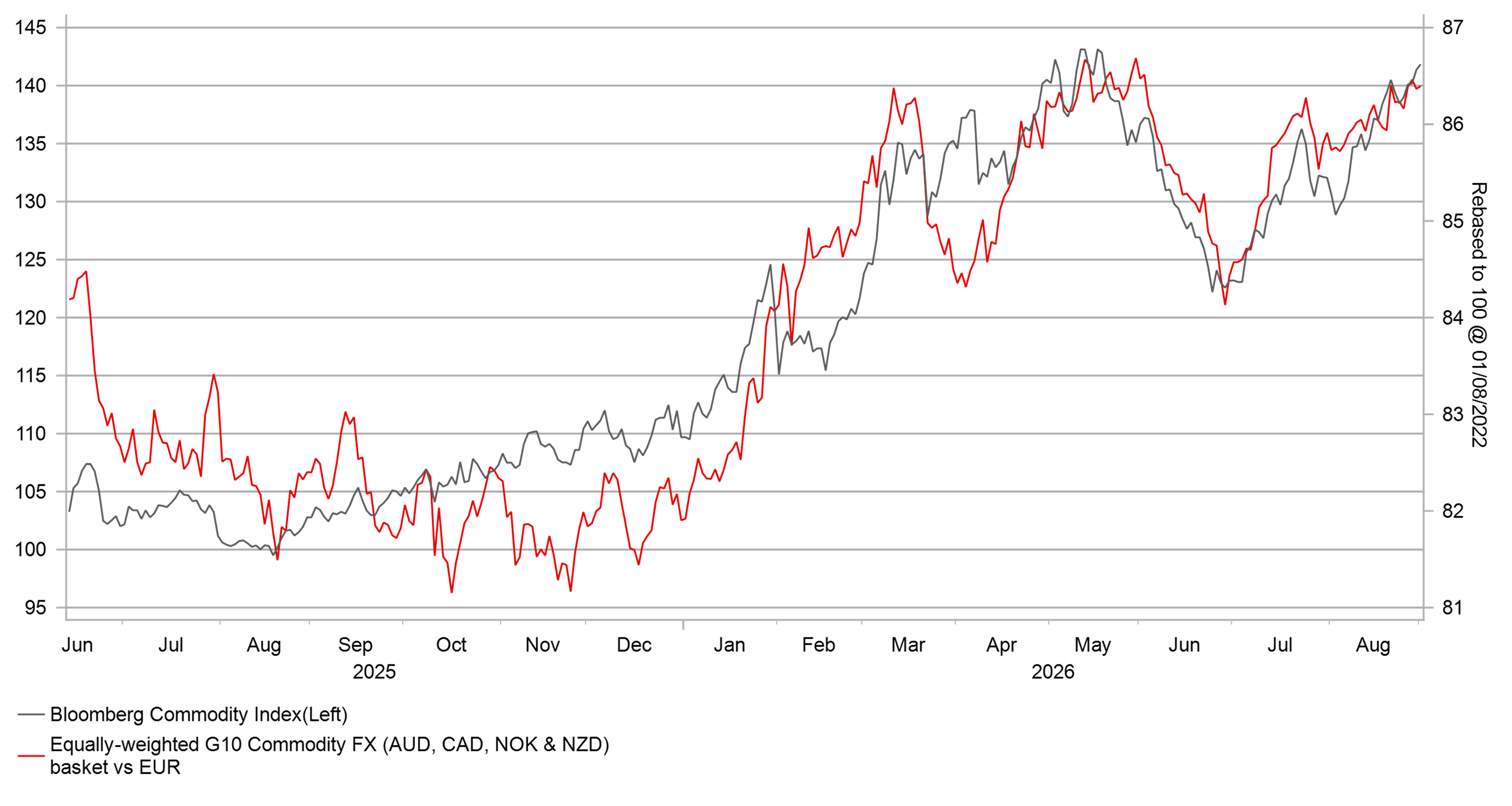
RISING COMMODITY PRICES ALSO HELPING COMMODITY-RELATED G10 FX
Source: Bloomberg, Macrobond, MUFG Research
KEY RELEASES AND EVENTS
Country | BST | Indicator/Event | Period | Consensus | Previous | Mkt Moving |
FR | 08:50 | French Manufacturing PMI | (Aug) | 51.5 | 49.8 | !! |
GE | 08:55 | German Manufacturing PMI | (Aug) | 54.1 | 52.2 | !!! |
EZ | 09:00 | Manufacturing PMI | (Aug) | 52.8 | 51.9 | !! |
UK | 09:30 | Manufacturing PMI | (Aug) | 51.5 | 51.9 | !! |
UK | 09:30 | Mortgage Approvals | (Jul) | 59.00K | 58.20K | !! |
UK | 09:30 | BoE Consumer Credit | (Jul) | 1.800B | 1.807B | ! |
UK | 09:30 | Net Lending to Individuals | (Jul) | 9.200B | 9.500B | ! |
EZ | 10:00 | Unemployment Rate | (Jul) | 6.3% | 6.3% | ! |
EZ | 10:00 | CPI (MoM) | (Aug) | 0.50% | 0.2% | !!! |
EZ | 10:00 | CPI (YoY) | (Aug) | 3.3% | 2.9% | !!! |
EZ | 10:00 | Core CPI (YoY) | (Aug) | 2.5% | 2.5% | !!! |
EZ | 13:30 | ECB's Nagel speaks | !! | |||
US | 14:05 | Fed Vice Chair for Supervision Barr Speaks | - | - | - | !! |
CA | 14:30 | Manufacturing PMI | (Aug) | - | 53.5 | ! |
US | 14:45 | Manufacturing PMI | (Aug) | 53.2 | 53.2 | !!! |
US | 15:00 | ISM Manufacturing PMI | (Aug) | 55.2 | 55.6 | !!!! |
US | 15:00 | ISM Manufacturing Prices | (Aug) | 71.2 | 71.1 | !!! |
US | 15:00 | JOLTS Job Openings | (Jul) | 7.330M | 7.359M | !!! |
US | 15:00 | Construction Spending (MoM) | (Jul) | 0.0% | -0.1% | !! |
Source: Bloomberg & Investing.com