
Oil and inflation help deepen the divide across Asia FX
Download the full PDF report using the link above.
Week Ahead FX outlook:
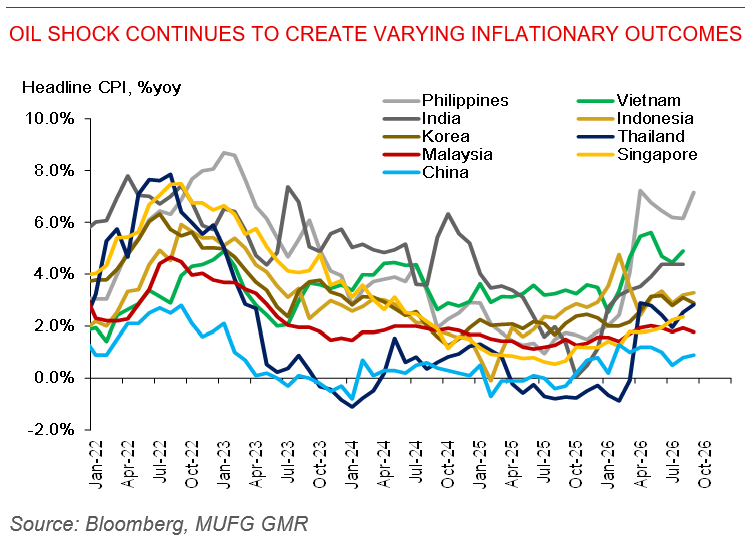
US ISM, ADP, and payrolls will determine the USD/rates factor. But the Asia economic calendar should create greater relative dispersion. Stronger US data would exert pressure on Asia FX broadly, but the relative regional performance should depend on domestic inflation, oil exposure, policy space and tech-cycle support. Notably, there will be a flurry of Asia inflation data from Indonesia, Vietnam, Thailand, Korea, and Taiwan next week.
We expect higher inflation in Thailand, the Philippines and Vietnam, while Korea inflation is expected to ease slightly and Taiwan inflation to moderate. We retain our cautious outlook for THB, PHP, and IDR. In particular, BOT held rates at 1% this week, while Bank Indonesia has not moved the key policy rate in recent months. Meanwhile, contained inflation in Malaysia should allow BNM to keep the policy rate on hold at 2.75% next week.
Indonesia has both CPI and Q3 GDP next week. We would frame IDR risk around still elevated US yields, oil shock impact on trade and fiscal positions, portfolio outflows, rather than just inflation alone.
China’s monetary policy framework is evolving, with the PBOC shifting its main policy anchor from the seven-day to the overnight reverse repo rate. The overnight rate was set at 1.25%, compared with 1.40% for the seven-day rate, with daily overnight operations beginning from 2 November. We view this primarily as a change in the PBOC’s operating framework, giving the central bank a more direct tool to manage overnight liquidity and short-term market rates. For the week ahead, the focus will be on how smoothly money-market rates adjust to the new framework and whether the transition signals any broader change in the PBOC’s liquidity stance.
Oil shock continues to create varying inflationary outcomes