

Ahead Today
G3: US initial jobless claims, Germany PPI
Asia: China LPR, Malaysia trade, Taiwan export orders
Market Highlights
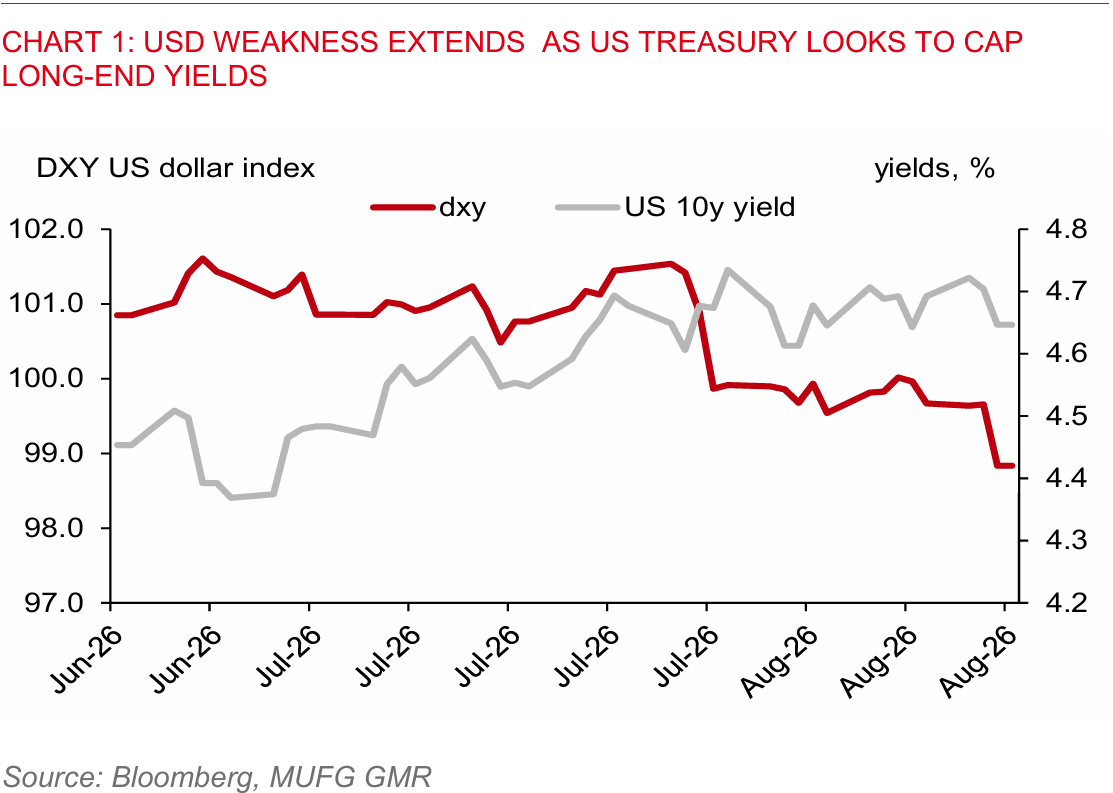
The US dollar weakened after US Treasury Secretary Bessent announced a significant expansion of long-dated Treasury buyback operations, a move to ease pressure from rising long-end yields. Treasury purchases of 10-year to 30-year securities will be increased substantially. The immediate market reaction was a decline in long-end Treasury yields and a weaker dollar. While buybacks alone are unlikely to alter longer-term fundamentals, they do signal willingness by policymakers to lean against further yield increases. This suggests the relative-rate story that has supported the dollar is fading.
Looking ahead, moderating Fed tightening expectations and Treasury efforts to contain long-end yields could continue to cap dollar upside. Absent a renewed rise in US inflation or yields, the hurdle for another sustained dollar rally is becoming increasingly high. This should continue to provide a supportive backdrop for Asian currencies in the near term, particularly those with resilient domestic fundamentals, stronger external balances and positive exposure to global tech cycle.
The Korean won has outperformed regional peers this month. Beyond a softer dollar backdrop, the won is also supported by a resilient semiconductor and AI investment cycle, supporting exports, earnings, and portfolio inflows. Importantly, despite the sharp appreciation seen recently, the won remains undervalued after several years of underperformance. That said, USDKRW appears increasingly oversold in the near term and may be vulnerable to consolidation.
In Indonesia, Bank Indonesia left the policy rate unchanged at 5.75%, reinforcing policy continuity under Acting Governor Destry Damayanti and maintaining its focus on rupiah stability. The recent rupiah stabilisation has provided room for BI to stand pat while relying on incentives to attract foreign inflows, including keeping SRBI yields elevated and lowering hedging swap costs. While a softer dollar backdrop is supportive for IDR in the near term, investor caution is likely to persist amid ongoing MSCI concerns over Indonesian equity market accessibility and liquidity.
The broader takeaway remains that a less supportive USD environment is creating opportunities for selective Asia FX outperformance, with KRW continuing to stand out as one of the preferred expressions of that theme.