

Ahead Today
G3: US existing home sales
Asia: China CPI and PPI
Market Highlights
The upside risks to US labour data have played out. April nonfarm payrolls rose 115k, well above consensus expectations of +65k, although momentum has slowed from 185k in March. The unemployment rate was unchanged at 4.3%, while wage growth firmed to 3.6%yoy from 3.4% in March. That said, the dollar failed to rally meaningfully, with DXY closing lower last Friday. A sharp hawkish repricing of Fed expectations is unlikely in our view, limiting the extent of any USD upside.
On the geopolitical front, there appears to be limited appetite on either side to further escalate tensions in the Middle East too. But a durable resolution that ends the US–Iran conflict and reopens the Strait of Hormuz remains challenging, prolonging the energy disruption. Iran has responded to the US proposal by demanding war reparations, Iranian control over the Strait of Hormuz, an end to US sanctions, and the release of frozen assets. President Trump’s swift rejection of these counter-demands underscores the wide gulf between both sides, pointing to a risk of prolonged uncertainty rather than rapid de-escalation. For oil markets, this suggests a persistent geopolitical risk premium as Hormuz disruptions drag on.
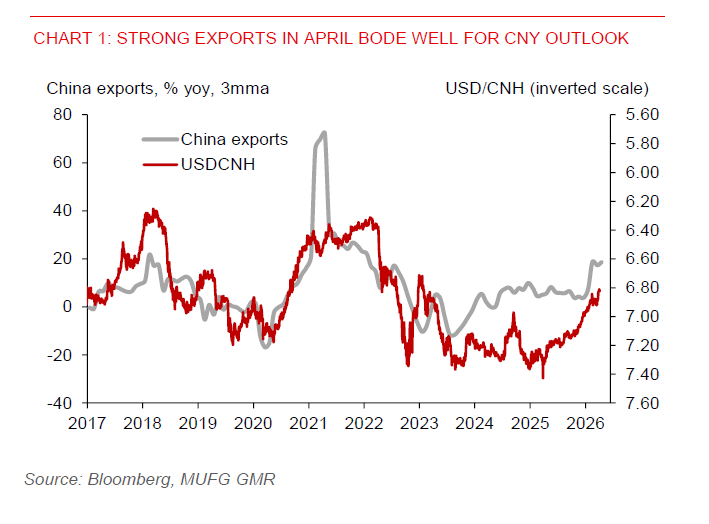
Limited appetite for further escalation in the Middle East, alongside capped USD strength despite an NFP report that beats market expectations, is broadly supportive for Asian currencies. In addition, China’s exports rose 14%yoy in April from 2.5% in March, while the trade surplus widened sharply to US$84.8bn from US$51.1bn. We expect the strength in China’s external sector to lend support to CNY appreciation and generate positive spillovers for selective regional currencies, including SGD, MYR, and TWD. Taiwan’s export growth moderated to 39%yoy in April from 61.8% previously, but remains robust, confirming the sustained upcycle in regional tech exports.
However, as energy-related disruptions linger, rising risks of fuel shortages could pose a more differentiated challenge for regional FX, particularly for economies with relatively low crude inventory buffers. This includes India and several ASEAN markets such as the Philippines, Vietnam, and Indonesia, although we acknowledge ongoing efforts across the region to secure alternative supply from non-Middle East producers.