

Ahead Today
G3: US PPI
Asia: South Korea Money Supply
Market Highlights
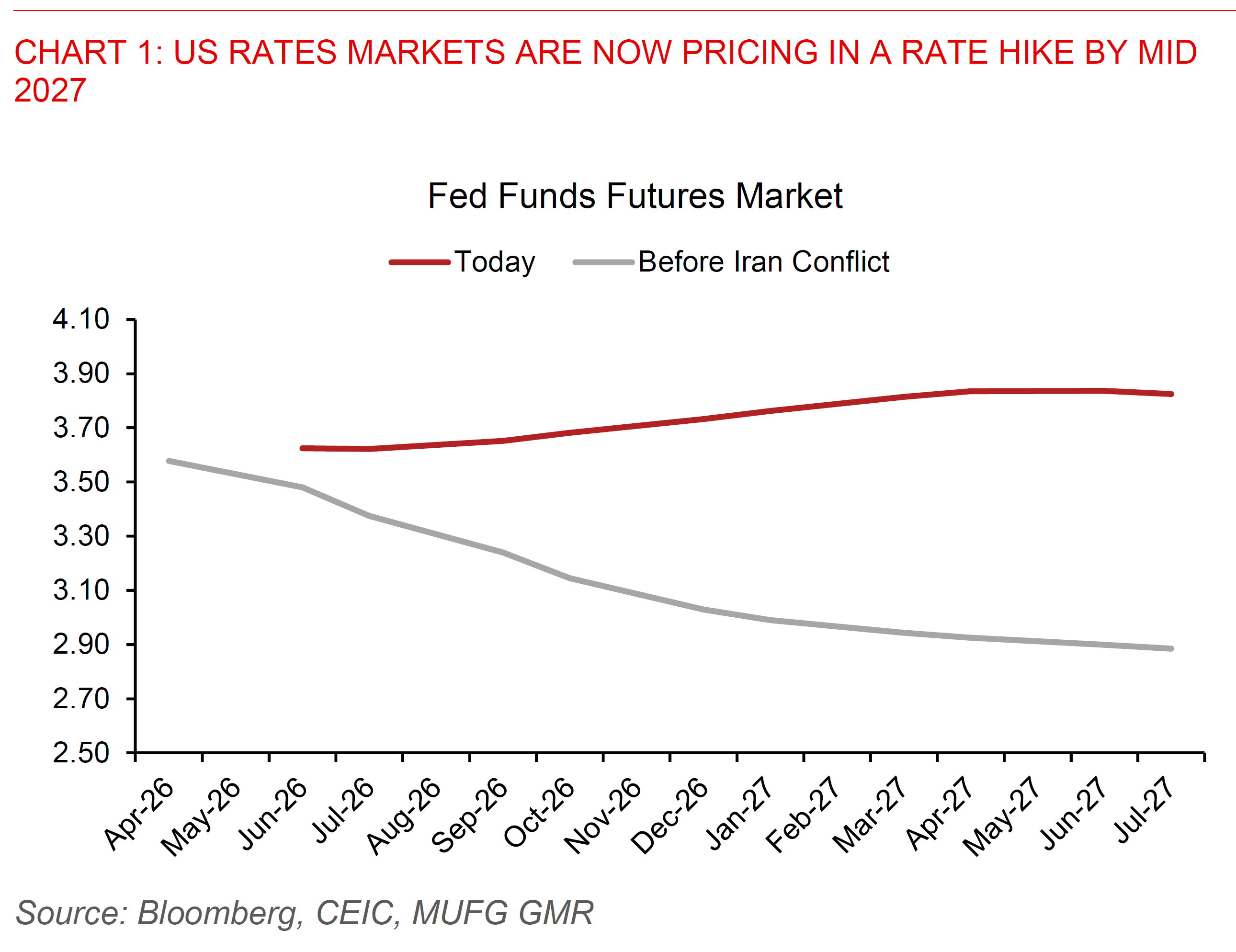
Markets were dominated by a hotter-than-expected US April CPI print together with Iran and oil price developments, and if anything it seemed that price action were already moving ahead of key developments. In particular, US headline inflation rose to 3.8% year-on-year, a three-year high driven by a 17.9% surge in energy costs — as the US-Iran ceasefire remained uncertain. WTI settled near $102 and Brent just below $108, up over 4% on the day, after satellite imagery showed Iran's Kharg Island export terminal had been idle for several consecutive days. The hot data halted Wall Street's record run — the S&P 500 fell 0.2%, the Nasdaq dropped 0.7%, and chip stocks bore the brunt with the semiconductor index down roughly 3%. Bonds sold off sharply, with the US 10-year yield rising to a near one-year high of 4.46% and the 30-year back above 5%, while rates markets began pricing in a Fed hike by mid-2027. In the UK, a political crisis compounded the pressure on gilts — four junior ministers resigned and over 90 Labour MPs called on Prime Minister Starmer to step down following Labour's disastrous local election results, sending longer-dated gilt yields to multi-decade highs.
Asia saw its own share of volatility, and in particular the Asian FX already vulnerable to oil prices such as INR and PHP saw their woes compounded by higher US rates, coupled with some local developments in the likes of Indonesia pushing up USD/IDR to all-time highs as well. South Korea's Kospi fell as much as 5.1% on Tuesday after presidential policy chief Kim Yong-beom floated a "citizen dividend" funded by taxes on AI profits via a Facebook post, rattling Samsung and SK Hynix — the two stocks that have powered the Kospi's 81% rally this year. The index pared losses to around 2.3% after Kim clarified the proposal referred to existing excess tax revenues rather than a new windfall levy, and a Blue House official described the remarks as his personal view. In Japan, US Treasury Secretary Bessent met Finance Minister Katayama in Tokyo, with both sides reaffirming that "excess FX volatility is undesirable" — a signal widely read as tacit US approval of Japan's recent intervention. Bessent also met Prime Minister Takaichi, stating that "the fundamentals of the Japanese economy are indeed strong and resilient." Separately, the Bank of Japan's April meeting minutes showed the Hormuz crisis was a key factor in the board's 6-3 vote to hold rates at 0.75%, though the summary of opinions signalled a June hike remains "quite possible." In Indonesia, MSCI confirmed the removal of PT Barito Renewables Energy and PT Dian Swastatika Sentosa from its indexes — effective May 29 — as part of its quarterly review targeting stocks with concentrated ownership. Four additional Indonesian names were also cut, with total passive outflows potentially up to $1.6–2.0 billion. India's Nifty 50 fell 1.8% for a fourth consecutive session, weighed by India’s vulnerability to oil prices, and this also compounded weak capital inflows into India leading to INR underperformance.
Looking ahead today, the Trump-Xi summit in Beijing is the dominant geopolitical focus. On the data front, US April PPI is due, a key read following yesterday's CPI surprise, alongside a $25 billion 30-year Treasury auction that will test duration appetite.