

Ahead Today
G3: US NAHB Housing Index
Asia: China Monthly data, Thailand GDP
Market Highlights
Global government yields rose sharply heading into the start of this week, as three forces collided: surging oil prices, fading hopes for a Strait of Hormuz resolution, and mounting fiscal concerns especially in the UK and US. The Strait of Hormuz remains meaningfully closed— now approaching eleven weeks — after the Trump-Xi summit in Beijing concluded without a breakthrough on reopening the waterway, sending Brent oil above US$110/bbl. US 10-year Treasury yields surged 12 basis points to close at 4.594%, their highest since May 2025, while the 30-year hit 5.127% — its highest closing level since July 2007 and the largest one-week gain since April 2025. Critically, the move was not purely driven by rising inflation expectations: 10-year TIPS real yields also rose sharply to around 2.05%, a dynamic more damaging to risk assets and EM currencies than nominal yield moves alone. Japan's long-end was equally dramatic, with the 30-year JGB breaching 4% for the first time since 1999 and the yen sliding past 158 against the dollar, while UK 30-year gilt yields rose 18 basis points on the day to their highest since 1998, compounded by domestic political turmoil.
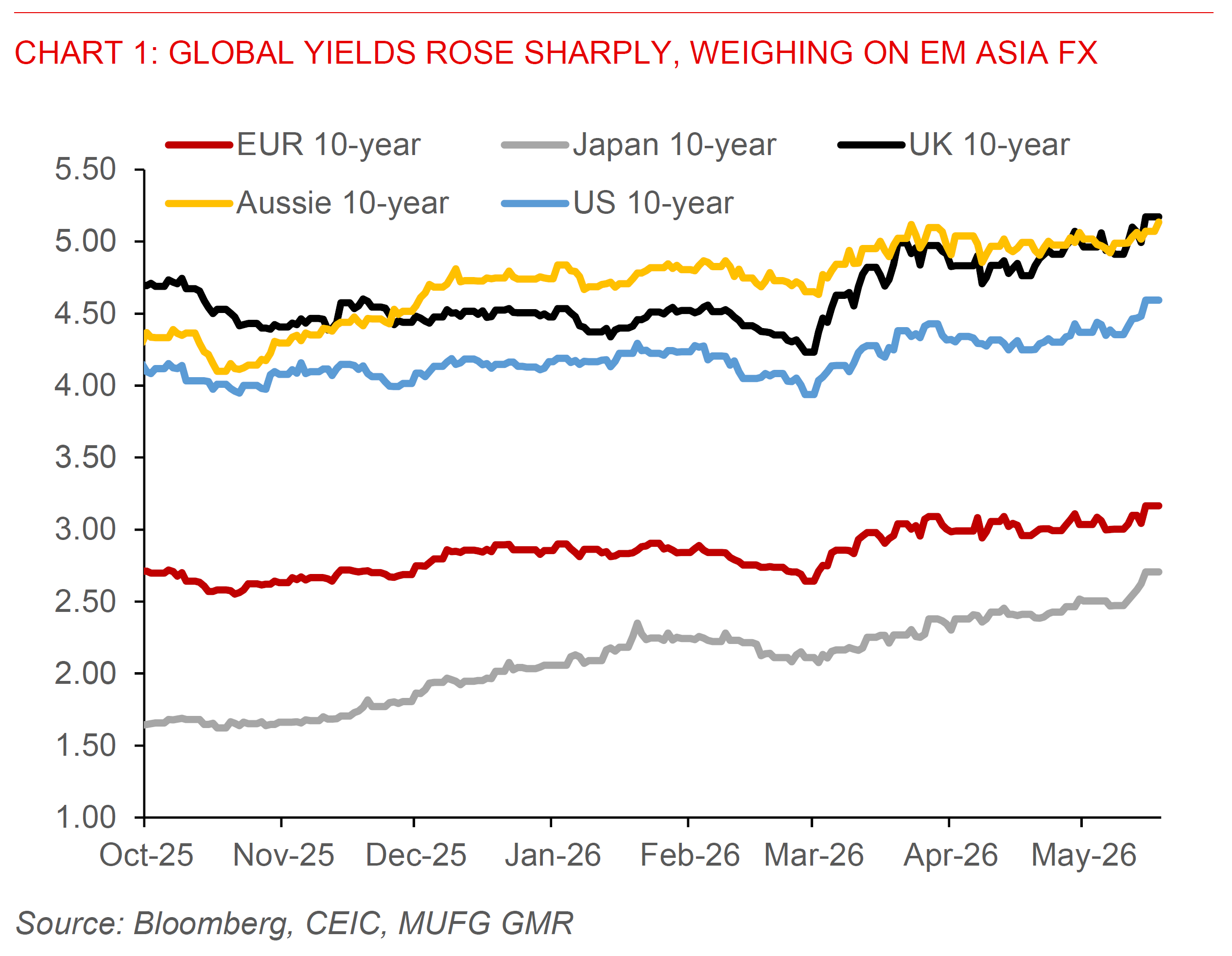
Asian EM currencies bore the brunt of the dollar's strength, higher US real yields, and elevated energy prices. This was particularly true for the oil importers such as INR and PHP, which now face a double whammy of higher oil prices and rising US yields, coupled with currencies with domestic headwinds and sensitive to US yields such as IDR. The MSCI EM Currency Index closed the week of 15 May 0.9% lower, its worst weekly performance since early March. The Indian rupee was the most prominent casualty, breaching 96 per dollar for the first time on record on Friday, with a cumulative depreciation of roughly 5.5% since the Iran conflict began in late February, making it Asia's worst-performing major currency in 2026. The Thai baht and Philippine peso also underperformed, while the New Zealand dollar fell toward 0.5850 on rising Fed rate hike expectations. Compounding the pressure, the 60-day correlation between Brent crude and the Bloomberg Dollar Spot Index has reportedly reached 0.55 — the highest since the index's inception in 2005 — meaning Asian oil importers face a simultaneous squeeze from a stronger dollar and a higher commodity import bill. India moved swiftly over the weekend to defend the rupee, tightening silver import rules and requiring prior government approval for silver bar imports, while Sri Lanka imposed a 50% import duty surcharge on private vehicles for three months, both citing foreign exchange reserve pressures.
Looking to the day ahead, the G7 Finance Ministers and Central Bank Governors meeting opens today in Paris (through 19 May), with the global bond selloff on the agenda. On trade, the White House confirmed over the weekend that China has agreed to purchase at least $17 billion of US agricultural products annually through 2028, while both sides agreed to establish bilateral trade and investment councils and to mutually cut levies on certain products — though China has not provided specifics on the tariff reductions. The agreement offers a degree of relief for Asian markets, though the spike in US yields and the Strait of Hormuz impasse remains the dominant macro variable. China's April activity data are also due this morning, with continued signals of a two-speed economy with robust industrial production offset by soft domestic demand.