

Ahead Today
G3: US mortgage applications
Asia: Philippines unemployment rate, Indonesia consumer confidence
Market Highlights
External pressures on Asia FX remain in the near term, although domestic fundamentals and central bank responses are likely to drive some divergent performances across the region.
The US dollar (DXY) has remained firm above the 100 level, while US Treasury yields have moved higher, with the 2-year yield rising around 7bps to 4.18% and the 10-year yield up 8bps to 4.55%. Markets are now fully pricing in one additional Fed rate hike by October. Notably, the ISM Services Employment Index improved to 51.2 in June from 47.9 previously, while the pass-through from lower crude oil prices to US gasoline prices has been slow.
At the same time, geopolitical risks in the Middle East have re-emerged despite the temporary ceasefire between the US and Iran. Reports suggest that the US has launched renewed strikes against Iran following attacks on vessels transiting the Strait of Hormuz. Brent crude rose 3% to $74/bbl, marking its largest daily increase since 2 June. While oil prices remain well below recent highs, developments in the Middle East warrant close monitoring.
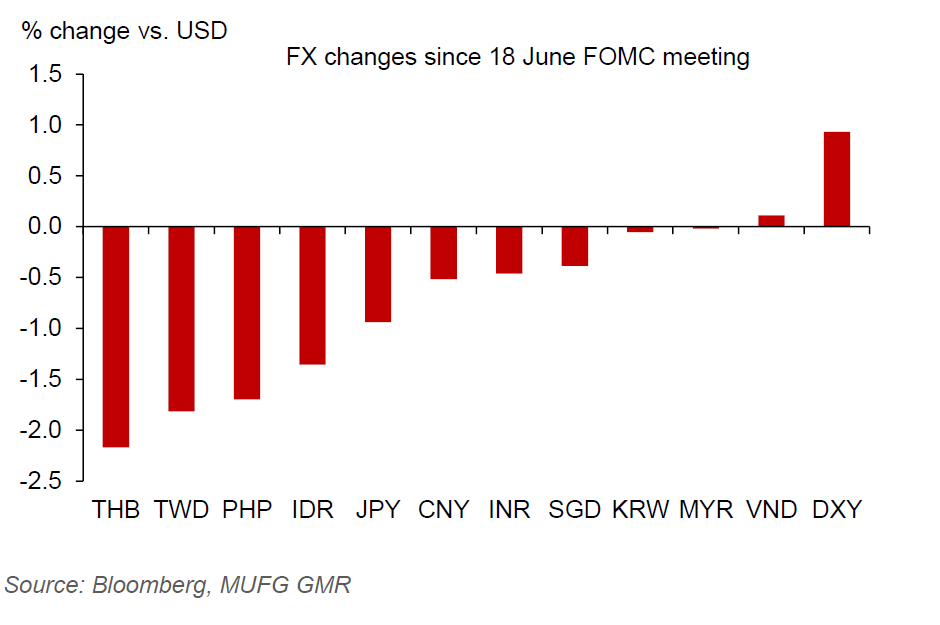
Most Asian currencies have weakened against the US dollar since the 18 June FOMC meeting.
In Indonesia, rupiah volatility has eased considerably following Bank Indonesia's intensified support measures, including policy rate hikes and higher SRBI yields. Nonetheless, the rupiah remains sensitive to higher US yields. Meanwhile, the domestic macro backdrop has become somewhat less supportive. Manufacturing activity contracted in June, exports fell 5.8%yoy, the trade balance recorded its largest deficit since April 2019 in May, and inflation rose to 3.3%yoy, moving closer to the upper bound of BI's 2.5%±1% target range.
In Thailand, inflation moderated further to 2.4%yoy in June, although signs of underlying economic stress persist. Non-performing loan ratios have continued to deteriorate across several key sectors, highlighting ongoing vulnerabilities in the domestic economy. We continue to expect the BOT to keep the policy rate unchanged at 1.0%, which weighs on the baht's relative carry attractiveness.
As for the Malaysian ringgit, BNM's efforts to encourage government-linked companies and exporters to repatriate overseas earnings have helped limit disorderly currency movements. However, political risks are likely to move increasingly into focus. With the 11 July state election approaching, we could see a modest election-related risk premium being priced into the ringgit in the near term.
In the Philippines, the peso continues to face headwinds from slowing economic growth, inflation that remains elevated at above 6%, and relatively subdued capital inflows. Further BSP tightening is likely to remain supportive in containing inflation pressures and helping to support the currency.