

Ahead Today
G3: US FOMC minutes
Asia: BI policy decision, Philippines BOP
Market Highlights
Markets have scaled back US rate hike expectations following softer US economic and inflation data for July. The convergence in expected relative rates, previously supportive of USD gains, appears to have run its course in the near term. But the softer US macro data are still insufficient to shift market expectation towards outright Fed policy easing. The August US employment and inflation reports will be particularly important in shaping expectations for the Fed's next policy move. Meanwhile, the US-Iran conflict continues to drag on, with Brent crude rebounding above US$90/bbl and average US retail gasoline prices staying above $4 per gallon, keeping upside inflation risks alive.
In Japan, however, markets have continued to price in more BOJ tightening for the next 12 months. Together with recent yen intervention, this has helped stabilize USDJPY around the 160.00 level and contained further yen depreciation for now. But Japan’s weaker-than-expected Q2 GDP growth raises questions about how aggressively the BOJ can tighten policy over the coming months, potentially challenging the extent of rate hikes currently being priced in by markets.
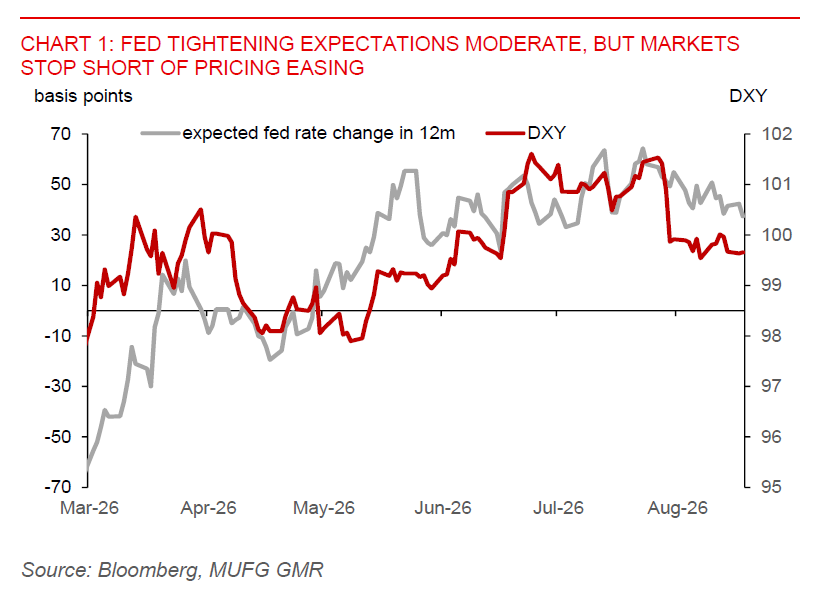
August price action thus far suggests that markets are becoming increasingly selective in their Asia FX outlook. The strongest gains were concentrated in KRW and TWD, pointing to investor preference for currencies leveraged to a softer US rates environment and a resilient global technology cycle.
In contrast, JPY remained the region's laggard despite BOJ tightening expectations. The burden of proof remains on stronger wage, inflation, and activity data.
Meanwhile, several ASEAN currencies have strengthened month to date despite Brent crude prices staying around $90/bbl, suggesting that lower front-end US yields are partly supportive of regional FX gains. That said, any renewed surge in Brent prices would likely pose headwinds for the baht and peso – both of which are experiencing an economic slowdown. In Indonesia, the recent rupiah stabilisation, partly helped by BI policy measures, is likely to give room for BI to keep the policy rate unchanged at 5.75% today. But Indonesia’s weakened trade balance and still tight dollar liquidity conditions warrant caution on the rupiah’s outlook.