

Ahead Today
G3: US ADP employment, factory orders, durable goods orders
Asia: Singapore PMI
Market Highlights
Markets have repriced the US rates outlook following Fed Chair Warsh’s Jackson Hole speech last Friday, increasingly embracing a "high-for-longer" narrative amid persistent inflation pressures and renewed supply-side shocks. Markets now price a 66% probability of a September Fed rate hike and roughly 1.5 hikes by end-2026. Since Jackson Hole on 28 August, US Treasury yields have surged across the curve, with the 2y yield up 16.8bp, the 10y yield up 12.2bp and the 30y yield up 8.0bp.
The repricing is occurring against an increasingly challenging inflation backdrop. Brent crude surged 4.6% overnight to almost $95/bbl following renewed strikes between the US and Iran. At the same time, agricultural commodity prices continue to trend higher, adding further upside risks to global food inflation. These developments have partly helped push global bond markets back into a broad selloff, with the US 10y Treasury yield climbing to 4.80%, while Japan's 10y JGB yield touched 3%.
Inflation data continue to validate these concerns. South Korea's headline inflation accelerated to 3.1%yoy in August from 2.8% in July and core inflation jumped sharply to 3.4%yoy from 2.6%.
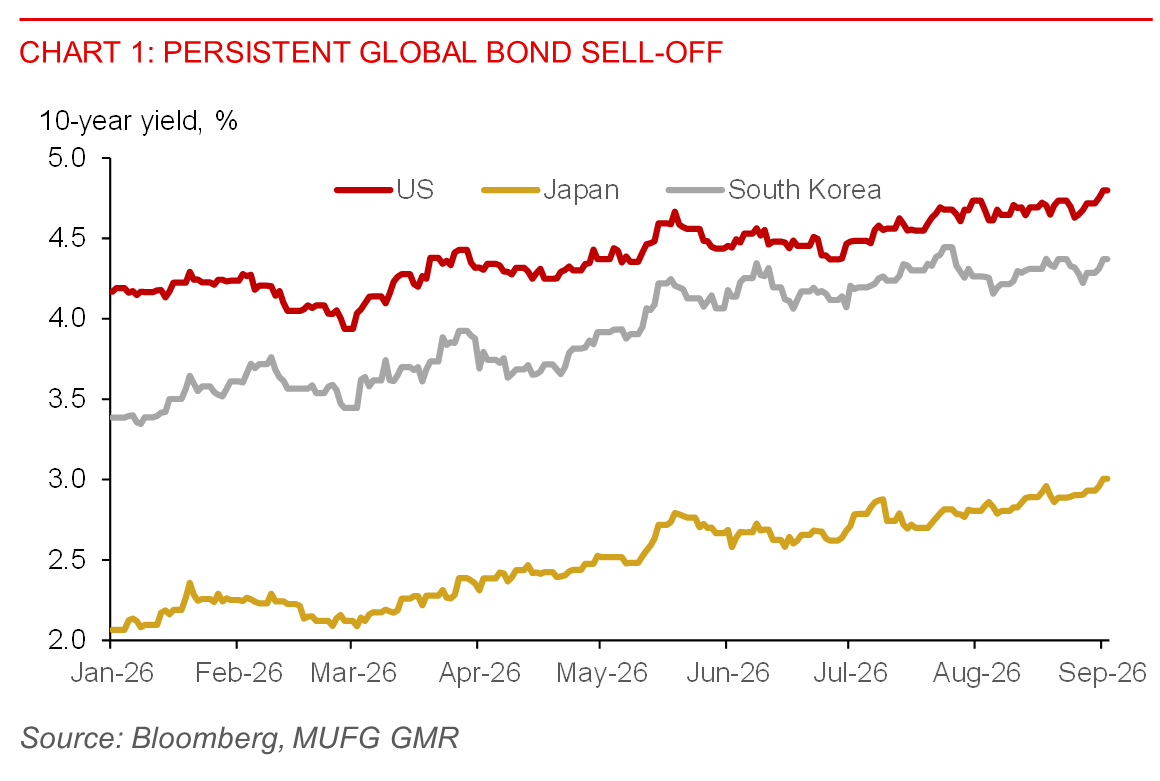
Asian currencies face headwinds from rising US yields and oil prices. Rising oil prices worsen the terms of trade for net energy importers such as Thailand, the Philippines, India, and Korea, while simultaneously boosting inflation expectations.
Meanwhile, we remain cautious on the rupiah. August CPI inflation accelerated to 3.19%yoy and with GDP growth continuing to exceed 5%, inflation risks remain skewed to the upside. July's trade balance returned to a modest surplus of $0.12bn after two months of deficits, largely due to a narrowing in the oil and gas trade deficit to $2.9bn from $3.5bn previously. Nonetheless, the trade balance remains substantially below 2025 averages, highlighting the ongoing drag from higher oil and gas imports. Bank Indonesia's policy support and intervention framework should continue to provide near-term support for the rupiah, but sustained Brent prices above $90/bbl would place increasing pressure on both Indonesia's fiscal and external balances.