

Ahead Today
G3: Dallas Fed manufacturing activity, Germany CPI
Asia: China PMI, Thailand BOP, India GDP
Market Highlights
Markets start the week digesting a hawkish message from the Fed following Fed Chair Warsh's Jackson Hole speech. While stopping short of explicitly backing a September rate hike, Warsh stressed that inflation remains insufficiently contained, reaffirmed the Fed's commitment to its 2% target, and argued that current financial conditions are not restrictive. He also noted that recent improvements in inflation data are not yet enough to signal a meaningful improvement in underlying price trends.
The speech prompted a repricing of US rates. Markets now assign a 58% probability of a September hike and price roughly 1.5 hikes by year-end. Treasury yields moved higher, led by the front end, with the 2-year yield rising 11bp while the 10y-2y curve flattened by almost 7bp. The move lifted the dollar, with DXY gaining 0.5% on Friday, suggesting investors are reassessing expectations for the Fed rate path ahead.
For Asia FX, the key implication is that the market narrative has likely shifted toward whether inflation remains sticky enough to warrant policy tightening. While recent dollar weakness had provided support for Asia FX broadly, Friday's market reaction suggests that several regional currencies could face a tougher backdrop this week if front-end US yield increases prove persistent.
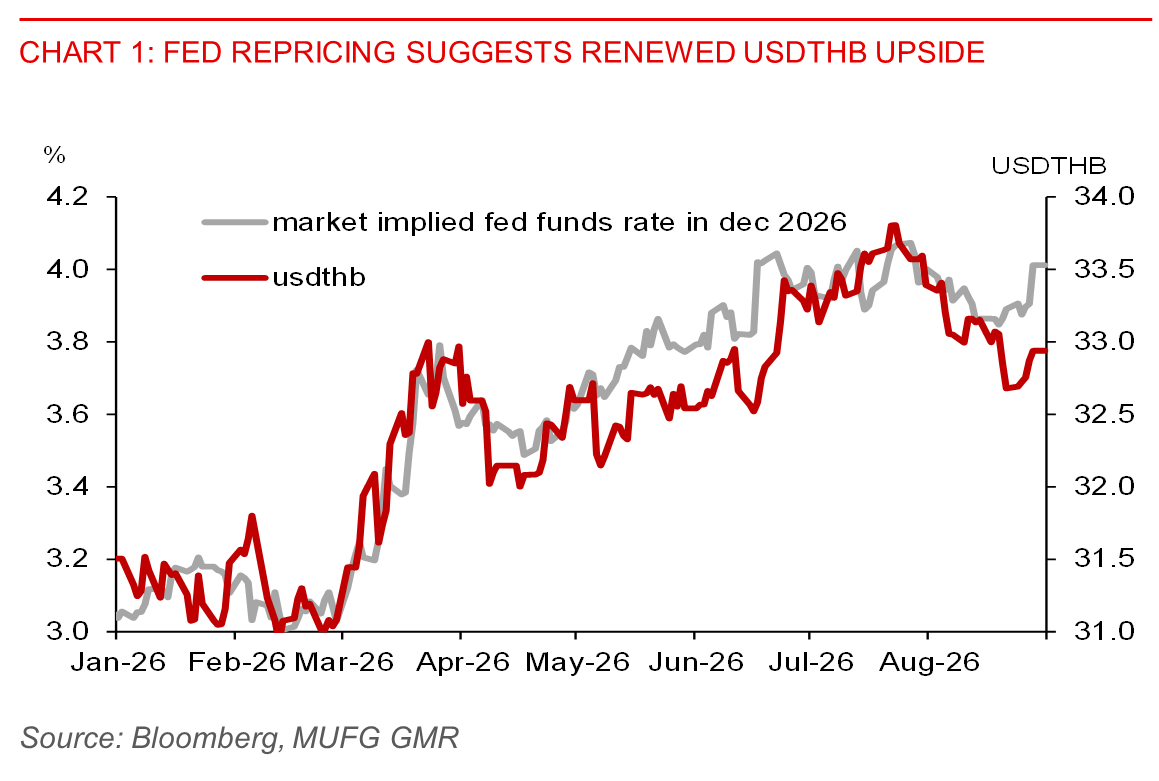
Among ASEAN currencies, THB and IDR appear particularly exposed to the rise in US rate expectations. Thailand continues to offer limited yield support, while elevated Brent prices are weighing on the external balance. Last week's BOT meeting reinforced that policymakers remain comfortable maintaining a growth-supportive stance despite inflation risks. Meanwhile, recent policy measures to curb gold-related flows could reduce support for the baht.
For Indonesia, higher US yields arrive as investors are increasingly monitoring domestic developments. Recent protests have highlighted concerns over living costs and jobs, while approval ratings for the government have softened. Although BI's currency-supportive stance has helped stabilize the rupiah, a further increase in Treasury yields could reduce support from portfolio inflows and place renewed upward pressure on USDIDR.
In contrast, SGD and MYR continue to look more resilient than implied by US rate differentials alone. Stronger external positions, healthier domestic fundamentals, and policy credibility should help cushion both currencies.