

Ahead Today
G3: US initial jobless claims, ECB policy decision
Asia: Singapore CPI, Taiwan industrial production
Market Highlights
Geopolitical risks in the Middle East continue to escalate as tensions between the US and Iran intensify once again. President Trump warned that the US would target Iranian bridges and power infrastructure if Iran attacks vessels transiting the Strait of Hormuz. In response, Iran stated that it would strike power facilities across the Gulf region if its own infrastructure and energy assets come under attack. Tehran has also warned shipping companies against using alternative routes around Hormuz. Since the collapse of the US-Iran ceasefire memorandum signed in June, renewed hostilities have led to a sharp decline in tanker traffic through the Strait of Hormuz. Adding to supply concerns, the Houthis have reportedly attacked two Saudi oil tankers in the Red Sea, threatening shipping through the Bab el-Mandeb Strait—an increasingly important alternative route for regional oil exports.
The key market risk is whether the conflict shifts from a phase of renewed escalation to one that triggers a broader global energy shock. Brent crude prices have rebounded above USD90/bbl this month. At the same time, US Treasury yields have moved higher, with the 2-year yield rising to 4.3% and the 10-year yield to 4.65%.
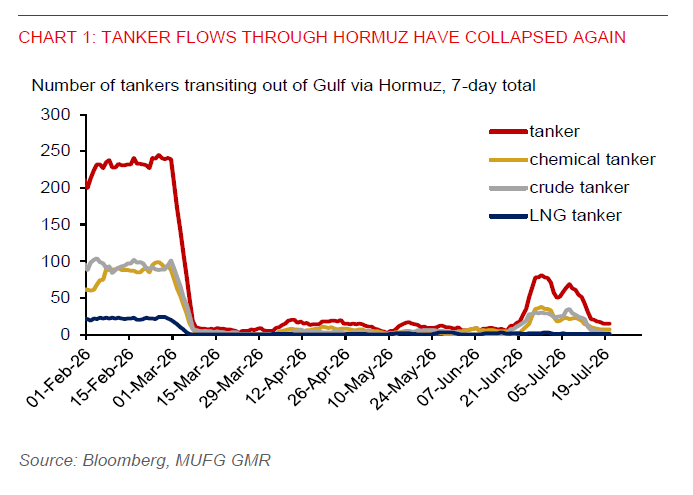
Disruptions to oil shipments from the Gulf, combined with rising US Treasury yields, are likely to weigh broadly on Asian currencies. Many regional economies remain highly dependent on imported energy, including Japan, Korea, Singapore, the Philippines, and Thailand. In addition, the Middle East accounts for more than half of Asia’s naphtha imports, making the region’s petrochemical sector particularly vulnerable to supply disruptions. Should oil prices remain elevated and concerns over fuel shortages persist, the spillover effects could be significant, particularly for energy-intensive industries and economies with large external energy needs.
The Thai baht remains especially vulnerable in this environment, falling 0.5% against the US dollar and leading regional losses yesterday. Baht weakness could persist with the current account deteriorating on the back of elevated oil prices.
In Indonesia, Bank Indonesia (BI) left its policy rate unchanged at 5.75% yesterday, defying market expectations for a 25bp rate hike. The recent stabilization of the rupiah appears to have given policymakers room to remain on hold for now. Governor Perry Warjiyo also emphasized that targeted measures to attract foreign inflows are likely to be more effective than higher interest rates in supporting the currency. Such measures include raising SRBI yields and reducing hedging swap costs for investors. That said, BI expects the Fed to tighten policy in Q4. While recent FX-supportive measures should help moderate the pace of rupiah depreciation, we believe further BI tightening may still be required given elevated US Treasury yields and heightened global uncertainties.