

Ahead Today
G3: US retail sales, University of Michigan sentiment survey; eurozone GDP
Asia: GDP data from Malaysia, Taiwan, and HK, India wholesale price, Thailand gross international reserves, Malaysia current account
Market Highlights
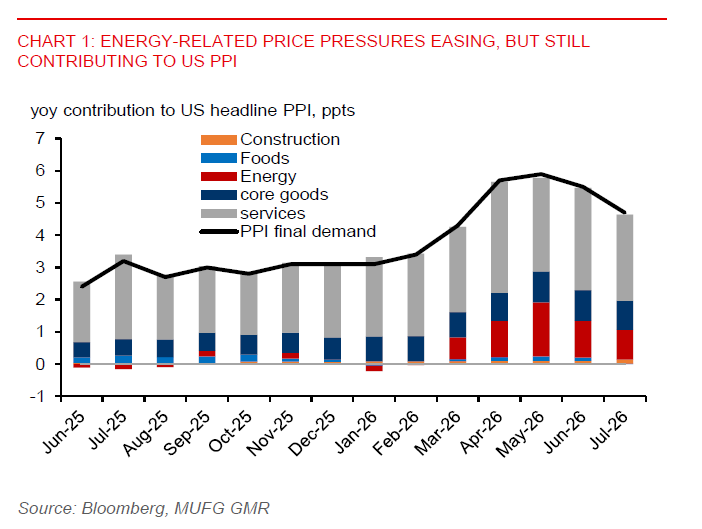
US producer price inflation (PPI) moderated in July, offering tentative signs that upstream price pressures may be easing. Headline PPI slowed to 4.7%yoy from 5.5%yoy in June, below market expectations of 4.9%yoy, while core PPI eased to 4.2%yoy from 4.7%yoy. The moderation in headline PPI was largely driven by a smaller contribution from services inflation, which fell to 2.7pp from 3.2pp in June, alongside a moderation in energy-related price pressures as the impact of the Middle East conflict somewhat eased. That said, energy still contributed 0.9pp to headline PPI, versus a flat contribution prior to the Middle East conflict. On a sequential basis, headline PPI was flat in July, while core PPI slowed to 0.2%mom from 0.4%mom in June, undershooting market expectations of 0.3%.
Markets have modestly pared back expectations for Fed rate hikes in September, though still pricing around a 90% probability of a 25bp rate hike in December. The DXY has remained resilient near the 100 level, while USDJPY has rebounded towards 160.00 following its recent decline. With CPI still above the Fed's 2% target, markets will assess if the Fed is committed to tackle inflation, especially if price pressures prove sticky in the coming months.
In Asia, attention will turn to Malaysia’s final Q2 GDP release later today, with consensus expecting growth of 5.8%yoy. The economy should continue to benefit from strength in the electrical and electronics sector amid robust global semiconductor demand. Malaysia’s trade surplus also remains an important pillar of MYR resilience amid rising domestic political risks. Strong electronics exports, which rose 42.5%yoy in H1, have more than offset higher oil import costs stemming from the Middle East conflict, while steady exports of palm oil and other palm-based products continue to underpin the country’s external balance.
Meanwhile, despite softer Chinese growth momentum in Q2, the PBOC has continued to guide USDCNY lower through its daily fixing rate, helping to anchor CNY strength. This remains supportive for MYR given the historically close co-movement between the two currencies. Combined with Malaysia’s robust trade surplus, a stable or firmer CNY could help cushion MYR against bouts of domestic political uncertainty and external market volatility.