

Trim oil exposure, stay selective on regional FX
Ahead Today
G3: US Initial Jobless Claims
Asia: Malaysia Policy Rate, Indonesia GDP, Taiwan CPI, Singapore Retail Sales
Market Highlights
The Democratic sweep of both the House and Senate at the US midterm election represents a meaningful shift in the political landscape and has triggered an unwind of part of the political and geopolitical risk premium embedded in markets. US Treasury yields fell across the board, while the dollar eased. Brent has sold off sharply as markets price a greater probability of de-escalation in the Iran conflict, although the underlying geopolitical risk has not disappeared. Our decision earlier this week to trim oil-related FX exposures ahead of the midterms looks well timed. The election represented a binary event risk at a point when positions linked to higher oil prices had already performed strongly. For Asia FX, the decline in oil removes an important terms-of-trade headwind for energy importers and argues for reducing some of the differentiation trades that were built around higher energy prices.
However, we would not interpret the post-election fall in US yields and the dollar as the beginning of a broad USD sell-off yet. US private payrolls rose by 86k in October, beating the 67k consensus and reinforcing signs of resilient labour demand following Tuesday’s stronger JOLTS print. Market expectations remain skewed toward further Fed tightening, with markets still pricing about 80% probability of a December rate hike.
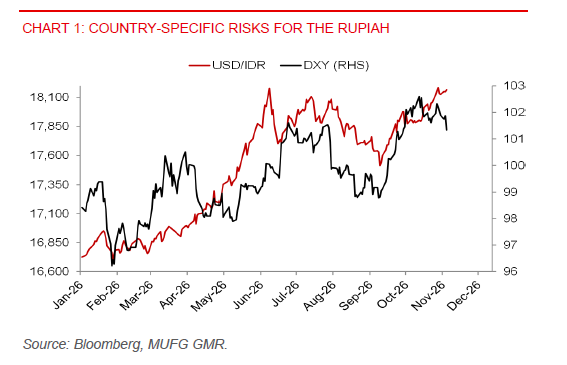
Meanwhile, we stay cautious of the rupiah, as domestic risks outweigh the softer dollar. The dismissal of President Prabowo’s chief of staff following allegations of illegal surveillance adds another layer of country-specific risk at a time when investor confidence is already fragile and foreign equity outflows remain a concern. Attention now turns to Q3 GDP, where market consensus expects growth to moderate to 5.2%yoy from 5.29% in Q2, reflecting softer investment and government spending. A weaker print would further complicate Bank Indonesia’s policy trade-off between supporting growth and maintaining FX stability. A softer USD can slow depreciation pressure, but it is unlikely to fully offset domestic political risk and persistent portfolio outflows.
South Korea and Taiwan remain beneficiaries of the regional AI and electronics upcycle, but their currencies have responded very differently following the US midterms. KRW appreciated by 0.3% against the dollar, while TWD fell 0.1%. This week, foreign investors have sold a net US$10.3bn in Taiwanese equities. Large net foreign equity outflows appear to cap TWD's ability to benefit from the more supportive external backdrop.
The Malaysian Ringgit strengthened against the dollar, with USD/MYR falling towards 4.06 ahead of today's Bank Negara Malaysia policy decision. Markets widely expect BNM to maintain its policy rate at 2.75%, supported by resilient domestic growth and manageable inflation. The softer dollar following the US midterm election will likely become more supportive for the ringgit.