

US Midterms take centre stage
Ahead Today
G3: US Midterm Elections, Trade Balance and ISM Services, Eurozone PMI
Asia: China RatingDog PMI Services, India PMI Services
Market Highlights
US midterm elections take centre stage today, with control of Congress set to shape the policy outlook for the remainder of President Trump’s term. Our global team sees a closer race than prediction markets imply, assigning a 50% probability to divided government versus 45% for a Democratic sweep. A divided Congress is viewed as the more market-friendly outcome, as policy gridlock could constrain major fiscal and regulatory changes, and Republicans winning both is with low chance.
Meanwhile, September JOLTS job openings rose to 7.52mn from 7.19mn, beating the 7.16mn consensus and pointing to firmer labour demand. US 10-year Treasury yields rose 6bps to 4.96% as markets increased bets on further Fed tightening, with Friday’s payrolls now in focus. Brent also traded choppily around $104/bbl amid conflicting headlines over US-Iran peace talks.
For Asia FX, the impact from the US midterm election will likely run through US yields, broader risk sentiment and US dollar performance channel. A Democratic sweep of both the House and Senate would likely be modestly positive for Asian FX, as stronger fiscal gridlock would reduce expectations for further US fiscal expansion, weighing on US yields and the USD, while a Democratic House/Republican Senate split would also imply divided government, but with less perceived constraint on the Republican/Trump policy agenda, so the smaller USD-negative and Asian-FX-positive reaction. In both cases, the impact is likely limited because tariff and trade policy remain substantially under presidential/executive control.
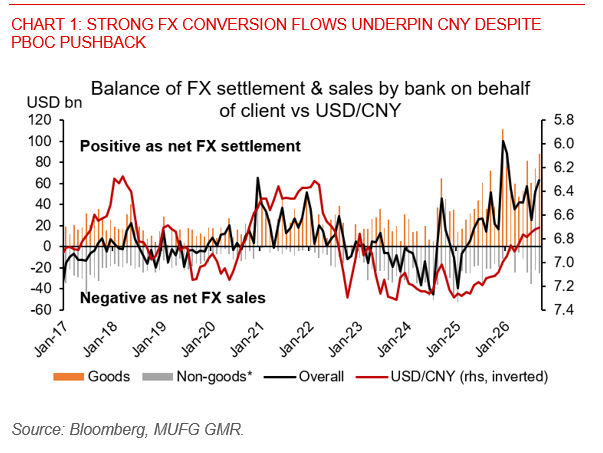
In China, PBOC raised the FX reserve requirement ratio to 6% from 4% after USD/CNY fell towards 6.65, effective 15 November. The measure is expected to lock up approximately USD24 billion in foreign exchange liquidity. This policy, in our view, is to reduce the pace of CNY’s appreciation against the Dollar, rather than an effort to reverse CNY appreciation trend. CNY’s strengthening this year has been supported by China’s large trade surplus and rising corporate FX conversion of proceeds from trade surplus to Reminbi. Also note that the PBOC’s reaction function remains asymmetric, with policymakers historically responding more forcefully to persistent depreciation than appreciation. We maintain our USD/CNY forecasts at 6.65 by end-2026 and 6.50 by Q3 2027.
Vietnam’s external position strengthened sharply in October, with the trade surplus jumping to $7.31bn from $1.27bn in September. Exports surged 51.4%yoy, outpacing the 43.1% rise in imports, while inflation remained broadly stable at 5.09%yoy. The stronger trade balance provides an underlying source of support for VND through export receipts, although Vietnam’s widening bilateral surplus with the US keeps trade-policy risks firmly in focus.
South Korea’s inflation data reinforced the contrast between easing headline inflation and persistent underlying price pressures. Headline CPI moderated to 2.8%yoy in October from 2.9%, while core inflation remained at 2.8%yoy, above consensus. Combined with strong growth and the semiconductor export boom, sticky core inflation should keep expectations for further BoK tightening alive. For KRW, that relatively supportive rate backdrop adds to the fundamental support from Korea’s increasingly large trade surplus, although foreign equity flows remain a pivotal offset.