

Less hawkish Fed comments lowers US yields
Ahead Today
G3: US PCE, US MBA Mortgage Applications, US Personal Spending, Germany CPI
Asia: China Official PMI data, China RatingDog PMI, Philippines Trade, Thailand Current Account and Exports, India Bank Credit
Market Highlights
US 2-year yields fell around 5bps from 4.93% to 4.88%, while front-end rates markets lowered the probability of an October rate hike, as somewhat less hawkish comments from New York Fed President John Williams stabilised US Treasury yields. In particular, he said that one more interest rate hike “late this year” may be appropriate to help contain inflation, while saying that there was no urgency to act following the Fed’s decision to lift rates earlier this month if the economy evolves in a manner broadly consistent with his forecast. Broader Fedspeak were overall consistent with further interest rate increases through the cycle, with Fed Governor Barr repeating a warning that further adjustments are likely needed to ensure that inflation comes down to target in a timeline fashion, while St Louis Fed President Musalem said interest rates are still not high enough to weigh on economic growth.
It’s also interesting that before the Fedspeak overnight the latest US data releases challenged, but did not yet reverse the market’s recent repricing towards a more hawkish Fed. US job openings fell to 7.1mn in August, below the 7.2mn expected, while consumer confidence declined to 81.9 in September from 88.6 (lowest level since, pointing to greater caution among employers and households. Nonetheless, hiring was little changed and layoffs remained subdued, suggesting a low-hire, low-fire labour market rather than an abrupt deterioration in employment conditions. The US two-year yield remained elevated near 5%, highlighting that markets are not yet convinced the data are weak enough to materially alter the Fed’s policy path. We think sustained relief from US rate and dollar pressure will require not only further evidence of labour-market moderation, but also clearer signs that inflation is easing.
That makes the upcoming US PCE release a key test for the dollar and regional currencies. Markets are expecting August’s PCE and Core PCE to firm up at 3.7% and 3.3%, unchanged from July’s print. Any surprises to the upside would make it harder for markets to look through elevated oil prices, which keeps Fed tightening expectations, US yields and the dollar supported despite softer labour demand. Conversely, softer inflation and subdued personal spending would strengthen the case that demand is cooling without a renewed impulse on inflation.
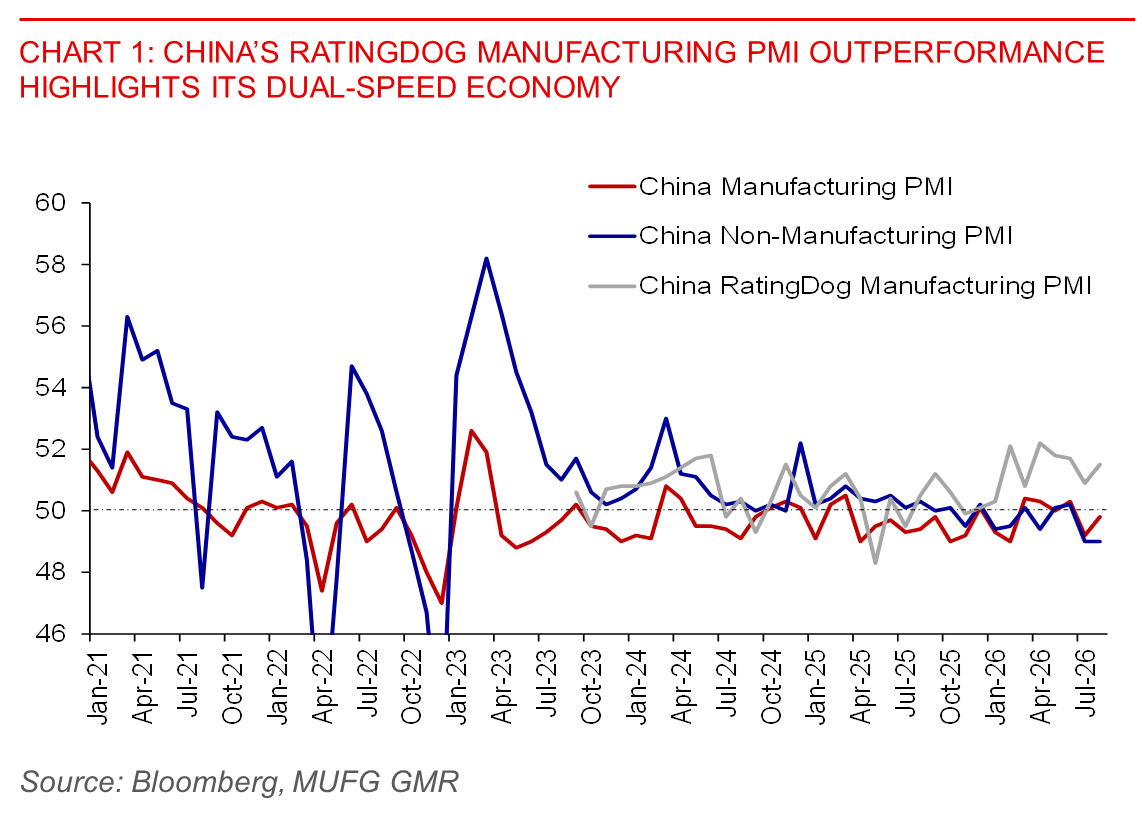
China’s September PMIs will provide the main regional counterpoint, with the divergence between the surveys likely to matter as much as their headline direction. The official manufacturing PMI is expected to rise to 50.1 from 49.8, while the RatingDog PMI (which places greater weight on smaller, private and export-oriented firms) is forecast to edge up to 51.7 from 51.5, supported by stronger output, new orders and exports. A wider divergence would reinforce our view of a dual-speed economy, with resilient technology and export activity contrasting with weaker domestic demand and investment.
The key question is whether faster fiscal and quasi-fiscal policy implementation, including the “Six Networks” projects, begins to lift construction activity, demand for industrial inputs and the domestically oriented components of the official PMI in Q4. We expect faster project execution to support investment and narrow the gap between the two surveys over time. We remain constructive on CNY, supported by China’s trade surplus, technology-sector sentiment and policy support (see here).
Elsewhere in the region, the data should help distinguish structural support from exposure to the oil shock. Thailand’s current account releases, coupled with the Philippines’ trade balance will be important in gauging the impact of oil prices and spillover to currencies. Meanwhile India’s bank credit growth data will be important in gauging the credit cycle and how soon the RBI might have to hike rates. We continue to forecast RBI hiking by 50bps in this cycle with a risk for 75bps. In Australia, the RBA’s unanimous 25bp hike to 4.60% also illustrates the policy dilemma facing the region. Higher energy costs and domestic capacity pressures prompted further tightening, even as Australian inflation, consumption and housing have been showing further signs of slowing.