

External shocks test uneven regional FX buffers
Ahead Today
G3: Dallas Fed manufacturing activity
Asia: China industrial profits, Singapore industrial production
Market Highlights
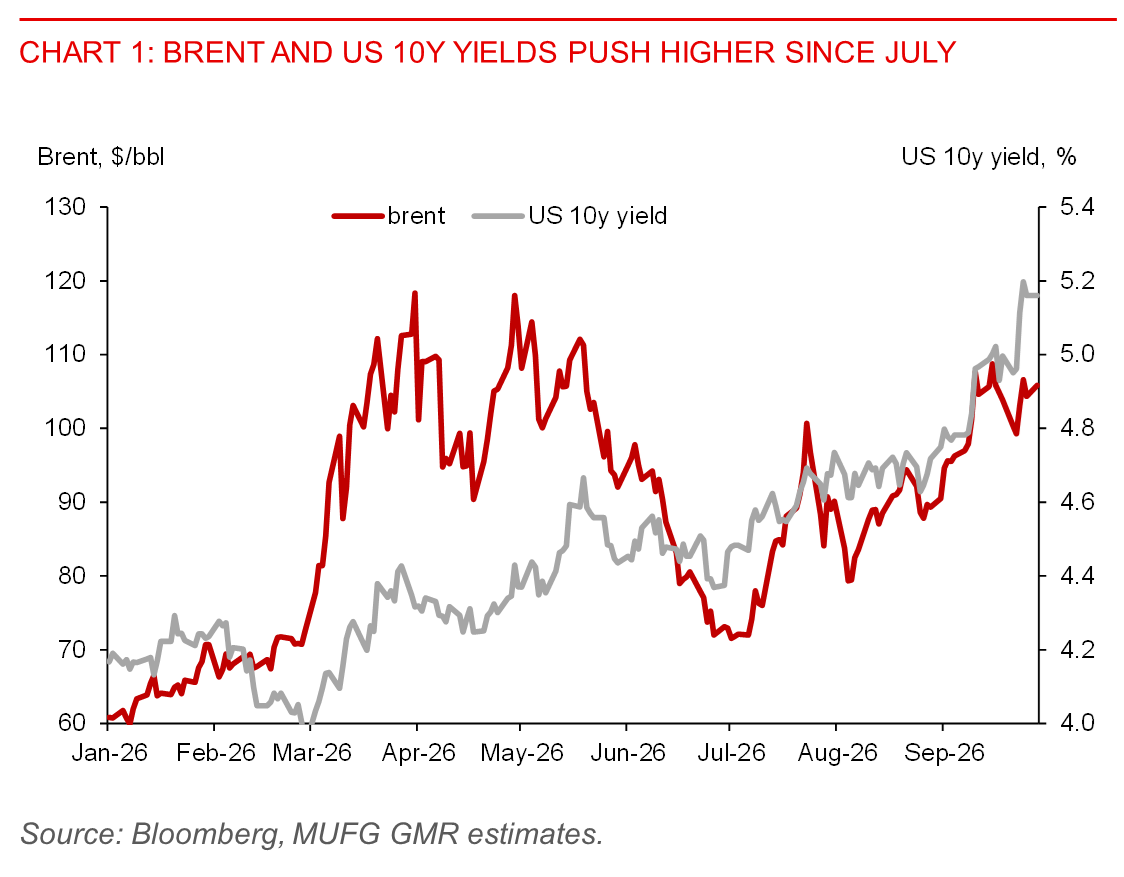
The global backdrop remains challenging for Asia FX as elevated oil prices and high global yields continue to reinforce each other, even as the dollar eased modestly last Friday. Middle East tensions remain elevated, with no clear resolution to the disruption around the Strait of Hormuz and uncertainty over when oil supply can normalise. The tightening in physical crude markets is increasingly visible in the premium of spot crude over front-month Brent, which has risen to around US$18/bbl from a negative spread at the start of September, albeit still below the roughly US$35/bbl reached in April. With oil supply uncertainty persisting, elevated crude prices should keep global inflation risks alive. Brent price and the US 10y yield have also become more correlated since July.
US 10-year yields are now above 5.1%, while yields are also materially higher in Japan, Korea, Indonesia, and the Philippines. The rise in oil prices alongside higher long-term yields suggests markets are attaching a larger inflation risk to the global outlook.
Importantly, for Asia FX, US yields have risen faster than local yields across several Asian markets, widening the US yield advantage and weakening relative rate support for regional currencies. Over the past three months, this deterioration in relative rates has been particularly pronounced in Thailand, China, Indonesia, and Singapore.
That said, SGD remains one of the region's more defensive currencies, although its appreciation momentum has stalled amid the tougher external environment. This is supported by an appreciating S$NEER that provides an important buffer for SGD against rising US yields.
CNY is also benefiting from a policy buffer. While China's relative yield position has deteriorated against rising US rates, the PBOC's lower USD/CNY fixing bias has partly helped guided CNY stronger in recent months.
IDR and THB remain more exposed. Indonesia's rate support has been eroded by the rise in US yields, while Bank Indonesia has shifted its emphasis away from further rate hikes towards non-rate stabilisation measures, including cheaper FX hedging for portfolio investors. Renewed foreign portfolio outflows in September and the prospect of weaker trade balances in August-September nevertheless suggest that underlying rupiah pressure has not disappeared.
Thailand faces a more fundamental constraint. Weak growth makes it difficult for the BOT to counter widening US rate pressure through tighter domestic policy.
Meanwhile, the yen strengthened around 1.0% last Friday, outperforming the region, following signals from both Tokyo and Washington on the desirability of a stronger yen.