

High US rates bite, while tech risks build
Ahead Today
G3: US University of Michigan survey
Asia: China loan prime rates, Malaysia trade, Taiwan export orders
Market Highlights
Asia FX remains on the defensive as markets adjust to a more hawkish global rates backdrop. Markets now price a 25bp Fed hike in December followed by another two hikes next year, keeping US rates and the dollar elevated. The US 10-year yield has been elevated around 5%, up by nearly 90bp since the start of the year, while DXY is nearly 5% stronger since Jackson Hole. EUR/USD has broken below 1.10, although USD/JPY continues to hold below 160.00 level.
Broad US equity weakness has continued despite a strong Anthropic IPO debut, while Fed Vice Chair Philip Jefferson noted that the AI boom is adding to near-term inflation through stronger demand.
For Asia, the key risk is whether tech equity declines eventually translate into softer hyperscaler capex, semiconductor orders, and physical data-centre investment. That would shift the current tech equity selloffs into a more fundamental growth and export shock.
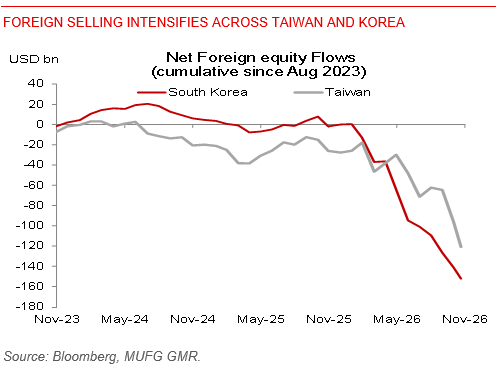
Higher US rates and dollar strength remain a key headwind on Asia FX. But the tech outlook is the next risk to watch amid a sell-off in US tech equities.
For KRW, strong trade fundamentals are cushioning the KOSPI sell-off. Expectations of a BoK hike next week amid strong growth and sticky inflation, together with a semiconductor-led trade surplus, have helped KRW hold up despite KOSPI weakness and net foreign equity outflows. The risk is that KRW's high beta to the global AI capex cycle becomes a vulnerability if the tech equity correction starts translating into weaker semiconductor demand.
TWD shows more clearly how portfolio flows can overwhelm supportive tech fundamentals. Net foreign equity outflows of more than US$24bn this month have been considerably larger than Korea's roughly US$11bn, contributing to greater TWD pressure despite Taiwan's strong AI and semiconductor exposure.
For MYR, domestic fundamentals remain supportive, but external forces dominate. Malaysia's inflation remained contained at 1.9% yoy in October, alongside resilient growth, leaving a favourable domestic growth-inflation mix. Nevertheless, USD/MYR has broken above 4.10 as higher US rates, dollar strength and weaker tech sentiment outweigh domestic support. MYR remains exposed to swings in the global electronics cycle, even as Malaysia's expanding role in data-centre investment provides a medium-term offset.
USD/THB at around 34.00 could face increasing resistance. Brent fell 1.3% yesterday as the US, China and Russia signalled efforts to increase oil-product supply. Lower oil prices are a helpful offset for energy-importing Thailand. While the strong dollar remains a headwind, we see room for USD/THB to consolidate around current levels, with 34.00 level an important near-term resistance area.