

Focus on Nonfarm Payrolls
Ahead Today
G3: US Nonfarm Payrolls, Unemployment Rate, Factory Orders, Durable Goods Orders, Eurozone CPI
Asia: Thailand gross international reserves
Market Highlights
The USD remained firmly supported ahead of tonight's nonfarm payrolls report, with the DXY briefly climbing to its highest level since May 2025 as investors continued to favour the US growth and yield story. While this week's softer inflation data reduced expectations for an October Fed hike, inflation remains above the 2% target, and incoming activity indicators continue to point to a resilient US economy. Initial jobless claims fell to 197k, while construction spending rose 0.9%mom in August. Elevated Treasury yields helped sustain broad USD demand, with most Asia FX weakening against the US dollar despite generally constructive regional data.
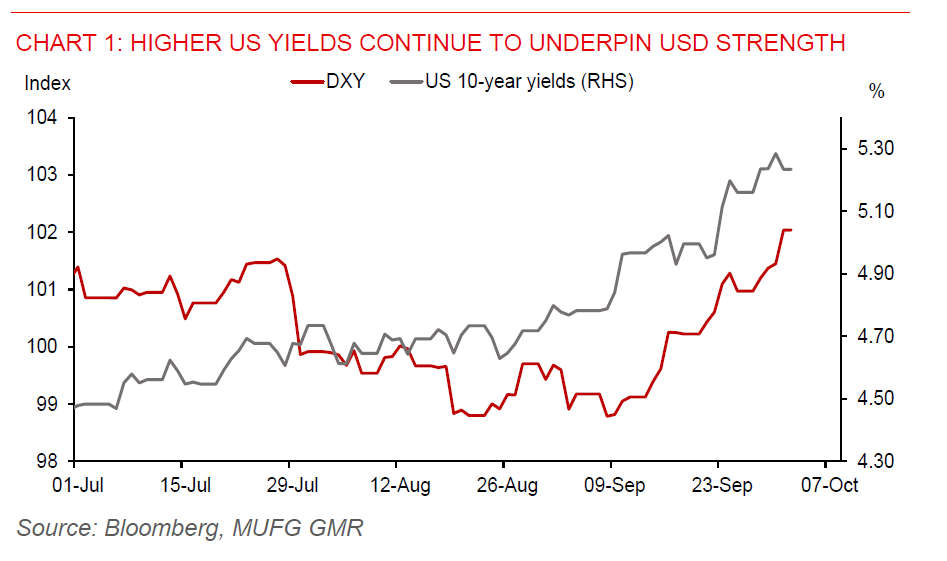
US manufacturing data offered little reason to challenge the stronger USD narrative. The ISM manufacturing index eased only marginally to 54.5 in September from 54.6 previously, remaining comfortably in expansion territory. More notably, the prices-paid component jumped to 77.9 from 71.1, suggesting that upstream inflation pressures remain firm. With long-end Treasury yields still near recent highs and the DXY reaching the 102.00 level, market attention has shifted towards tonight's payrolls report, which is expected to show employment growth of 90k and an unchanged unemployment rate of 4.1%.
For Asia FX, a softer than expected payroll print could pull US yields lower and allow stronger regional fundamentals to translate more clearly into FX performance, particularly for tech-linked Asian currencies such as KRW, TWD, MYR, and SGD. Conversely, continued US labour-market resilience would reinforce higher-for-longer US rates, keeping US yields and the USD supported, limiting the benefit from stronger Asian macro data.
Asia's economic releases were broadly constructive and pointed to continued resilience in regional manufacturing activity. Japan's latest Tankan survey remained consistent with a supportive corporate backdrop and steady investment intentions, while South Korea's exports rose 83.5%yoy in September, comfortably beating expectations of 62.5%yoy and accelerating from 68.7%yoy print last month. Manufacturing PMIs also remained in expansion territory across Korea (53.9), Japan (54.1) and Vietnam (51.9), suggesting that manufacturing activity across Asia continues to benefit from improving external demand and technology-related investment.
Indonesia was also among the stronger data performers in the region. Manufacturing PMI rose to 52.4 in September from 49.8 previously, while export growth accelerated to 6.72%yoy in August, beating expectations of 4.17%yoy and improving from 6.05%yoy previously. The trade surplus surprisingly widened to $3.5bn, from $122mn in July, despite a rebound in oil prices. Headline inflation edged higher to 3.28%yoy from 3.19%, broadly in line with the 3.30% consensus. Taken together, the latest releases suggest that both domestic activity and external demand remained relatively resilient during the quarter.
Nevertheless, the external environment remains less supportive for the rupiah. The combination of elevated oil prices, a stronger USD and higher US yields continue to tighten financial conditions across the region. As a result, external drivers may remain the dominant influence on USD/IDR in the near term, particularly ahead of tonight's payrolls report.