

Exports resilient, domestic demand lags
Ahead Today
G3: US Retail sales, industrial production, and import prices
Asia: Hong Kong unemployment rate
Market Highlights
The dollar extended its climb past 103.50 as markets continued to price a more prolonged Fed tightening cycle, keeping Asia FX on the defensive. US 2-year yields remain elevated above 4.8%, following last week’s sharp Treasury selloff. Fed Chair Warsh steered clear of the near-term policy outlook overnight, focusing instead on the uncertain impact of AI on productivity, employment, and financial markets. The absence of any pushback against recent Fed repricing leaves elevated US yields and the resilient dollar as key headwinds for regional currencies. Markets will look to today’s US retail sales and industrial production data for further signs of economic resilience.
Japan’s economy unexpectedly contracted in Q3, with GDP falling 0.1%qoq annualised against expectations for 0.2% growth, as weak consumption offset resilient investment. The miss did not derail expectations for a December BoJ hike as markets are still pricing in about 85% probability of a 25bps hike, with hawkish board member Hajime Takata calling for a nimble approach to further tightening. Meanwhile, USD/JPY has struggled to sustain a move above 160 despite sharper Fed repricing, with expectations for BoJ normalisation and FX intervention risk likely constraining further upside for the pair.
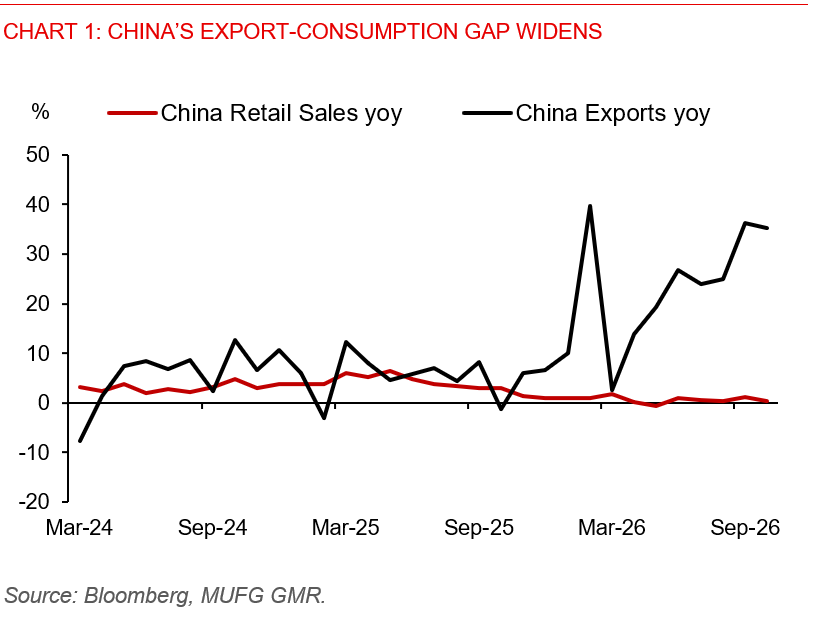
China’s October activity data highlighted an increasingly stark divide between external resilience and weak domestic demand. Retail sales slowed to just 0.4%yoy in October, industrial production eased to 4.8%yoy from 5.5%, while fixed-asset investment contracted 8.1%yoy in the first ten months of this year. But export momentum remains strong. Strong export receipts and corporate FX conversion will likely remain supportive for CNY.
Thailand shows a similar divergence. Q3 GDP growth picked up to 2.9%yoy from 2.4%yoy, partly due to low base effects from a year ago. Growth was driven by an 18.3%yoy rise in exports and 11.8%yoy growth in investment as the global AI cycle boosted electronics activity. Domestic demand remained comparatively soft, however, with household consumption rising just 2.5%yoy. Sequential growth was also modest at 0.3%qoq, following flat growth in Q2. The uneven nature of growth suggests that the central bank could continue to maintain a pro-growth stance, keeping policy rate at 1%.