

High US rates, uneven regional outlook
Ahead Today
G3: US empire manufacturing
Asia: China activity data, Thailand Q3 GDP, India wholesale prices
Market Highlights
Markets are pricing higher US rates in the near term, but also a greater drag on medium-term US growth from restrictive policy. That slowdown has yet to materialise. US GDP expanded at 3.4%qoq annualised in Q3, payroll growth rebounded to 165k in October from 60k in September, and inflation remains above target. With another Fed hike in December still possible, elevated US yields should keep the dollar supported into year-end.
For USDJPY, cheap valuation alone is insufficient while rate differentials remain wide. The approach towards 160 brings intervention risk back into focus, particularly after Japanese officials signalled greater coordination with the US against rapid, one-sided yen depreciation. This should provide some resistance to further USD/JPY upside, but a sustained yen recovery ultimately requires further BOJ normalisation and a narrower US-Japan rate differential.
Beyond the broad USD backdrop, policy and growth divergence is becoming an increasingly important driver of relative performance within Asia FX. Economies are moving through different stages of the cycle, while central banks face increasingly differentiated inflation and activity dynamics. This should favour currencies where resilient growth, stronger external balances and firmer policy settings reinforce one another, while leaving slower-growth economies with greater easing needs more vulnerable.
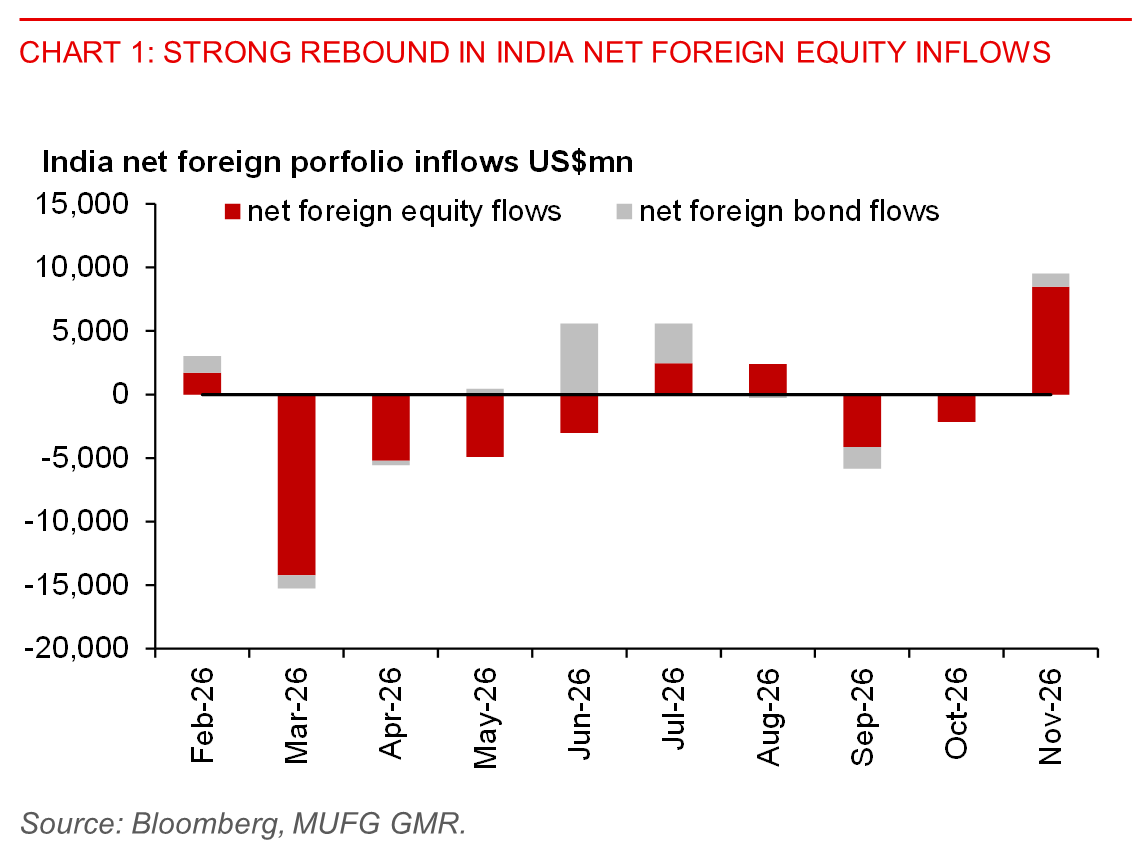
INR is supported by resilient domestic demand, tighter RBI policy, and improving portfolio inflows. Inflation accelerated to 6.1% yoy, reinforcing expectations of further tightening, while net foreign equity and bond inflows reached $8.5bn and $1bn respectively so far this month. FCNR(B)-driven dollar inflows have also helped strengthen the FX reserve buffer. Higher oil prices remain the key vulnerability, however, with the trade deficit widening to $39.9bn in October from $30.2bn in September.
China presents a different dynamic. Credit momentum remains subdued, with new yuan loans contracting by RMB100bn in October and outstanding RMB loan growth slowing to 4.6% yoy from 4.8% yoy in September. Yet weak domestic credit conditions are not translating into greater pressure for PBOC easing, with policymakers highlighting already-low lending rates. Instead, the external backdrop is becoming increasingly supportive for CNY, as stronger export momentum continues to generate appreciation pressure despite the yuan's relatively unattractive yield.