

Surprise policy hold by MAS
Ahead Today
G3: US CPI and MBA Mortgage Applications
Asia: China CPI, PPI and Exports, India Wholesale Prices
Market Highlights
Markets are watching closely for US CPI numbers coupled with China’s inflation and export numbers out later today, while the Monetary Authority of Singapore also delivered a surprise exchange rate policy hold in its October meeting relative to consensus expectations for a very slight tightening.
In particular, the consensus expects US headline CPI inflation to rise to 3.6%yoy in September from 3.4%yoy, and this will be the key test of whether the recent repricing towards a Fed hold in October can be sustained. An in-line print would likely leave the Fed in wait-and-see mode and is also consistent with recent commentary from Fed speakers around skipping the October meeting in raising rates. Suffice to say a stronger than expected reading here could lift US yields and extend USD strength.
China’s data should offer a more mixed signal for regional FX. CPI and PPI are expected by the market to pick up to 1.0%yoy and 4.4%yoy respectively, while export and import growth should remain robust. Resilient trade coupled with continued PBoC fixing support would be supportive for CNY and regional sentiment, although a sharper slowdown in imports could renew concerns over domestic demand.
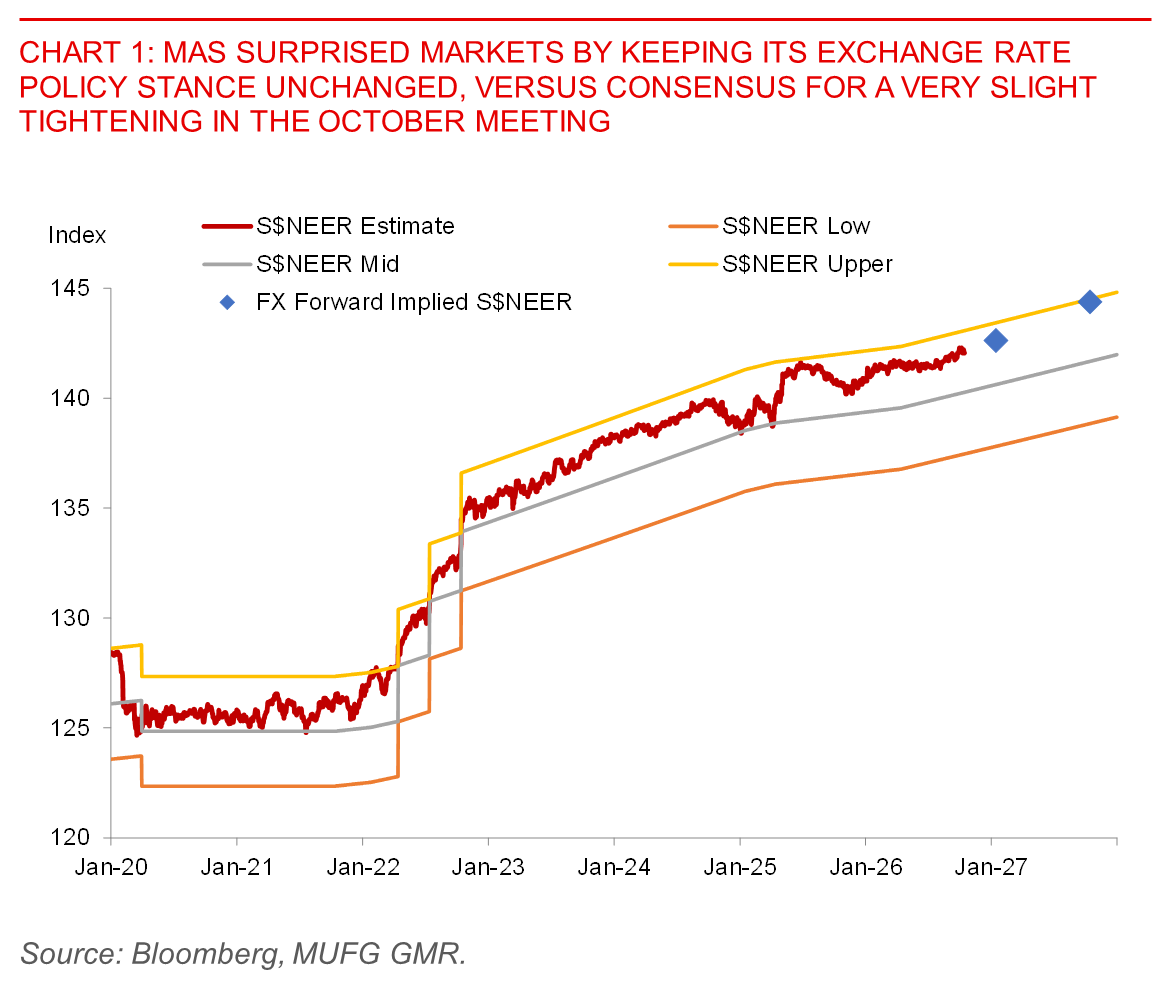
The surprise in markets was an unexpected hold by the Monetary Authority of Singapore in its October policy, with no change to the slope or the width of the exchange rate policy band, relative to a very slight tightening in policy in the July meeting. The consensus and the market were positioned and expecting for MAS tightening very slightly once again this meeting. The Singapore central bank said in its statement that core inflation is expected to ease discernibly from the middle of next year, with domestic costs to stay subdued and helped by an expected slowing in supply-driven imported inflation. Meanwhile, MAS also expects the positive output gap to narrow through next year as the AI cycle eases. What’s also interesting is that MAS highlighted contained unit labour cost increase in the services sector due to continued productivity gains as one key driver dampening inflation, and this could partly reflect authorities’ concerns around softening of Singapore’s labour market and some higher retrenchments in Singapore’s services sector.
Net-net, the “forward guidance” in MAS monetary policy statement sounds like the central bank might remain on hold for now unless the situation changes, with MAS saying it is well-positioned to respond effectively to any risk to medium-term price stability and the current appreciating policy band will allow the S$NEER to continue to strengthen and lean against anticipated near-term rise in imported inflation.
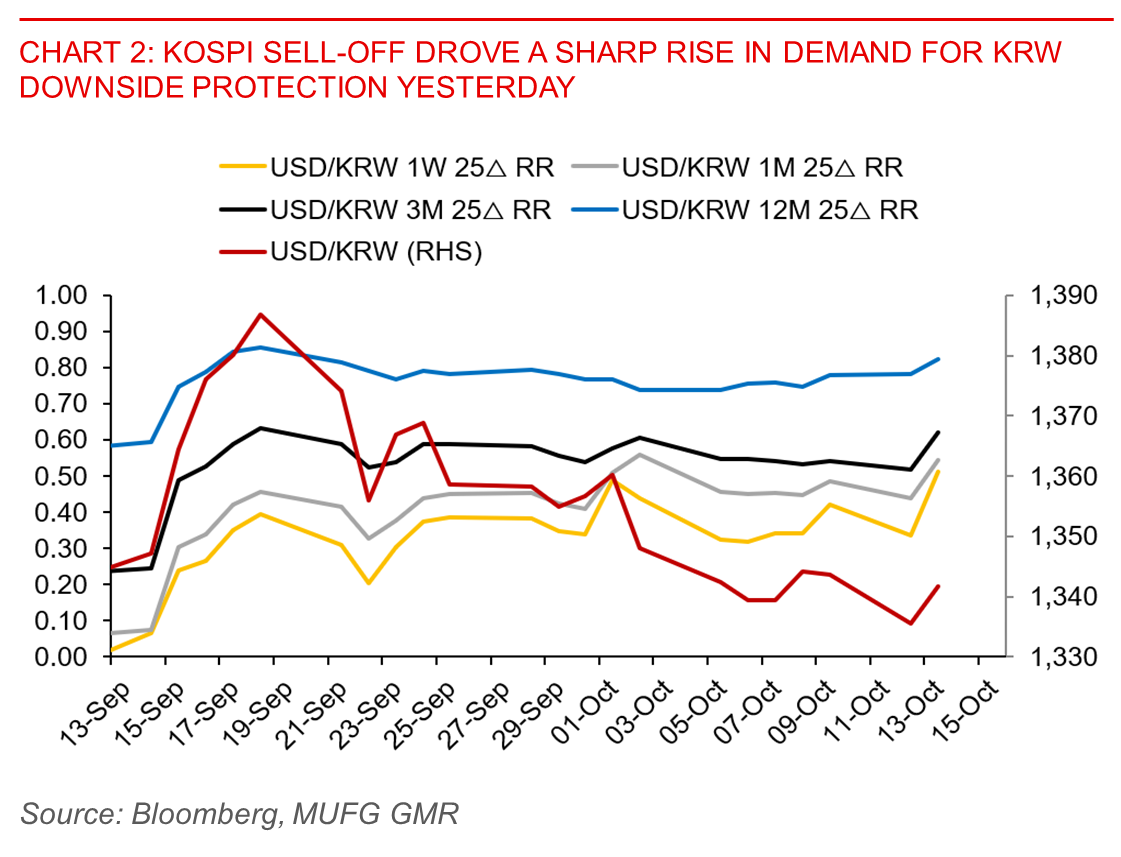
In South Korea, the sharp sell-off in equities has driven a marked rise in demand for KRW downside protection, with the KOSPI extending its decline by 5.5% in yesterday’s trading session to the 6,035 level, as losses intensified across the semiconductor sector. Samsung Electronics and SK Hynix led the move lower amid renewed concerns over cheaper Chinese competition following reports of progress in memory-chip technology at China’s CXMT, weakness in US semiconductor stocks and broader questions over the sustainability of AI-related capital expenditure. The rise in KRW risk reversals shown suggests investors have responded by paying more for protection against won depreciation, consistent with the US$3.3bn of foreign equity outflows from South Korea yesterday, which generated underlying KRW selling as investors converted the proceeds into foreign currency.
The RBI’s latest FX measures have supported spot INR to the 95.2 level but added some costs to rupee derivatives liquidity. Reuters reported that USD/INR forward quotes were temporarily withdrawn amid uncertainty over whether the 20% cash-margin requirement covered interbank trades, although the RBI subsequently indicated that it did not. Until formal clarification is issued, cautious market-making could widen bid-ask spreads, raise hedging costs and shift activity offshore.
We note that offshore INR forward premiums fell sharply across all tenors between 12 and 13 October. The broad-based move suggests that offshore demand for INR downside protection was rapidly unwound after the RBI restricted non-resident NDF access to genuine hedging, raised the cost of FX hedges and provided state oil companies with a dedicated dollar window. Together, these measures reduced speculative NDF demand and spot dollar buying, helping INR rally by around 1.5%, albeit at the cost of higher hedging expenses and less liquid onshore forward markets.