

Regional FX faces a resilient dollar and high US yields
Ahead Today
G3: US ISM Manufacturing, initial jobless claims, Eurozone manufacturing PMI
Asia: Indonesia CPI and trade
Market Highlights
The latest US data point to softer inflation but still-resilient labour demand ahead of Friday’s nonfarm payrolls report. Private payrolls rose by 90k in September, above the 75k consensus and up from a revised 36k in August. Headline PCE inflation held at 3.4%yoy, below the Bloomberg consensus of 3.7%yoy, while core PCE remained at 3.0%yoy. Consumer spending also remained resilient, even as personal income growth slowed to 0.2%mom in September from 0.3%mom in August.
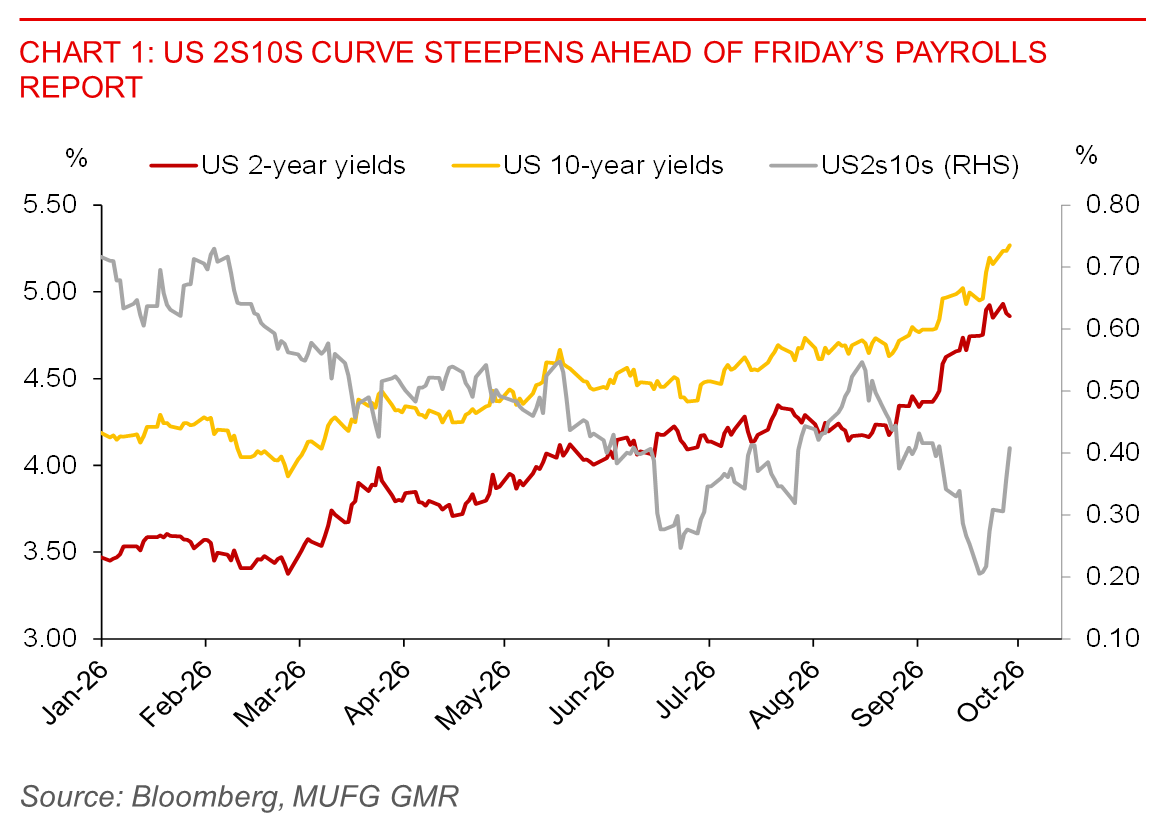
The US 2s10s curve has steepened by around 9bp since Tuesday’s JOLTS and consumer confidence data. The move reflects front-end outperformance, as softer inflation and consumer confidence data somewhat tempered Fed tightening expectations, while inflation risks kept longer-dated yields elevated.
Despite the softer inflation reading, markets are still expecting further Fed tightening, with one rate hike fully priced for December. This leaves Friday’s nonfarm payrolls report as the next key test for the Fed outlook and US yields. Importantly, the US dollar stays firm, holding above the 101 level as measured by DXY.
Meanwhile, China’s September PMIs were broadly encouraging. The official manufacturing PMI returned to expansion at 50.1, while non-manufacturing rose to 50.2 from 49.0. The RatingDog surveys were firmer, with manufacturing PMI at 52.1, services PMI at 51.6 and the composite PMI at 52.4.
Elsewhere in Asia, incoming data remain mixed. South Korea’s August industrial production fell 4.8%mom, although the weakness was largely driven by a strike-related fall in auto production, suggesting caution in interpreting the headline decline as a broader deterioration in Korea’s manufacturing cycle.
For Thailand, the July BOP trade balance was revised sharply higher from a deficit of $47mn to a $1.8bn surplus, while August data steadied at around $1.8bn surplus. Nevertheless, we remain cautious on THB. Higher oil prices should worsen Thailand’s terms of trade and widen its oil deficit, while softer tourism receipts reduce an important FX buffer. Slow growth, limited fiscal space, and net foreign portfolio outflows add to the pressure. With the BoT policy rate at just 1.0%, Thailand has limited rate support against elevated US yields.
USD/IDR encountered resistance around 18,000 and subsequently retreated, with BI’s FX stabilisation measures offering some near-term support. However, we remain cautious on IDR given inflation pressures, a weaker trade balance buffer, and the external combination of elevated US yields and oil prices. Indonesia’s September headline inflation could rise to 3.3%yoy from 3.2%, nearing the upper end of BI’s 1.5%-3.5% target range. Meanwhile, the August trade balance could swing into deficit from a small surplus in July as the rebound in oil prices raises the import bill.