
Please download PDF using the link above for the full report
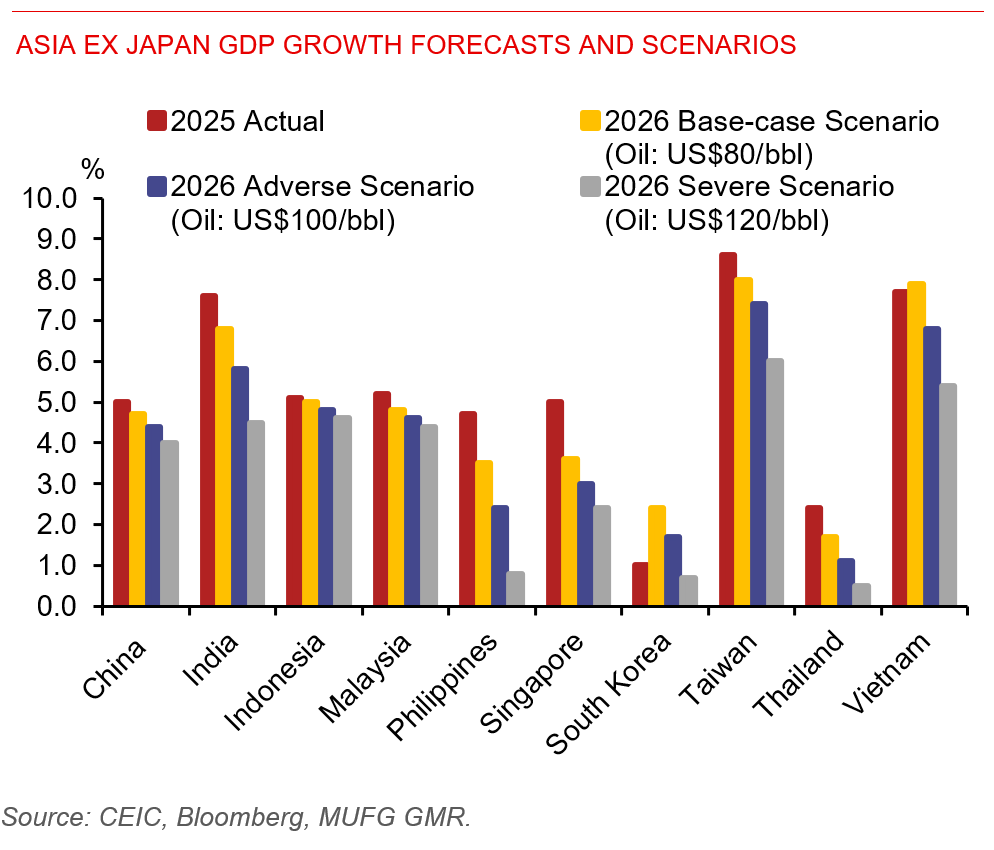
A base case, where the Iran war and the Hormuz disruption unwind approaching end of May, is our core case. Asia growth softens slightly in near term but stabilizes into 2H2026 as declining energy prices ease the drag on current account, corporate margins and real income. Inflation will remain largely contained and allows most central banks to maintain their neutral-accommodative stance.
Iran war has exerted significant pressure on Asia’s net energy‑importing currencies, with PHP, INR, THB and IDR depreciating most against the dollar since late February. However, in our base case, while reopening of the Strait of Hormuz and the associated decline in oil prices would unwind some pressures, we expect a divergent performance across Asian currencies, rather than a unanimous rebound in remaining Q2. In remaining Q2, we think that:
1) KRW, significantly exposed to adverse impact of oil price shock and a high-beta currency, likely benefits most, with extra support from sustained AI theme and strong exports - which helped KRW’s strong rebound since early April, after its sharp depreciation in March.
2) THB’s strength likely contained by weak growth, and we expect PHP and INR to further depreciate in remaining Q2, before recovering in later part of H2, as Peso likely suffers from second-round effect on domestic prices, and potential tighter financial condition and associated weaker growth profile, INR continues to suffer from its negative capital inflow prospect.
3) MYR is likely to be one of the best performers in Q2, as a net energy commodity exporter, with USD80 per barrel oil price would still mean resilient terms of trade, a firm domestic demand, underpinned by strong investment approvals and supportive labour market conditions.
4) USDCNY to decline to 6.6 by year end in base case scenario. Since late February, CNY was the only currency in Asia appreciated against the dollar amid the dollar index’s 0.9% appreciation and has remained remarkably stable.
Under the Adverse Scenario transit the Strait of Hormuz, over time, higher energy costs would worsen the terms of trade, pressure on trade balance, and supply shortages would intensify and weigh on industrial activity and overall economy. A prolonged blockade of the Strait of Hormuz brings the risks of recessions for Asian economies, causing capital outflow, creating pressure for significant pressure. In the Sever scenario, we expect a broad base depreciation among Asian currencies, with some like KRW to depreciate more than 8%, and INR and PHP to depreciate more than 5%, and a relatively mild 3% depreciation for CNY against the dollar.
Asia ex Japan GDP Growth Forecasts and Scenarios